 VIPSolutions
Give step-by-step solution with explanation and final answer:For the following voliage and current phasors, calculate the complex power. sppaent power. €ol power, nd feacive power: Determine whether he power facor 5 leading of 139910. Ve 2602 10° Vrms, [= 682-25" Arms The valve ofthe apparent power s[—JVA “Tne value of he real power is JW. The value of he rescive power 5[JVAR The power factor + [Gs swe]
Question:
Give step-by-step solution with explanation and final answer: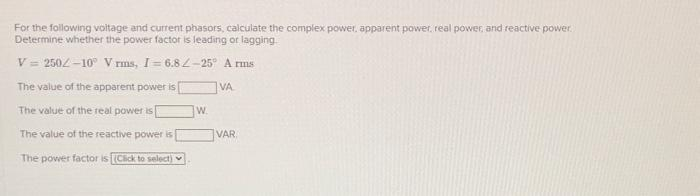 For the following voliage and current phasors, calculate the complex power. sppaent power. €ol power, nd feacive power:
Determine whether he power facor 5 leading of 139910.
Ve 2602 10° Vrms, [= 682-25" Arms
The valve ofthe apparent power s[—JVA
“Tne value of he real power is JW.
The value of he rescive power 5[JVAR
The power factor + [Gs swe]
This is AI generated Response.
Asked by: M Murali
Created at: 2025-08-31 16:07:05
Asked by: M Murali
Created at: 2025-08-31 16:07:05
Final Answer:
Rendered
Raw Text
Did you like this answer?
Let's solve the problem step by step:
Given:
- Voltage, \( V = 250 \angle -10^\circ \) V (rms)
- Current, \( I = 6.8 \angle -25^\circ \) A (rms)
### **Step 1: Find the Complex Power \( S \)**
The complex power \( S \) is given by:
\[
S = V \cdot I^*
\]
where \( I^* \) is the complex conjugate of \( I \).
- \( V = 250 \angle -10^\circ \)
- \( I^* = 6.8 \angle +25^\circ \)
So:
\[
S = 250 \angle -10^\circ \times 6.8 \angle +25^\circ = (250 \times 6.8) \angle (25^\circ - 10^\circ)
\]
\[
S = 1700 \angle 15^\circ \ \text{VA}
\]
---
### **Step 2: Apparent Power (\( |S| \))**
The apparent power is the magnitude of \( S \):
\[
|S| = 1700 \ \text{VA}
\]
---
### **Step 3: Real Power (\( P \))**
The real power is:
\[
P = |S| \cos(\theta_S)
\]
where \( \theta_S = 15^\circ \):
\[
P = 1700 \cos(15^\circ)
\]
\[
P \approx 1700 \times 0.9659 \approx 1642 \ \text{W}
\]
---
### **Step 4: Reactive Power (\( Q \))**
The reactive power is:
\[
Q = |S| \sin(\theta_S)
\]
\[
Q = 1700 \sin(15^\circ)
\]
\[
Q \approx 1700 \times 0.2588 \approx 440 \ \text{VAR}
\]
---
### **Step 5: Power Factor**
\[
\text{Power Factor} = \cos(\theta_S) = \cos(15^\circ) \approx 0.966
\]
- **Leading or lagging?**
Since the current lags the voltage by \( -25^\circ - (-10^\circ) = -15^\circ \), the power factor is **lagging**.
---
## **Final Answers**
- **Apparent Power:** \( 1700 \) VA
- **Real Power:** \( 1642 \) W
- **Reactive Power:** \( 440 \) VAR
- **Power Factor:** 0.966, **lagging**
---
### **Filled Answers:**
- The value of the apparent power is **1700** VA.
- The value of the real power is **1642** W.
- The value of the reactive power is **440** VAR.
- The power factor is **lagging**.
Question:
Give ME Each Step 50 Words Explanation only Theory
This is AI generated Response.
Asked by: M Murali
Created at: 2025-08-31 16:08:20
Asked by: M Murali
Created at: 2025-08-31 16:08:20
Final Answer:
Rendered
Raw Text
Did you like this answer?
Certainly! Here's a 50-word explanation for each step, focusing on the theory:
**Step 1: Find Complex Power \( S \)**
Complex power combines real and reactive components, representing total power flow. It is calculated by multiplying the voltage phasor by the conjugate of the current phasor, incorporating both magnitude and phase angle to determine power in the AC circuit.
**Step 2: Apparent Power \( |S| \)**
Apparent power is the magnitude of complex power, representing the total power supplied to the circuit. It combines both real and reactive power, indicating the total energy transfer regardless of phase difference, measured in volt-amperes (VA).
**Step 3: Real Power \( P \)**
Real power is the active power consumed by resistive elements, doing actual work. It is the projection of complex power onto the real axis, calculated as the product of apparent power and cosine of the phase angle, representing energy used per unit time.
**Step 4: Reactive Power \( Q \)**
Reactive power accounts for energy stored and released by reactive components like inductors and capacitors. It is orthogonal to real power, calculated as the product of apparent power and sine of the phase angle, measured in volt-ampere reactive (VAR).
**Step 5: Power Factor**
Power factor is the cosine of the phase angle between voltage and current, indicating the efficiency of power usage. A lagging power factor (current lagging voltage) signifies inductive loads; a leading power factor indicates capacitive loads, affecting power distribution efficiency.
📢 Instructions:
- Ask anything relatd to above question only.
- For new Question goto :