 VIPSolutions
Give step-by-step solution with explanation and final answer:Find the rms value of the voltage waveform of the given figure as well 3s the average power absorbed by a 8-0 resistor when the. Voltage fs applied across that resistor 0) 1 | (TF TT RTE The ims value of the given voltage waveform i v. The average power absorbed by the 8-0 resistor | W.
Question:
Give step-by-step solution with explanation and final answer: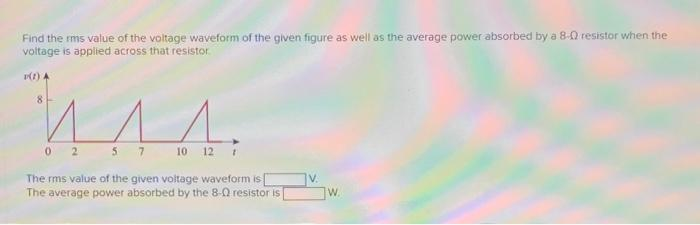 Find the rms value of the voltage waveform of the given figure as well 3s the average power absorbed by a 8-0 resistor when the.
Voltage fs applied across that resistor
0)
1 |
(TF TT RTE
The ims value of the given voltage waveform i v.
The average power absorbed by the 8-0 resistor | W.
This is AI generated Response.
Asked by: M Murali
Created at: 2025-08-31 15:48:11
Asked by: M Murali
Created at: 2025-08-31 15:48:11
Final Answer:
Rendered
Raw Text
Did you like this answer?
Let's solve the problem step by step:
### **Step 1: Analyze the Voltage Waveform**
The waveform is a periodic triangle wave:
- The period \( T = 6 \) s (from 0 to 6, 6 to 12, etc.).
- Each cycle rises linearly from 0 to 8 V over 3 seconds, then drops to 0 V at 6 seconds.
### **Step 2: Write the Expression for One Period**
For \( 0 \le t < 6 \):
\[
v(t) = \frac{8}{3} t \quad \text{for} \quad 0 \le t < 3
\]
\[
v(t) = 8 - \frac{8}{3}(t-3) = 16 - \frac{8}{3}t \quad \text{for} \quad 3 \le t < 6
\]
### **Step 3: RMS Value Formula**
The RMS value over one period is:
\[
V_{rms} = \sqrt{\frac{1}{T} \int_0^T v^2(t) dt}
\]
Where \( T = 6 \) s.
### **Step 4: Calculate the RMS Value**
#### Interval 1: \( 0 \le t < 3 \)
\[
v(t) = \frac{8}{3}t
\]
\[
v^2(t) = \left(\frac{8}{3}t\right)^2 = \frac{64}{9} t^2
\]
\[
\int_0^3 v^2(t) dt = \int_0^3 \frac{64}{9} t^2 dt = \frac{64}{9} \cdot \frac{t^3}{3} \Bigg|_0^3 = \frac{64}{9} \cdot \frac{27}{3} = \frac{64}{9} \cdot 9 = 64
\]
#### Interval 2: \( 3 \le t < 6 \)
\[
v(t) = 16 - \frac{8}{3}t
\]
\[
v^2(t) = (16 - \frac{8}{3}t)^2 = 256 - 2 \cdot 16 \cdot \frac{8}{3} t + \left(\frac{8}{3} t\right)^2 = 256 - \frac{256}{3}t + \frac{64}{9}t^2
\]
\[
\int_3^6 v^2(t) dt = \int_3^6 \left(256 - \frac{256}{3} t + \frac{64}{9} t^2\right) dt
\]
Integrate term by term:
- \( \int_3^6 256 dt = 256 (6-3) = 768 \)
- \( \int_3^6 \frac{256}{3} t dt = \frac{256}{3} \cdot \frac{t^2}{2} \Bigg|_3^6 = \frac{256}{3} \cdot \frac{36-9}{2} = \frac{256}{3} \cdot \frac{27}{2} = 256 \cdot \frac{27}{6} = 256 \cdot 4.5 = 1152 \)
- \( \int_3^6 \frac{64}{9} t^2 dt = \frac{64}{9} \cdot \frac{t^3}{3} \Bigg|_3^6 = \frac{64}{9} \cdot \frac{216 - 27}{3} = \frac{64}{9} \cdot \frac{189}{3} = \frac{64}{9} \cdot 63 = 448 \)
Sum:
\[
\int_3^6 v^2(t) dt = 768 - 1152 + 448 = 64
\]
#### Total over one period:
\[
\int_0^6 v^2(t) dt = 64 + 64 = 128
\]
### **Step 5: Calculate RMS**
\[
V_{rms} = \sqrt{\frac{1}{6} \cdot 128} = \sqrt{21.333} \approx 4.62 \text{ V}
\]
---
### **Step 6: Average Power Absorbed by 8 Ω Resistor**
\[
P_{avg} = \frac{V_{rms}^2}{R}
\]
Where \( R = 8 \) Ω and \( V_{rms} \approx 4.62 \) V.
\[
P_{avg} = \frac{(4.62)^2}{8} \approx \frac{21.34}{8} \approx 2.67 \text{ W}
\]
---
## **Final Answers**
- **The rms value of the given voltage waveform is:** \(\boxed{4.62}\) V
- **The average power absorbed by the 8-Ω resistor is:** \(\boxed{2.67}\) W
Let me know if you need further clarifications!
Question:
Give ME each step 50 Words Explanation only Theory
This is AI generated Response.
Asked by: M Murali
Created at: 2025-08-31 15:48:55
Asked by: M Murali
Created at: 2025-08-31 15:48:55
Final Answer:
Rendered
Raw Text
Did you like this answer?
Certainly! Here's a step-by-step explanation with 50 words each:
**Step 1: Analyze the Waveform**
Identify the shape, period, and amplitude of the voltage waveform. Recognize it as a triangle wave with a specific period and peak voltage, which helps in setting up the RMS calculation and understanding the voltage variation over time.
**Step 2: Write the Mathematical Expression**
Derive equations for the voltage during each segment of the cycle, considering linear rise and fall within each half-period. This allows precise integration of \( v^2(t) \) over each interval, essential for calculating RMS accurately.
**Step 3: RMS Value Definition**
The RMS (Root Mean Square) value measures the effective voltage that delivers the same power as a DC voltage. It involves integrating the squared voltage over one period, dividing by the period, and taking the square root, representing the waveform's average power content.
**Step 4: Calculate RMS via Integration**
Integrate the squared voltage over each interval, sum the results, and normalize by the period. This process involves basic calculus, where integrating \( v^2(t) \) over each segment yields the total energy contribution needed to find the overall RMS.
**Step 5: Final RMS Calculation**
Divide the total integral by the period length, then take the square root to find the RMS value. This step consolidates the area under \( v^2(t) \) curve into a single effective voltage value, representing the waveform's true power equivalence.
**Step 6: Power Dissipation Calculation**
Use the RMS voltage and resistor value to compute average power using \( P = V_{rms}^2 / R \). This formula relates the effective voltage to the power dissipated in the resistor, providing an understanding of the energy transfer in the circuit.
📢 Instructions:
- Ask anything relatd to above question only.
- For new Question goto :