 VIPSolutions
Give step-by-step solution with explanation and final answer:o f(t)=t’e"u(t) » f(t)=(sinwt)(cosmt)u(t) o f(t)=0.03(1-cos2t)u(t), n) f(t)=te*(sinSt)u(t)
Question:
Give step-by-step solution with explanation and final answer: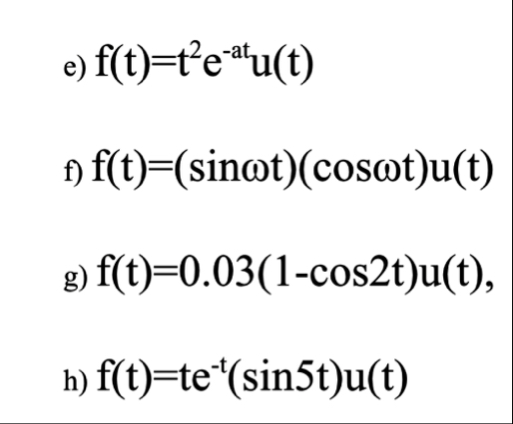 o f(t)=t’e"u(t)
» f(t)=(sinwt)(cosmt)u(t)
o f(t)=0.03(1-cos2t)u(t),
n) f(t)=te*(sinSt)u(t)
This is AI generated Response.
Asked by: M Raju
Created at: 2025-09-06 08:21:45
Asked by: M Raju
Created at: 2025-09-06 08:21:45
Final Answer:
Rendered
Raw Text
Did you like this answer?
Let's find the **Laplace Transform** of each function \( f(t) \). Recall that the Laplace transform is defined as:
\[
\mathcal{L}\{f(t)\} = F(s) = \int_0^{\infty} e^{-st} f(t) dt
\]
where \( u(t) \) is the unit step function (so all functions are 0 for \( t < 0 \)). We'll use standard Laplace transform tables for efficiency.
---
### (e) \( f(t) = t^2 e^{-at} u(t) \)
**Laplace transform of \( t^n e^{-at} \):**
\[
\mathcal{L}\{t^n e^{-at}\} = \frac{n!}{(s+a)^{n+1}}
\]
For \( n = 2 \):
\[
\mathcal{L}\{t^2 e^{-at}\} = \frac{2!}{(s+a)^{3}} = \frac{2}{(s+a)^3}
\]
---
### (f) \( f(t) = (\sin \omega t)(\cos \omega t) u(t) \)
First, use the identity:
\[
\sin \omega t \cos \omega t = \frac{1}{2} \sin 2\omega t
\]
So,
\[
f(t) = \frac{1}{2} \sin 2\omega t \cdot u(t)
\]
Laplace transform of \( \sin a t \):
\[
\mathcal{L}\{\sin at\} = \frac{a}{s^2 + a^2}
\]
Here, \( a = 2\omega \):
\[
F(s) = \frac{1}{2} \frac{2\omega}{s^2 + (2\omega)^2} = \frac{\omega}{s^2 + 4\omega^2}
\]
---
### (g) \( f(t) = 0.03(1 - \cos 2t) u(t) \)
Break it up:
- Laplace of 1: \( \frac{1}{s} \)
- Laplace of \( \cos 2t \): \( \frac{s}{s^2 + 4} \)
So,
\[
F(s) = 0.03\left( \frac{1}{s} - \frac{s}{s^2 + 4} \right)
\]
---
### (h) \( f(t) = t e^{-t} \sin 5t \cdot u(t) \)
Use the Laplace transform:
\[
\mathcal{L}\{t e^{-\alpha t} \sin \beta t\} = \frac{2\beta (s+\alpha) - \beta^3}{[(s+\alpha)^2 + \beta^2]^2}
\]
But let's use the property:
\[
\mathcal{L}\{t f(t)\} = -\frac{d}{ds}[F(s)]
\]
First, \( \mathcal{L}\{e^{-t} \sin 5t\} \):
Let’s recall:
\[
\mathcal{L}\{e^{-at} \sin(\omega t)\} = \frac{\omega}{(s+a)^2 + \omega^2}
\]
Here, \( a = 1 \), \( \omega = 5 \):
\[
F(s) = \frac{5}{(s+1)^2 + 25}
\]
Now, Laplace of \( t e^{-t} \sin 5t \):
\[
\mathcal{L}\{t e^{-t} \sin 5t\} = -\frac{d}{ds} \left( \frac{5}{(s+1)^2 + 25} \right)
\]
Let \( u = (s+1)^2 + 25 \):
\[
\frac{d}{ds} \left( \frac{5}{u} \right) = 5 \cdot \frac{-1}{u^2} \cdot \frac{d}{ds}[u] = -5 \cdot \frac{2(s+1)}{u^2}
\]
So,
\[
F(s) = -\frac{d}{ds} \left( \frac{5}{(s+1)^2 + 25} \right) = \frac{10(s+1)}{\left[ (s+1)^2 + 25 \right]^2}
\]
---
## **Final Answers:**
### (e)
\[
\boxed{F(s) = \frac{2}{(s+a)^3}}
\]
### (f)
\[
\boxed{F(s) = \frac{\omega}{s^2 + 4\omega^2}}
\]
### (g)
\[
\boxed{F(s) = 0.03\left( \frac{1}{s} - \frac{s}{s^2 + 4} \right)}
\]
### (h)
\[
\boxed{F(s) = \frac{10(s+1)}{\left[(s+1)^2 + 25\right]^2}}
\]
If you need any further detailed steps for any part, let me know!
Question:
Give ME Each Problem 50 Words Explaines only Theory
This is AI generated Response.
Asked by: M Raju
Created at: 2025-09-06 08:22:21
Asked by: M Raju
Created at: 2025-09-06 08:22:21
Final Answer:
Rendered
Raw Text
Did you like this answer?
Certainly! Here are 50-word theoretical explanations for each problem:
**(e)**
The Laplace transform of \( t^n e^{-at} \) involves factorials and powers of \( s + a \). Specifically, for integer \( n \), it simplifies to \( \frac{n!}{(s+a)^{n+1}} \), capturing the polynomial time dependence and exponential decay.
**(f)**
Using the identity \( \sin \omega t \cos \omega t = \frac{1}{2} \sin 2\omega t \), the transform simplifies. The Laplace of sine functions is standard, resulting in a rational function with \( s^2 + a^2 \) in the denominator, representing oscillatory behavior in the frequency domain.
**(g)**
The Laplace transform of a constant minus a cosine function separates into the difference of their transforms. The transform of 1 is \( 1/s \), and of cosine is \( s/(s^2 + \omega^2) \). This approach simplifies complex functions involving step functions and trigonometric components.
**(h)**
The Laplace transform of \( t e^{-\alpha t} \sin \beta t \) uses differentiation of the basic transform \( \frac{\beta}{(s+\alpha)^2 + \beta^2} \) with respect to \( s \). This method leverages the differentiation property to handle multiplication by \( t \), yielding a rational function representing damping and oscillation.
📢 Instructions:
- Ask anything relatd to above question only.
- For new Question goto :