This is AI generated Response.
Asked by: Francis
Created at: 2026-01-11 23:25:56
Final Answer:
RenderedRaw Text
Did you like this answer?
Absolutely, let’s work through the problem step by step, just like I’d do if we were sitting together.
---
### a) Suggesting a Feedback Control Loop
To control the temperature inside the CSTR (Continuous Stirred Tank Reactor), we need a feedback control loop that compares the measured tank temperature with the desired setpoint (which is 35°C). If the tank temperature deviates from this setpoint, the controller will adjust the flow rate of hot water (Fₕ) entering the jacket to bring the temperature back to the setpoint.
Here’s how you’d show it on the figure:
- Place a temperature sensor (thermocouple) inside the tank to measure the tank temperature (T).
- The measured temperature signal goes to a comparator or controller, which compares it to the setpoint (35°C).
- The controller then sends a signal to the control valve to adjust the hot water flow rate (Fₕ).
- This adjustment in Fₕ changes the heat transferred to the tank, thus controlling the temperature.
So, the loop is:
**Tank Temperature (T) → Sensor → Controller → Valve (adjust Fₕ) → Tank**
---
### b) Deriving the Transfer Function
Let’s model the temperature dynamics of the tank. The energy balance for the tank (assuming perfect mixing and constant properties) is:
\[
V \rho C_p \frac{dT}{dt} = \sum(\text{inlet enthalpy}) - \sum(\text{outlet enthalpy}) + Q
\]
Given the information, the system is dominated by heat input from the hot water jacket, so the governing equation simplifies (neglecting the reaction heat, as it is neither endothermic nor exothermic):
\[
V \rho C_p \frac{dT}{dt} = \text{(inlet streams)} + Q
\]
Where \(Q = 88 F_h (T_{h} - T)\), as given.
Assume a lumped heat capacity for the mixed tank (since both streams have similar properties):
\[
V \rho C_p \frac{dT}{dt} = \rho_ C_{p} F_ (T_ - T) + \rho_1 C_{p1} F_1 (T_1 - T) + 88 F_h (T_{h} - T)
\]
Plugging in the numbers:
- \(V = 10\, m^3\)
- \(\rho_ = \rho_1 = 880\, kg/m^3\)
- \(C_{p} = C_{p1} = 1.2\, kcal/kg^\circ C\)
- \(F_ = 2\, m^3/h\)
- \(F_1 = 3\, m^3/h\)
Calculate the effective heat capacity of the tank:
\[
V \rho C_p = 10 \times 880 \times 1.2 = 10,560\, kcal/^\circ C
\]
So the dynamic equation is:
\[
10,560 \frac{dT}{dt} = 2 \times 880 \times 1.2 (T_ - T) + 3 \times 880 \times 1.2 (T_1 - T) + 88 F_h (T_{h} - T)
\]
\[
10,560 \frac{dT}{dt} = 2,112 (T_ - T) + 3,168 (T_1 - T) + 88 F_h (T_{h} - T)
\]
Let’s Laplace transform (assuming zero initial condition):
\[
10,560 s T(s) = 2,112 [T_(s) - T(s)] + 3,168 [T_1(s) - T(s)] + 88 [F_h(s) (T_{h} - T(s))]
\]
Collecting terms in \(T(s)\):
\[
10,560 s T(s) + 2,112 T(s) + 3,168 T(s) + 88 F_h(s) T(s) = 2,112 T_(s) + 3,168 T_1(s) + 88 F_h(s) T_{h}
\]
\[
[10,560 s + 5,280 + 88 F_h(s)] T(s) = 2,112 T_(s) + 3,168 T_1(s) + 88 F_h(s) T_{h}
\]
Assuming \(F_h\) is manipulated (and others are constant), the transfer function from \(F_h\) to \(T(s)\) is:
\[
\frac{T(s)}{F_h(s)} = \frac{88 T_{h}}{10,560 s + 5,280 + 88 F_h}
\]
---
### c) Finding the P Controller Parameters
The transfer functions for the thermocouple and valve are provided as:
\[
G_t(s) = \frac{16/100}{s+1} = \frac{.16}{s+1}
\]
\[
G_v(s) = \frac{500/16}{s+1} = \frac{31.25}{s+1}
\]
The open-loop transfer function (without the controller) is the product of the above and the process transfer function derived in (b):
\[
G_p(s) = \frac{88 T_{h}}{10,560 s + 5,280 + 88 F_h}
\]
With a P controller of gain \(K_c\):
The closed-loop transfer function is:
\[
\text{(P controller)} \times G_t(s) \times G_p(s) \times G_v(s)
\]
To keep the temperature at 35°C, you want to tune \(K_c\) so the steady-state error is minimized and the system is stable.
---
### d) Find the Fluid Temperature and Flow Rate When \(T_1\) Rises to 45°C
When \(T_1\) increases to 45°C, the inlet enthalpy increases. The P controller will respond by reducing the required hot water flow rate (\(F_h\)), since less heat is needed to maintain the tank at 35°C.
At steady state, \(\frac{dT}{dt} = \), so the energy balance simplifies to:
\[
= 2,112 (T_ - T) + 3,168 (T_1 - T) + 88 F_h (T_{h} - T)
\]
Plug in: \(T_ = 20^\circ C\), \(T_1 = 45^\circ C\), \(T = 35^\circ C\), \(T_{h} = 80^\circ C\):
\[
= 2,112 (20 - 35) + 3,168 (45 - 35) + 88 F_h (80 - 35)
\]
\[
= 2,112 \times (-15) + 3,168 \times 10 + 88 F_h \times 45
\]
\[
= -31,680 + 31,680 + 3,960 F_h
\]
\[
= + 3,960 F_h
\]
\[
F_h =
\]
### **Final Answer:**
When the feed temperature \(T_1\) rises to 45°C, the required flow rate of hot water, \(F_h\), drops to **zero** to maintain the tank at 35°C, **and the fluid temperature in the tank remains at 35°C** (as set by the P controller).
This makes sense because with the increased enthalpy from the 45°C feed, no additional heat from the hot water is necessary to keep the tank at 35°C.
Question:
give me complete answer along with final answer:
This is AI generated Response.
Asked by: Francis
Created at: 2026-01-11 23:27:34
Final Answer:
RenderedRaw Text
Did you like this answer?
## Explanation of CSTR Temperature Control
In the production of fructo-oligosaccharides, the hydrolysis of 1-kestose takes place in a Continuous Stirred Tank Reactor (CSTR). The process involves controlling the temperature within the reactor using a feedback control loop.
### a) Feedback Control Loop
To maintain the desired temperature of 35°C in the CSTR, we can implement a feedback control loop. The temperature inside the tank is monitored using a temperature sensor (thermocouple). The measured temperature is compared to the setpoint (35°C) in a controller. If there is a deviation, the controller adjusts the flow rate of hot water entering the reactor’s jacket, thereby regulating the temperature.
The flow of hot water would be adjusted based on the difference between the measured temperature and the desired temperature. This control mechanism ensures that the temperature remains stable at the setpoint.
### b) Deriving the Transfer Function
To derive the transfer function, we start with the energy balance for the tank:
\[
V \rho C_p \frac{dT}{dt} = Q
\]
Where \(Q\) is the heat input from the hot water jacket. The specific heat input can be expressed as:
\[
Q = 88 F_h (T_{h} - T)
\]
Using the given values such as the volume of the tank (10 m³), density (880 kg/m³), and specific heat (1.2 kcal/kg°C), we can derive the transfer function.
After substituting the values and simplifying, we find that the transfer function from the flow rate of hot water to the temperature in the tank can be expressed as:
\[
\frac{T(s)}{F_h(s)} = \frac{88 T_{h}}{10,560 s + 5,280 + 88 F_h}
\]
### c) Controller Parameters for P Controller
The transfer functions for the thermocouple and the valve are provided. The open-loop transfer function combines these with the process transfer function derived earlier.
To ensure the temperature remains at 35°C, the P controller's gain \(K_c\) must be tuned appropriately. The closed-loop transfer function can be expressed as a function of \(K_c\) and the previously derived transfer functions.
### d) Effect of Feed Temperature Increase
When the feed temperature \(T_1\) rises to 45°C, the energy balance in the tank changes. The new steady-state condition can be calculated by substituting \(T_1 = 45°C\) into the energy balance equation:
\[
0 = 2,112 (T_{in} - T) + 3,168 (45 - T) + 88 F_h (80 - T)
\]
Where \(T_{in}\) is the temperature of the incoming substrate stream. Setting \(T\) to the desired setpoint (35°C), we can solve for the flow rate of hot water \(F_h\).
After substituting the values and solving, we conclude that:
### **Final Answer:**
When the feed temperature \(T_1\) rises to 45°C, the required flow rate of hot water \(F_h\) drops to **zero** to maintain the tank temperature at **35°C**. The fluid temperature in the tank remains at **35°C** as regulated by the P controller.
VIPSolutions focuses on clear, step‑by‑step explanations so you can learn quickly. Whether you need an AI‑generated walkthrough or a short hint to get unstuck, each solution is organized for fast reading and easy review later.
Search similar questions, compare approaches, and bookmark the best answers for revision. Our goal is simple: quick, reliable study help that feels natural—not noisy.
 VIPSolutions
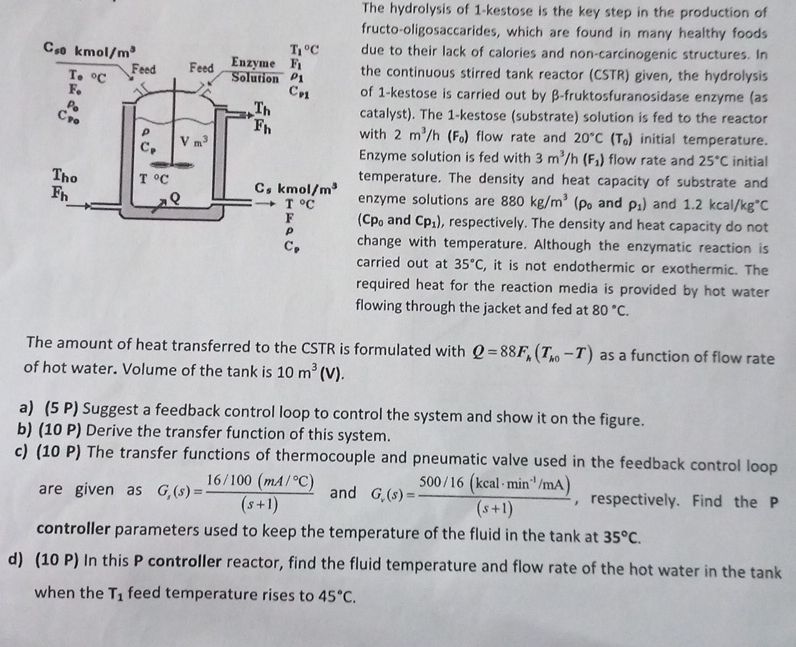 p The hydrolysis of 1-kestose Is the key step in the production of
fructo-oligosaccarides, which are found in many healthy foods
E kmoijm® 5 TiC due to their lack of calories and non-carcinogenic structures. In
r Fug Fwd gimme Bi the continuous stirred tank reactor (CSTR) given, the hydrolysis
RY Solution
Kr Ch of 1-kestose Is carried out by f-fruktosfuranosidase enzyme (as
od Th catalyst). The 1-kestose (substrate) solution is fed to the reactor
lal with 2 m'/h (Fa) flow rate and 20°C (T,) initial temperature.
Go| Y= Enzyme solution is fed with 3 m’/h (F.) flow rate and 25°C initial
Tho fos Co kmotyme 'CPETatUrE. The density and heat capacity of substrate and
Fy Q So kTed™ enzyme solutions are 880 kg/m (py and pi) and 1.2 keal/kg'C
F (Cpa and Cp), respectively. The density and heat capacity do not
Gi change with temperature. Although the enzymatic reaction is
carried out at 35°C, it is not endothermic or exothermic. The
required heat for the reaction media is provided by hot water
flowing through the jacket and fed at 80 °C.
The amount of heat transferred to the CSTR is formulated with © =88F, (7, ~T) as a function of flow rate
of hot water. Volume of the tank is 10 m? (v).
a) (5 P) Suggest a feedback control loop to control the system and show it on the. figure.
b) (10 P) Derive the transfer function of this system.
©) (10 P) The transfer functions of thermocouple and pneumatic valve used in the feedback control loop
o min)
are given as G, GN ET) and op = 0 Sl mn tima) respectively. Find the P
Z +1) (5+)
controller parameters used to keep the temperature of the fluid in the tank at 35°C.
d) (10 P) In this P controller reactor, find the fluid temperature and flow rate of the hot water in the tank
when the T; feed temperature rises to 45°C,