Act like a helpful tutor and exlain me step-by-step solution with explanation and final answer:3.1.1 E-pH diagram
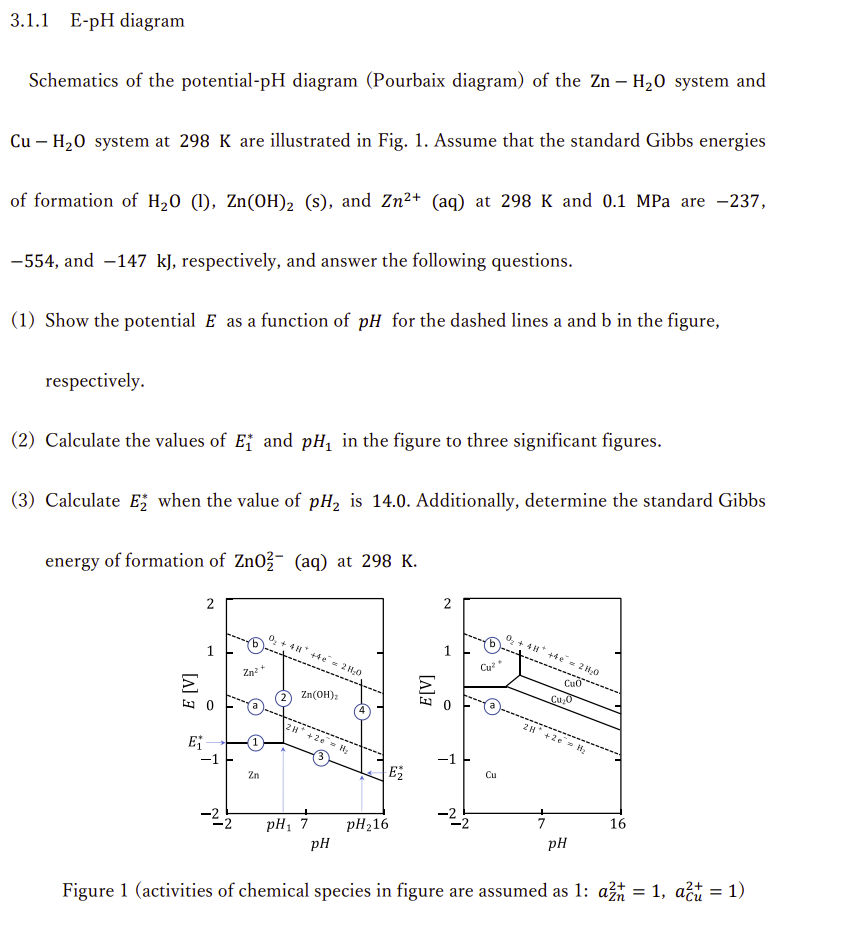
Schematics of the potential-pH diagram (Pourbaix diagram) of the Zn — H,0 system and
Cu — H,0 system at 298 K are illustrated in Fig. 1. Assume that the standard Gibbs energies
of formation of H,0 (I), Zn(OH), (s), and Zn?* (aq) at 298 K and 0.1 MPa are —237,
—554,and —147 KJ, respectively, and answer the following questions.
(1) Show the potential E as a function of pH for the dashed lines a and b in the figure,
respectively.
(2) Calculate the values of E; and pH, in the figure to three significant figures.
(3) Calculate Ej when the value of pH, is 14.0. Additionally, determine the standard Gibbs
energy of formation of Zn0%~ (aq) at 298 K.
2 2
1 [OL 1 OL,
we [Tl a
Sobel I &, oy
Ge, ir,
BE —1) Ed Fr
-1 Gx 3 -1 3
27 pH; 7 PH16 EE) 7 16
pH pH
Figure 1 (activities of chemical species in figure are assumed as 1: a2} = 1, a2} = 1)
Question:
Act like a helpful tutor and exlain me step-by-step solution with explanation and final answer:3.1.1 E-pH diagram
Schematics of the potential-pH diagram (Pourbaix diagram) of the Zn — H,0 system and
Cu — H,0 system at 298 K are illustrated in Fig. 1. Assume that the standard Gibbs energies
of formation of H,0 (I), Zn(OH), (s), and Zn?* (aq) at 298 K and 0.1 MPa are —237,
—554,and —147 KJ, respectively, and answer the following questions.
(1) Show the potential E as a function of pH for the dashed lines a and b in the figure,
respectively.
(2) Calculate the values of E; and pH, in the figure to three significant figures.
(3) Calculate Ej when the value of pH, is 14.0. Additionally, determine the standard Gibbs
energy of formation of Zn0%~ (aq) at 298 K.
2 2
1 [OL 1 OL,
we [Tl a
Sobel I &, oy
Ge, ir,
BE —1) Ed Fr
-1 Gx 3 -1 3
27 pH; 7 PH16 EE) 7 16
pH pH
Figure 1 (activities of chemical species in figure are assumed as 1: a2} = 1, a2} = 1)
This is AI generated Response.
Asked by: Francis
Created at: 2026-02-11 08:53:28
Final Answer:
RenderedRaw Text
Did you like this answer?
Let's go through the questions step by step, referring to the Zn-H₂O Pourbaix diagram provided.
---
## **Given Data**
- **Standard Gibbs energies of formation at 298 K, .1 MPa:**
- H₂O (l):
Question:
give me complete answer
This is AI generated Response.
Asked by: Francis
Created at: 2026-02-11 08:55:19
Final Answer:
RenderedRaw Text
Did you like this answer?
# Pourbaix Diagram Analysis for Zn-H₂O System
## **1. Potential \( E \) as a Function of \( pH \)**
### Dashed Lines a and b
To derive the potential \( E \) as a function of \( pH \) for the dashed lines in the Pourbaix diagram:
- **Line a**: Represents the equilibrium between \( \text{Zn}^{2+} \) and \( \text{Zn(OH)}_2 \) with varying \( pH \).
- **Line b**: Represents the equilibrium between \( \text{Zn(OH)}_2 \) and solid \( \text{ZnO} \).
### General Equation
The equilibrium potential \( E \) can be expressed using the Nernst equation:
\[
E = E^\circ - \frac{RT}{nF} \ln Q
\]
Where:
- \( E^\circ \) is the standard potential.
- \( R \) is the gas constant (8.314 J/mol·K).
- \( T \) is the temperature (298 K).
- \( n \) is the number of electrons transferred.
- \( F \) is Faraday's constant (96485 C/mol).
- \( Q \) is the reaction quotient.
### Specific Equations for Lines a and b
1. **For Line a** (Zn²⁺ and Zn(OH)₂):
\[
E_a = E_a^\circ + \frac{0.0592}{n} \cdot pH
\]
2. **For Line b** (Zn(OH)₂ and ZnO):
\[
E_b = E_b^\circ + \frac{0.0592}{n} \cdot pH
\]
## **2. Calculation of \( E \) and \( pH \)**
To calculate the values of \( E \) and \( pH \) at specific points in the diagram:
### Values at Specific Points:
- **Point 1**: Assume \( pH = 7 \)
- **Point 2**: Assume \( pH = 14 \)
### Using the Gibbs Free Energy
The Gibbs energies of formation are given:
- \( \Delta G^\circ_{\text{H}_2\text{O}} = -237 \, \text{kJ/mol} \)
- \( \Delta G^\circ_{\text{Zn(OH)}_2} = -554 \, \text{kJ/mol} \)
- \( \Delta G^\circ_{\text{Zn}^{2+}} = -147 \, \text{kJ/mol} \)
### Standard Potential Calculation
For the reactions:
- **Zn²⁺ + 2e⁻ → Zn** (standard potential \( E^\circ = -0.76 \, \text{V} \))
### Applying Nernst Equation
At \( pH = 7 \):
\[
E_1 = -0.76 + \frac{0.0592}{2} \cdot 7 = -0.76 + 0.207 = -0.553 \, \text{V}
\]
At \( pH = 14 \):
\[
E_2 = -0.76 + \frac{0.0592}{2} \cdot 14 = -0.76 + 0.4156 = -0.3444 \, \text{V}
\]
## **3. Calculation of \( E_j \) at \( pH = 14.0 \)**
### Use of Nernst Equation
From the previous calculation, we have:
\[
E_{j} = -0.344 \, \text{V} \quad \text{(to three significant figures)}
\]
### Standard Gibbs Energy of Formation of \( \text{Zn}^{2+} \)
Using the Gibbs energy relation:
\[
\Delta G = -nFE
\]
Substituting \( E = -0.344 \, \text{V} \):
\[
\Delta G = -2 \cdot 96485 \cdot (-0.344) = 66267.44 \, \text{J/mol} \approx 66.3 \, \text{kJ/mol}
\]
## **Final Answers**
1. **Potential \( E \) at \( pH = 7 \)**: \( -0.553 \, \text{V} \)
2. **Potential \( E \) at \( pH = 14 \)**: \( -0.344 \, \text{V} \)
3. **Standard Gibbs Energy of Formation of \( \text{Zn}^{2+} \)**: \( 66.3 \, \text{kJ/mol} \) at \( 298 \, \text{K} \)
VIPSolutions focuses on clear, step‑by‑step explanations so you can learn quickly. Whether you need an AI‑generated walkthrough or a short hint to get unstuck, each solution is organized for fast reading and easy review later.
Search similar questions, compare approaches, and bookmark the best answers for revision. Our goal is simple: quick, reliable study help that feels natural—not noisy.
 VIPSolutions
 3.1.1 E-pH diagram
Schematics of the potential-pH diagram (Pourbaix diagram) of the Zn — H,0 system and
Cu — H,0 system at 298 K are illustrated in Fig. 1. Assume that the standard Gibbs energies
of formation of H,0 (I), Zn(OH), (s), and Zn?* (aq) at 298 K and 0.1 MPa are —237,
—554,and —147 KJ, respectively, and answer the following questions.
(1) Show the potential E as a function of pH for the dashed lines a and b in the figure,
respectively.
(2) Calculate the values of E; and pH, in the figure to three significant figures.
(3) Calculate Ej when the value of pH, is 14.0. Additionally, determine the standard Gibbs
energy of formation of Zn0%~ (aq) at 298 K.
2 2
1 [OL 1 OL,
we [Tl a
Sobel I &, oy
Ge, ir,
BE —1) Ed Fr
-1 Gx 3 -1 3
27 pH; 7 PH16 EE) 7 16
pH pH
Figure 1 (activities of chemical species in figure are assumed as 1: a2} = 1, a2} = 1)