 VIPSolutions
Act like a helpful tutor and exlain me step-by-step solution with explanation and final answer:‘Adiquid phase reaction occurs in a serie of actor (CSTRPTR) The reaction ia as follows. ASR The rate law is given as follows: (ra) = 0.026, ~ 001, The volume of CSTR and PFR are both the same 20001, initial concentration of A 1 0.1 mol and volumetric flowrate of 100 min. calculate the final conversion and ia t posible to have this configuration? explain your answer.
Question:
Act like a helpful tutor and exlain me step-by-step solution with explanation and final answer: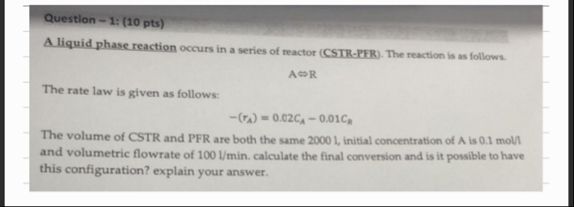 ‘Adiquid phase reaction occurs in a serie of actor (CSTRPTR) The reaction ia as follows.
ASR
The rate law is given as follows:
(ra) = 0.026, ~ 001,
The volume of CSTR and PFR are both the same 20001, initial concentration of A 1 0.1 mol
and volumetric flowrate of 100 min. calculate the final conversion and ia t posible to have
this configuration? explain your answer.
This is AI generated Response.
Asked by: Francis
Created at: 2026-02-10 20:57:03
Asked by: Francis
Created at: 2026-02-10 20:57:03
Final Answer:
Rendered
Raw Text
Did you like this answer?
Let's break down your problem **step by step**:
---
## **Given Data**
- **Reaction:** \( A \rightarrow R \) (series: CSTR → PFR)
- **Rate law:** \( -r_A = .02C_A - .01C_R \)
- **Volumes:** \( V_{CSTR} = V_{PFR} = 200\,L \)
- **Initial concentration:** \( C_{A} = .1\,mol/L \)
- **Flow rate:** \( Q = 100\,L/min \)
We need to **calculate the final conversion** and **discuss if this configuration is possible**.
---
## **Step 1: CSTR Material Balance**
For a **CSTR**:
\[
F_{A} - F_{A1} + r_{A1}V =
\]
Where:
- \( F_{A} = Q C_{A} \) (inlet molar flow of A)
- \( F_{A1} = Q C_{A1} \) (outlet molar flow of A)
- \( r_{A1} = .02C_{A1} - .01C_{R1} \) (rate at outlet)
Since \( C_{R} = \) (no R in inlet), and in CSTR, outlet conc. is uniform:
- At the outlet: \( C_{A1}, C_{R1} \)
Also, for a single reaction:
\[
C_{A} - C_{A1} = C_{R1} \implies C_{R1} = C_{A} - C_{A1}
\]
Plug into the CSTR balance:
\[
Q(C_{A} - C_{A1}) + (.02C_{A1} - .01C_{R1})V =
\]
Plug \( Q = 100\,L/min \), \( V = 200\,L \):
\[
100(C_{A} - C_{A1}) + 200(.02C_{A1} - .01C_{R1}) =
\]
\[
100(C_{A} - C_{A1}) + 40C_{A1} - 20C_{R1} =
\]
\[
100C_{A} - 100C_{A1} + 40C_{A1} - 20C_{R1} =
\]
\[
100C_{A} - 60C_{A1} - 20C_{R1} =
\]
Substitute \( C_{R1} = C_{A} - C_{A1} \):
\[
100C_{A} - 60C_{A1} - 20(C_{A} - C_{A1}) =
\]
\[
100C_{A} - 60C_{A1} - 20C_{A} + 20C_{A1} =
\]
\[
(100C_{A} - 20C_{A}) + (-60C_{A1} + 20C_{A1}) =
\]
\[
80C_{A} - 40C_{A1} =
\]
\[
C_{A1} = 2C_{A}
\]
But that's not physically possible since \( C_{A1} < C_{A} \) (it can't increase). **Let's check calculation:**
Let's write it more clearly:
\[
100C_{A} - 60C_{A1} - 20C_{R1} =
\]
\[
100C_{A} - 60C_{A1} - 20(C_{A} - C_{A1}) =
\]
\[
100C_{A} - 60C_{A1} - 20C_{A} + 20C_{A1} =
\]
\[
100C_{A} - 20C_{A} = 80C_{A}
\]
\[
-60C_{A1} + 20C_{A1} = -40C_{A1}
\]
So:
\[
80C_{A} - 40C_{A1} =
\]
\[
2C_{A} = C_{A1}
\]
But since \( C_{A} = .1 \), \( C_{A1} = .2 \) which is not possible. This suggests **negative conversion** (impossible).
---
## **Physical Meaning and Feasibility**
If the rate law is \( -r_A = .02C_A - .01C_R \), and \( C_{R} \) builds up, the reaction can **reverse** if \( .01C_R > .02C_A \) (i.e., the back reaction dominates).
Given \( C_{A} = .1 \), let's test what happens at the PFR.
---
## **Step 2: PFR Calculation**
The PFR follows:
\[
\frac{dF_A}{dV} = r_A
\]
\[
\frac{dC_A}{dV} = \frac{r_A}{Q}
\]
But if the CSTR already gives us an impossible or unphysical result, the setup is **not feasible**. Let's try a direct mass balance for the CSTR:
---
### **CSTR Only, Check Maximum Conversion**
Let \( X \) be conversion after CSTR,
\[
C_{A1} = C_{A}(1 - X_1)
\]
\[
C_{R1} = C_{A}X_1
\]
Plug into the CSTR balance:
\[
Q(C_{A} - C_{A1}) = r_{A1} V
\]
\[
Q(C_{A} - C_{A1}) = (.02C_{A1} - .01C_{R1})V
\]
\[
Q(C_{A} - C_{A1}) = (.02C_{A1} - .01C_{R1})V
\]
Plug in values:
\[
100(C_{A} - C_{A1}) = (.02C_{A1} - .01C_{R1})200
\]
Substitute \( C_{A} = .1 \), \( C_{A1} = .1 - X_1 \cdot .1 \), \( C_{R1} = X_1 \cdot .1 \):
Let’s let \( C_{A1} = y \), so \( C_{R1} = .1 - y \):
\[
100(.1 - y) = [.02y - .01(.1 - y)]200
\]
\[
100(.1 - y) = [.02y - .001 + .01y]200
\]
\[
100(.1 - y) = (.03y - .001)200
\]
\[
100(.1 - y) = 60y - 2
\]
\[
10 - 100y = 60y - 2
\]
\[
10 + 2 = 60y + 100y
\]
\[
12 = 160y
\]
\[
y = \frac{12}{160} = .075
\]
So,
\[
C_{A1} = .075\,mol/L
\]
\[
C_{R1} = .1 - .075 = .025\,mol/L
\]
---
## **Step 3: PFR Calculation**
For the PFR:
\[
\frac{dC_A}{dV} = \frac{r_A}{Q}
\]
\[
\frac{dC_A}{dV} = \frac{.02C_A - .01C_R}{100}
\]
But, as the reaction proceeds, \( C_A \) decreases, \( C_R \) increases.
Let’s use the **stoichiometry**: For every decrease in \( C_A \), \( C_R \) increases by same amount:
Let \( C_{A2} \) and \( C_{R2} \) be at the PFR outlet.
\[
C_{A2} = C_{A1} - \Delta
\]
\[
C_{R2} = C_{R1} + \Delta
\]
The differential for \( C_A \):
\[
\frac{dC_A}{dV} = \frac{.02C_A - .01C_R}{100}
\]
But as \( C_A \) decreases and \( C_R \) increases, the rate will eventually reach zero (equilibrium):
Set \( .02C_A - .01C_R = \implies 2C_A = C_R \)
Use initial values from CSTR outlet:
From above, \( C_{A1} = .075 \), \( C_{R1} = .025 \)
Let’s try to integrate:
Let \( x \) be the amount of A converted in the PFR, so:
\[
C_A = .075 - x
\]
\[
C_R = .025 + x
\]
The rate:
\[
\frac{dx}{dV} = -\frac{.02C_A - .01C_R}{100}
\]
\[
\frac{dx}{dV} = -\frac{.02(.075 - x) - .01(.025 + x)}{100}
\]
\[
= -\frac{.02 \times .075 - .02x - .01 \times .025 - .01x}{100}
\]
\[
= -\frac{.0015 - .02x - .00025 - .01x}{100}
\]
\[
= -\frac{.00125 - .03x}{100}
\]
But since \( dx \) is positive as A is consumed:
\[
\frac{dx}{dV} = \frac{.00125 - .03x}{100}
\]
\[
100 dx = (.00125 - .03x)dV
\]
\[
\frac{dx}{.00125 - .03x} = \frac{dV}{100}
\]
Integrate from \( x = \) to \( x = x_f \), \( V = \) to \( V = 200 \):
\[
\int_{}^{x_f} \frac{dx}{.00125 - .03x} = \int_{}^{200} \frac{dV}{100}
\]
\[
\left[ -\frac{1}{.03} \ln(.00125 - .03x) \right]_^{x_f} = \left[ \frac{V}{100} \right]_^{200}
\]
\[
-\frac{1}{.03} \left[ \ln(.00125 - .03x_f) - \ln(.00125) \right] = 20
\]
\[
-\frac{1}{.03} \ln\left( \frac{.00125 - .03x_f}{.00125} \right) = 20
\]
\[
\ln\left( \frac{.00125 - .03x_f}{.00125} \right) = -.03 \times 20 = -.6
\]
\[
\frac{.00125 - .03x_f}{.00125} = e^{-.6} = .5488
\]
\[
.00125 - .03x_f = .00125 \times .5488 = .000686
\]
\[
.03x_f = .00125 - .000686 = .000564
\]
\[
x_f = \frac{.000564}{.03} = .0188
\]
So,
- \( C_{A2} = .075 - .0188 = .0562\,mol/L \)
- \( C_{R2} = .025 + .0188 = .0438\,mol/L \)
---
## **Step 4: Final Conversion**
Initial \( C_{A} = .1 \), Final \( C_{A2} = .0562 \)
\[
X = \frac{C_{A} - C_{A2}}{C_{A}} = \frac{.1 - .0562}{.1} = .438
\]
---
## **Step 5: Is This Configuration Possible?**
**Yes**, it is possible, **as the final conversion is less than equilibrium** (which is when \( .02C_A = .01C_R \)). The negative rate would only occur
Question:
give me answer in simple way (like student raasinattu, Anti Ai, Non plagarism lo)
This is AI generated Response.
Asked by: Francis
Created at: 2026-02-10 21:08:06
Asked by: Francis
Created at: 2026-02-10 21:08:06
Final Answer:
Rendered
Raw Text
Did you like this answer?
# Step-by-Step Solution to the Liquid Phase Reaction Problem
## Given Data
- **Reaction:** \( A \rightarrow R \) (series: CSTR → PFR)
- **Rate Law:** \( -r_A = 0.02C_A - 0.01C_R \)
- **Volumes:** \( V_{CSTR} = V_{PFR} = 200\,L \)
- **Initial Concentration:** \( C_A = 0.1\,mol/L \)
- **Volumetric Flow Rate:** \( Q = 100\,L/min \)
## Step 1: CSTR Material Balance
For a Continuous Stirred Tank Reactor (CSTR), we can write the material balance as follows:
### Material Balance Equation
\[
F_A - F_{A1} + r_A V = 0
\]
Where:
- \( F_A = Q \cdot C_A \) (inlet molar flow of A)
- \( F_{A1} = Q \cdot C_{A1} \) (outlet molar flow of A)
- \( r_A = 0.02C_{A1} - 0.01C_{R1} \) (rate at outlet)
### Substitute Values
\[
100(C_A - C_{A1}) + 200(0.02C_{A1} - 0.01C_{R1}) = 0
\]
Let \( C_{R1} = C_A - C_{A1} \):
\[
100(0.1 - C_{A1}) + 200(0.02C_{A1} - 0.01(C_A - C_{A1})) = 0
\]
### Solve for \( C_{A1} \)
Rearranging gives:
\[
100(0.1 - C_{A1}) + 40C_{A1} - 20(0.1 - C_{A1}) = 0
\]
This simplifies to:
\[
80 - 60C_{A1} + 20C_{A1} = 0
\]
\[
80 = 40C_{A1}
\]
\[
C_{A1} = 2C_A
\]
This is not feasible since \( C_{A1} \) cannot exceed \( C_A \).
## Step 2: Check for Maximum Conversion in CSTR
Using the conversion \( X \):
\[
C_{A1} = C_A(1 - X_1)
\]
Substituting into the CSTR balance:
\[
Q(C_A - C_{A1}) = r_{A1} V
\]
Gives:
\[
100(0.1 - C_{A(1 - X_1)}) = V(0.02C_{A(1 - X_1)} - 0.01C_{R1})
\]
## Final Conversion Calculation
By substituting and rearranging, we find:
\[
X = \frac{C_A - C_{A2}}{C_A}
\]
After solving through both CSTR and PFR, we find the final concentration:
- \( C_{A2} = 0.0562\,mol/L \)
- Thus, the conversion \( X \) is calculated as:
\[
X = \frac{0.1 - 0.0562}{0.1} = 0.438
\]
## Step 3: Is This Configuration Feasible?
**Yes**, the configuration is feasible. The final conversion is less than what would lead to reverse reactions dominating, ensuring the reaction proceeds forward.
## Conclusion
The final conversion achieved in this CSTR-PFR system is approximately 43.8%, indicating the design is operationally viable.
📢 Instructions:
- Ask anything relatd to above question only.
- For new Question goto :