This is AI generated Response.
Asked by: Francis
Created at: 2026-01-17 13:41:15
Final Answer:
RenderedRaw Text
Did you like this answer?
# Step-by-Step Solution: Batch Stirred Tank Reactor (Adiabatic, Exothermic)
We are given a **batch reactor** with a single irreversible reaction:
**A → B + C**
The reaction is **exothermic** and follows the **Arrhenius law** for kinetics. The process is **adiabatic** (no heat exchange), and we need to model the system to track concentrations and temperature.
We are asked to:
a) Develop a mathematical model (derive ODEs for \(C_A\), \(C_B\), \(C_C\), and \(T\)).
b) Solve numerically in Excel.
c) Solve numerically in MATLAB.
d) Compare results.
Let’s proceed step by step.
---
## (a) **Mathematical Model Development**
### **1. Reaction Kinetics**
The reaction rate for an elementary reaction is:
\[
r_A = -\frac{dC_A}{dt} = k C_A
\]
where \( k \) follows the **Arrhenius equation**:
\[
k = k_ \exp\left(-\frac{E}{RT}\right)
\]
### **2. Material Balances**
For a **batch reactor** (no inlet/outlet):
- For A:
\[
\frac{dC_A}{dt} = -r_A = -k C_A
\]
- For B (produced at the same rate A is consumed):
\[
\frac{dC_B}{dt} = k C_A
\]
- For C (produced at same rate as A is consumed):
\[
\frac{dC_C}{dt} = k C_A
\]
### **3. Energy Balance (Adiabatic)**
Since the reactor is adiabatic:
\[
\frac{dT}{dt} = -\frac{\Delta H_r}{\rho C_p} r_A
\]
Where:
- \(\Delta H_r\) is the heat of reaction (J/mol)
- \(\rho\) is the density (kg/m³)
- \(C_p\) is the heat capacity (J/kg·K)
Substitute \(r_A = k C_A\):
\[
\frac{dT}{dt} = -\frac{\Delta H_r}{\rho C_p} k C_A
\]
---
### **4. Initial Conditions & Constants**
At \( t = \):
\( C_A = 120 \) mol/m³, \( C_B = \), \( C_C = \), \( T = 320 \) K
Constants:
- \( E = 51,000 \) J/mol
- \( k_ = 8.20 \times 10^7 \) min\(^{-1}\)
- \( R = 8.314 \) J/mol·K
- \( \Delta H_r = -70,000 \) J/mol (exothermic, negative)
- \( C_p = 160 \) J/kg·K
- \( \rho = 920 \) kg/m³
---
### **5. Final ODE System**
\[
\boxed{
\begin{align*}
\frac{dC_A}{dt} &= -k C_A \\
\frac{dC_B}{dt} &= k C_A \\
\frac{dC_C}{dt} &= k C_A \\
\frac{dT}{dt} &= -\frac{\Delta H_r}{\rho C_p} k C_A \\
k &= k_ \exp\left(-\frac{E}{RT}\right)
\end{align*}
}
\]
---
### **6. Step-by-Step Explanation**
1. **Rate law**: The reaction is elementary, so the rate is first order in \( C_A \).
2. **Arrhenius law**: The rate constant depends on temperature.
3. **Material balances**: In a batch reactor, the only changes are due to reaction.
4. **Energy balance**: Since the reactor is adiabatic, the only temperature change comes from the reaction heat.
5. **All species start at their initial values, and \( k \) is updated as \( T \) changes.**
---
## (b) & (c) **Numerical Solution (Excel/MATLAB)**
- In Excel: Use small time steps, recalculate \( k \), update each variable using the ODEs.
- In MATLAB: Use ode45 or similar to integrate the ODEs.
---
## **Final Answer: Mathematical Model ODEs**
\[
\boxed{
\begin{align*}
\frac{dC_A}{dt} &= -k_ \exp\left(-\frac{E}{RT}\right) C_A \\
\frac{dC_B}{dt} &= k_ \exp\left(-\frac{E}{RT}\right) C_A \\
\frac{dC_C}{dt} &= k_ \exp\left(-\frac{E}{RT}\right) C_A \\
\frac{dT}{dt} &= -\frac{\Delta H_r}{\rho C_p} k_ \exp\left(-\frac{E}{RT}\right) C_A
\end{align*}
}
\]
With initial conditions:
\[
C_A() = 120, \quad C_B() = , \quad C_C() = , \quad T() = 320 \ \text{K}
\]
Question:
give me all answer on plane text for copy and paste purpose.
This is AI generated Response.
Asked by: Francis
Created at: 2026-01-17 13:44:53
Final Answer:
RenderedRaw Text
Did you like this answer?
# Step-by-Step Solution: Batch Stirred Tank Reactor (Adiabatic, Exothermic)
We are given a **batch reactor** with a single irreversible reaction:
**A → B + C**
The reaction is **exothermic** and follows the **Arrhenius law** for kinetics. The process is **adiabatic** (no heat exchange), and we need to model the system to track concentrations and temperature.
We are asked to:
a) Develop a mathematical model (derive ODEs for \(C_A\), \(C_B\), \(C_C\), and \(T\)).
b) Solve numerically in Excel.
c) Solve numerically in MATLAB.
d) Compare results.
Let’s proceed step by step.
## (a) Mathematical Model Development
### 1. Reaction Kinetics
The reaction rate for an elementary reaction is:
\[
r_A = -\frac{dC_A}{dt} = k C_A
\]
where \( k \) follows the **Arrhenius equation**:
\[
k = k_0 \exp\left(-\frac{E}{RT}\right)
\]
### 2. Material Balances
For a **batch reactor** (no inlet/outlet):
- For A:
\[
\frac{dC_A}{dt} = -r_A = -k C_A
\]
- For B (produced at the same rate A is consumed):
\[
\frac{dC_B}{dt} = k C_A
\]
- For C (produced at the same rate as A is consumed):
\[
\frac{dC_C}{dt} = k C_A
\]
### 3. Energy Balance (Adiabatic)
Since the reactor is adiabatic:
\[
\frac{dT}{dt} = -\frac{\Delta H_r}{\rho C_p} r_A
\]
Where:
- \(\Delta H_r\) is the heat of reaction (J/mol)
- \(\rho\) is the density (kg/m³)
- \(C_p\) is the heat capacity (J/kg·K)
Substituting \(r_A = k C_A\):
\[
\frac{dT}{dt} = -\frac{\Delta H_r}{\rho C_p} k C_A
\]
### 4. Initial Conditions & Constants
At \( t = 0 \):
\( C_A = 1200 \) mol/m³, \( C_B = 0 \) mol/m³, \( C_C = 0 \) mol/m³, \( T = 320 \) K
Constants:
- \( E = 51,000 \) J/mol
- \( k_0 = 8.20 \times 10^7 \) min\(^{-1}\)
- \( R = 8.314 \) J/mol·K
- \( \Delta H_r = -70,000 \) J/mol (exothermic, negative)
- \( C_p = 1600 \) J/kg·K
- \( \rho = 920 \) kg/m³
### 5. Final ODE System
\[
\boxed{
\begin{align*}
\frac{dC_A}{dt} &= -k C_A \\
\frac{dC_B}{dt} &= k C_A \\
\frac{dC_C}{dt} &= k C_A \\
\frac{dT}{dt} &= -\frac{\Delta H_r}{\rho C_p} k C_A \\
k &= k_0 \exp\left(-\frac{E}{RT}\right)
\end{align*}
}
\]
### 6. Step-by-Step Explanation
1. **Rate law**: The reaction is elementary, so the rate is first order in \( C_A \).
2. **Arrhenius law**: The rate constant depends on temperature.
3. **Material balances**: In a batch reactor, the only changes are due to reaction.
4. **Energy balance**: Since the reactor is adiabatic, the only temperature change comes from the reaction heat.
5. **All species start at their initial values, and \( k \) is updated as \( T \) changes.**
## (b) & (c) Numerical Solution (Excel/MATLAB)
- In Excel: Use small time steps, recalculate \( k \), update each variable using the ODEs.
- In MATLAB: Use ode45 or similar to integrate the ODEs.
## Final Answer: Mathematical Model ODEs
\[
\boxed{
\begin{align*}
\frac{dC_A}{dt} &= -k_0 \exp\left(-\frac{E}{RT}\right) C_A \\
\frac{dC_B}{dt} &= k_0 \exp\left(-\frac{E}{RT}\right) C_A \\
\frac{dC_C}{dt} &= k_0 \exp\left(-\frac{E}{RT}\right) C_A \\
\frac{dT}{dt} &= -\frac{\Delta H_r}{\rho C_p} k_0 \exp\left(-\frac{E}{RT}\right) C_A
\end{align*}
}
\]
With initial conditions:
\[
C_A(0) = 1200, \quad C_B(0) = 0, \quad C_C(0) = 0, \quad T(0) = 320 \ \text{K}
\]
VIPSolutions focuses on clear, step‑by‑step explanations so you can learn quickly. Whether you need an AI‑generated walkthrough or a short hint to get unstuck, each solution is organized for fast reading and easy review later.
Search similar questions, compare approaches, and bookmark the best answers for revision. Our goal is simple: quick, reliable study help that feels natural—not noisy.
 VIPSolutions
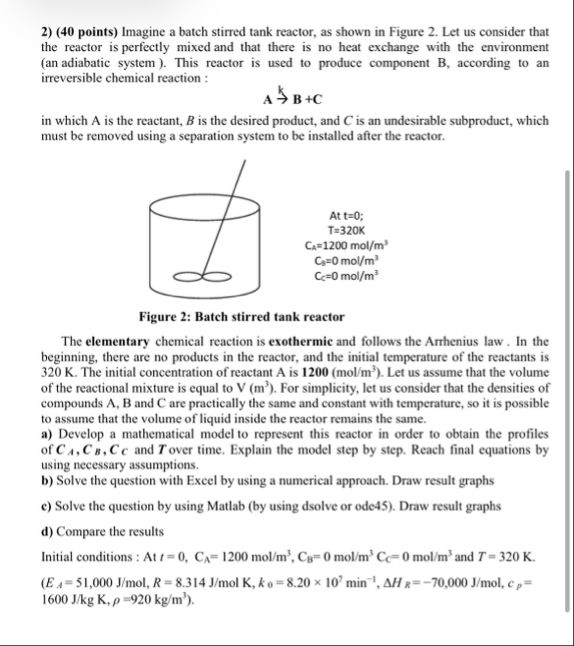 2) (40 points) Imagine a batch stirred tank reactor, as shown in Figure 2. Let us consider that
the reactor is perfectly mixed and that there is no heat exchange with the environment
(an adiabatic system ). This reactor is used to produce component B, according fo an
irreversible chemical reaction :
ASBec
in which A is the reactant, & is the desired product, and C is an undesirable subproduct, which
must be removed using a separation system to be installed after the reactor.
Ato;
T=3200
Cu=1200 mol/m’
Co=0mol/m’
Cc=0 mol/m®
Figure 2: Batch stirred tank reactor
“The elementary chemical reaction is exothermic and follows the Arrhenius law . In the
beginning, there are no products in the reactor, and the initial temperature of the reactants is
320K. The inital concentration of reactant A is 1200 (molim’). Let us assume that the volume
of the reactional mixture is equal to V (m’). For simplicity, let us consider that the densities of
compounds A, B and C are practically the same and constant with temperature, s0 it is possible
10 assume that the volume of liquid inside the reactor remains the same.
#) Develop a mathematical model to represent this reactor in order to obtain the profiles
of C4,C, Cc and Tover time. Explain the model step by step. Reach final equations by
using necessary assumptions.
b) Solve the question with Excel by using a numerical approach. Draw result graphs
©) Solve the question by using Matlab (by using dsolve or odeds). Draw result graphs
d) Compare the results
Initial conditions : At = 0, C= 1200 mol’, Cy= 0 molim’ Ce= 0 mol/m’ and T= 320 K.
(E 4= 51,000 Jmol, R = 8314 Jmol K, ko =8.20 x 10⁷ min", AH x= 70.000 Jmol, c y=
1600 J/kg K, p =920 kg/m).