 VIPSolutions
Give step-by-step solution with explanation and final answer:iN i Given the vector A = 28, + &4 — 4€,, covert A into: . . . 3m a) Cartesian coordinates at point PG, 2) eytindrical . . . 3m b) Spherical coordinates at point P(3,—, 2) cylindrical
Question:
Give step-by-step solution with explanation and final answer: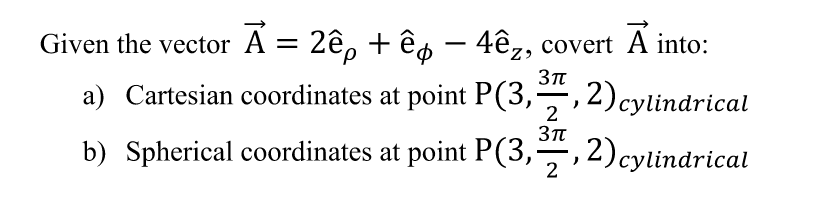 iN i
Given the vector A = 28, + &4 — 4€,, covert A into:
. . . 3m
a) Cartesian coordinates at point PG, 2) eytindrical
. . . 3m
b) Spherical coordinates at point P(3,—, 2) cylindrical
This is AI generated Response.
Asked by: M Murali
Created at: 2025-08-27 21:02:17
Asked by: M Murali
Created at: 2025-08-27 21:02:17
Final Answer:
Rendered
Raw Text
Did you like this answer?
Let's solve the problem **step-by-step**.
## **Given:**
\[
\vec{A} = 2\hat{e}_\rho + \hat{e}_\phi - 4\hat{e}_z
\]
at point \(P(3, \frac{3\pi}{2}, 2)_{cylindrical}\).
---
## **Step 1: Cylindrical to Cartesian Unit Vectors**
The relationships between cylindrical and Cartesian unit vectors are:
\[
\begin{align*}
\hat{e}_\rho &= \cos\phi\,\hat{i} + \sin\phi\,\hat{j} \\
\hat{e}_\phi &= -\sin\phi\,\hat{i} + \cos\phi\,\hat{j} \\
\hat{e}_z &= \hat{k}
\end{align*}
\]
---
## **Step 2: Substitute the Point**
Given \( (\rho, \phi, z) = (3, \frac{3\pi}{2}, 2) \):
- \(\cos\phi = \cos\left(\frac{3\pi}{2}\right) = 0\)
- \(\sin\phi = \sin\left(\frac{3\pi}{2}\right) = -1\)
---
## **Step 3: Express Each Unit Vector at This Point**
\[
\begin{align*}
\hat{e}_\rho &= (0)\hat{i} + (-1)\hat{j} = -\hat{j} \\
\hat{e}_\phi &= -(-1)\hat{i} + (0)\hat{j} = \hat{i} \\
\hat{e}_z &= \hat{k}
\end{align*}
\]
---
## **Step 4: Express \(\vec{A}\) in Cartesian**
\[
\vec{A} = 2\hat{e}_\rho + \hat{e}_\phi - 4\hat{e}_z
\]
Plug in the above:
\[
\vec{A} = 2(-\hat{j}) + (\hat{i}) - 4(\hat{k}) = \hat{i} - 2\hat{j} - 4\hat{k}
\]
### **Final Answer for (a):**
\[
\boxed{
\vec{A}_{cartesian} = \hat{i} - 2\hat{j} - 4\hat{k}
}
\]
at point \( (x, y, z) = (\rho \cos\phi, \rho \sin\phi, z) = (0, -3, 2) \).
---
## **Step 5: Cylindrical to Spherical Conversion**
### **Spherical Unit Vectors in Terms of Cylindrical**
\[
\begin{align*}
\hat{e}_\rho &= \sin\theta\,\hat{e}_r + \cos\theta\,\hat{e}_\theta \\
\hat{e}_z &= \cos\theta\,\hat{e}_r - \sin\theta\,\hat{e}_\theta \\
\hat{e}_\phi \text{ is the same in both}
\end{align*}
\]
### **Find \(\theta\) at the Point**
\[
\theta = \arccos\left(\frac{z}{r}\right)
\]
where \( r = \sqrt{\rho^2 + z^2} = \sqrt{9 + 4} = \sqrt{13} \).
\[
\cos\theta = \frac{z}{r} = \frac{2}{\sqrt{13}}
\]
\[
\sin\theta = \frac{\rho}{r} = \frac{3}{\sqrt{13}}
\]
---
### **Rewrite \(\vec{A}\) in Spherical**
\[
\hat{e}_\rho = \sin\theta\,\hat{e}_r + \cos\theta\,\hat{e}_\theta
\]
\[
\hat{e}_z = \cos\theta\,\hat{e}_r - \sin\theta\,\hat{e}_\theta
\]
Plug in the values:
\[
\vec{A} = 2\hat{e}_\rho + \hat{e}_\phi - 4\hat{e}_z
\]
\[
= 2(\sin\theta\,\hat{e}_r + \cos\theta\,\hat{e}_\theta) + \hat{e}_\phi - 4(\cos\theta\,\hat{e}_r - \sin\theta\,\hat{e}_\theta)
\]
Expand:
\[
= [2\sin\theta - 4\cos\theta]\,\hat{e}_r + [2\cos\theta + 4\sin\theta]\,\hat{e}_\theta + \hat{e}_\phi
\]
Plug in \(\sin\theta = \frac{3}{\sqrt{13}}\), \(\cos\theta = \frac{2}{\sqrt{13}}\):
\[
\begin{align*}
\hat{e}_r: &\quad 2\left(\frac{3}{\sqrt{13}}\right) - 4\left(\frac{2}{\sqrt{13}}\right) = \frac{6 - 8}{\sqrt{13}} = -\frac{2}{\sqrt{13}} \\
\hat{e}_\theta: &\quad 2\left(\frac{2}{\sqrt{13}}\right) + 4\left(\frac{3}{\sqrt{13}}\right) = \frac{4 + 12}{\sqrt{13}} = \frac{16}{\sqrt{13}} \\
\hat{e}_\phi: &\quad 1
\end{align*}
\]
### **Final Answer for (b):**
\[
\boxed{
\vec{A}_{spherical} = -\frac{2}{\sqrt{13}}\hat{e}_r + \frac{16}{\sqrt{13}}\hat{e}_\theta + \hat{e}_\phi
}
\]
at \( (r, \theta, \phi) = (\sqrt{13}, \arccos(2/\sqrt{13}), 3\pi/2) \).
---
## **Summary Table**
| Form | Expression | At Point |
|-------------|-------------------------------------------------------------|----------------------------------|
| Cartesian | \( \hat{i} - 2\hat{j} - 4\hat{k} \) | \( (x, y, z) = (0, -3, 2) \) |
| Spherical | \( -\frac{2}{\sqrt{13}}\hat{e}_r + \frac{16}{\sqrt{13}}\hat{e}_\theta + \hat{e}_\phi \) | \( (r, \theta, \phi) = (\sqrt{13}, \arccos(2/\sqrt{13}), 3\pi/2) \) |
Let me know if you need any clarifications or further explanations!
Question:
Give ME 60 Words Explanation in Cartesian only Theory and Spherical alos 60 Words
This is AI generated Response.
Asked by: M Murali
Created at: 2025-08-27 21:06:29
Asked by: M Murali
Created at: 2025-08-27 21:06:29
Final Answer:
Rendered
Raw Text
Did you like this answer?
**Cartesian Explanation:**
In Cartesian coordinates, vectors are expressed as components along x, y, and z axes. To convert from cylindrical components, use unit vector relationships with \(\hat{i}\), \(\hat{j}\), and \(\hat{k}\). This allows straightforward calculation of vector components at any point in space.
**Spherical Explanation:**
Spherical coordinates define points via radius \(r\), polar angle \(\theta\), and azimuthal angle \(\phi\). To convert vectors, decompose cylindrical or Cartesian components into spherical unit vectors \(\hat{e}_r\), \(\hat{e}_\theta\), and \(\hat{e}_\phi\) considering geometric relationships involving angles and distances.
📢 Instructions:
- Ask anything relatd to above question only.
- For new Question goto :