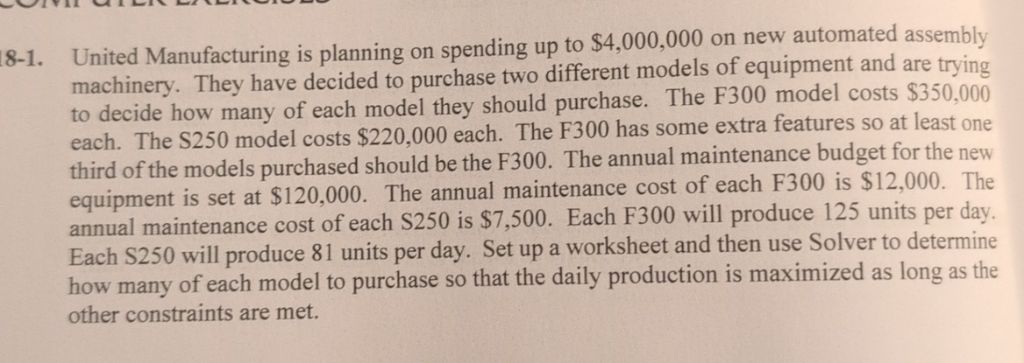
give full step by step answer and give final summary8-1. United Manufacturing is planning on spending up t0 $4,000,000 on new automated assembly
machinery. They have decided to purchase two different models of equipment and are trying
to decide how many of each model they should purchase. The F300 model costs $350.000
each. The $250 model costs $220,000 each. The F300 has some extra features so at least one
third of the models purchased should be the F300. The annual maintenance budget for the new
equipment is set at $120,000. The annual maintenance cost of each F300 is $12,000. The
annual maintenance cost of each S250 is $7,500. Each F300 will produce 125 units per day
Each S250 will produce 81 units per day. Setup a worksheet and then use Solver to determine
how many of each model to purchase so that the daily production is maximized as long as the
other constraints are met.
Question:
give full step by step answer and give final summary8-1. United Manufacturing is planning on spending up t0 $4,000,000 on new automated assembly
machinery. They have decided to purchase two different models of equipment and are trying
to decide how many of each model they should purchase. The F300 model costs $350.000
each. The $250 model costs $220,000 each. The F300 has some extra features so at least one
third of the models purchased should be the F300. The annual maintenance budget for the new
equipment is set at $120,000. The annual maintenance cost of each F300 is $12,000. The
annual maintenance cost of each S250 is $7,500. Each F300 will produce 125 units per day
Each S250 will produce 81 units per day. Setup a worksheet and then use Solver to determine
how many of each model to purchase so that the daily production is maximized as long as the
other constraints are met.
This is AI generated Response.
Asked by: lincy
Created at: 2025-10-19 20:16:29
Final Answer:
RenderedRaw Text
Did you like this answer?
Let's analyze the problem step by step:
---
## **Problem Breakdown**
- **Total budget for new equipment:** \$4,000,000
- **Models:**
- **F300**
- Cost per unit: \$350,000
- Annual maintenance per unit: \$12,000
- Units produced per day: 125
- **S250**
- Cost per unit: \$220,000
- Annual maintenance per unit: \$7,500
- Units produced per day: 81
- **Additional info:**
- At least 1/3 of the models purchased should be F300
- The number of units produced per day is limited by the number of units purchased
- The goal is to maximize daily production
---
## **Step 1: Define Variables**
Let:
- \( x \) = number of F300 units purchased
- \( y \) = number of S250 units purchased
---
## **Step 2: Write the Cost Constraint**
Total cost:
\[
350,000x + 220,000y \leq 4,000,000
\]
---
## **Step 3: Set the production constraints**
- Daily units:
\[
\text{F300 units per day} = 125x
\]
- S250 units per day:
\[
81y
\]
- Total daily production:
\[
P = 125x + 81y
\]
---
## **Step 4: Set the constraint for the ratio of F300 to total**
Because at least 1/3 of the total models should be F300:
\[
x \geq \frac{1}{3}(x + y) \implies 3x \geq x + y \implies 2x \geq y
\]
Or:
\[
y \leq 2x
\]
---
## **Step 5: Non-negativity constraints**
\[
x \geq , \quad y \geq
\]
---
## **Step 6: Objective Function**
Maximize total daily units:
\[
Z = 125x + 81y
\]
---
## **Step 7: Summarize the LP problem**
\[
\begin{cases}
\text{Maximize } Z = 125x + 81y \\
\text{Subject to:} \\
350,000x + 220,000y \leq 4,000,000 \\
y \leq 2x \\
x \geq , \quad y \geq
\end{cases}
\]
---
## **Step 8: Find the feasible region**
- From the cost constraint:
\[
350,000x + 220,000y \leq 4,000,000
\]
Divide through by 10,000:
\[
35x + 22y \leq 400
\]
- From \( y \leq 2x \)
- Both \( x, y \geq \)
---
## **Step 9: Find the corner points**
### **Point 1:** Intersection with axes:
- When \( y= \):
\[
35x \leq 400 \implies x \leq \frac{400}{35} \approx 11.43
\]
- When \( x= \):
\[
22y \leq 400 \implies y \leq \frac{400}{22} \approx 18.18
\]
### **Point 2:** Intersection of \( y = 2x \) with cost constraint:
Substitute \( y=2x \):
\[
35x + 22(2x) = 400
\]
\[
35x + 44x = 400
\]
\[
79x = 400
\]
\[
x = \frac{400}{79} \approx 5.06
\]
Then:
\[
y = 2x \approx 10.12
\]
Check if this point satisfies all constraints:
- \( y \leq 2x \): yes, equality
- \( x \geq \), \( y \geq \): yes
---
## **Step 10: Calculate the objective at the corner points**
### **Point A:** \( (x, y) = (,) \)
\[
Z=125()+81()=
\]
### **Point B:** \( (x, y) = (11.43, ) \)
\[
Z=125(11.43)+81()=125 \times 11.43 \approx 1,429.38
\]
### **Point C:** \( (x, y) = (5.06, 10.12) \)
\[
Z=125 \times 5.06 + 81 \times 10.12
\]
\[
= 632.5 + 819.72 \approx 1452.22
\]
---
## **Step 11: Final Decision**
The maximum production occurs at \( (x, y) \approx (5.06, 10.12) \), with an approximate daily production of **1452 units**.
---
## **## Final Summary**
- Purchase approximately **5 F300 units** and **10 S250 units**.
- This combination respects the budget constraint and the ratio constraint.
- The maximum daily production achievable is approximately **1452 units**.
---
Let me know if you'd like the exact fractional values or further elaboration!
Question:
give 2 sentence summary in each steps
This is AI generated Response.
Asked by: lincy
Created at: 2025-10-19 20:54:33
Final Answer:
RenderedRaw Text
Did you like this answer?
# Step-by-Step Solution Summary
## **Problem Breakdown**
United Manufacturing plans to invest up to $4,000,000 in two models of machinery: F300 and S250. Key constraints include budget limits, maintenance costs, production capabilities, and a requirement for at least one-third of the models to be F300.
## **Step 1: Define Variables**
Define \( x \) as the number of F300 units and \( y \) as the number of S250 units. This establishes the variables needed for further calculations and constraints.
## **Step 2: Write the Cost Constraint**
The total cost constraint is expressed as \( 350,000x + 220,000y \leq 4,000,000 \). This ensures that the total expenditure does not exceed the budget.
## **Step 3: Set the Production Constraints**
The production capabilities are defined as \( P = 125x + 81y \). This equation calculates the total daily production based on the number of units purchased.
## **Step 4: Set the Ratio Constraint for F300**
The requirement that at least one-third of models purchased should be F300 leads to the constraint \( y \leq 2x \). This ensures a minimum ratio of F300 units to total units.
## **Step 5: Non-negativity Constraints**
Non-negativity constraints are defined as \( x \geq 0 \) and \( y \geq 0 \). This stipulates that the number of units purchased cannot be negative.
## **Step 6: Objective Function**
The objective function is to maximize daily production: \( Z = 125x + 81y \). This function represents the goal of the optimization problem.
## **Step 7: Summarize the LP Problem**
The linear programming problem is summarized with the objective function and all constraints. This layout provides a clear framework for applying optimization techniques.
## **Step 8: Find the Feasible Region**
The feasible region is defined by the cost and ratio constraints. Graphing these inequalities will help identify the boundaries of potential solutions.
## **Step 9: Find the Corner Points**
Calculate the corner points by finding intersections of the constraints. These points are critical for evaluating the objective function.
## **Step 10: Calculate the Objective at the Corner Points**
Evaluate the production function \( Z \) at the identified corner points. This step determines which combination of units yields maximum production.
## **Step 11: Final Decision**
The optimal solution is approximately \( x \approx 5.06 \) (F300) and \( y \approx 10.12 \) (S250), resulting in a maximum daily production of approximately **1452 units**. This selection meets all constraints effectively.
## **Final Summary**
The strategy involves purchasing about **5 F300 units** and **10 S250 units** to maximize production while adhering to budget and ratio constraints. The calculated daily production capacity with this configuration is approximately **1452 units**.
VIPSolutions focuses on clear, step‑by‑step explanations so you can learn quickly. Whether you need an AI‑generated walkthrough or a short hint to get unstuck, each solution is organized for fast reading and easy review later.
Search similar questions, compare approaches, and bookmark the best answers for revision. Our goal is simple: quick, reliable study help that feels natural—not noisy.
 VIPSolutions
 8-1. United Manufacturing is planning on spending up t0 $4,000,000 on new automated assembly
machinery. They have decided to purchase two different models of equipment and are trying
to decide how many of each model they should purchase. The F300 model costs $350.000
each. The $250 model costs $220,000 each. The F300 has some extra features so at least one
third of the models purchased should be the F300. The annual maintenance budget for the new
equipment is set at $120,000. The annual maintenance cost of each F300 is $12,000. The
annual maintenance cost of each S250 is $7,500. Each F300 will produce 125 units per day
Each S250 will produce 81 units per day. Setup a worksheet and then use Solver to determine
how many of each model to purchase so that the daily production is maximized as long as the
other constraints are met.