give full answer with step by step answer and give final summaryProblem 7B
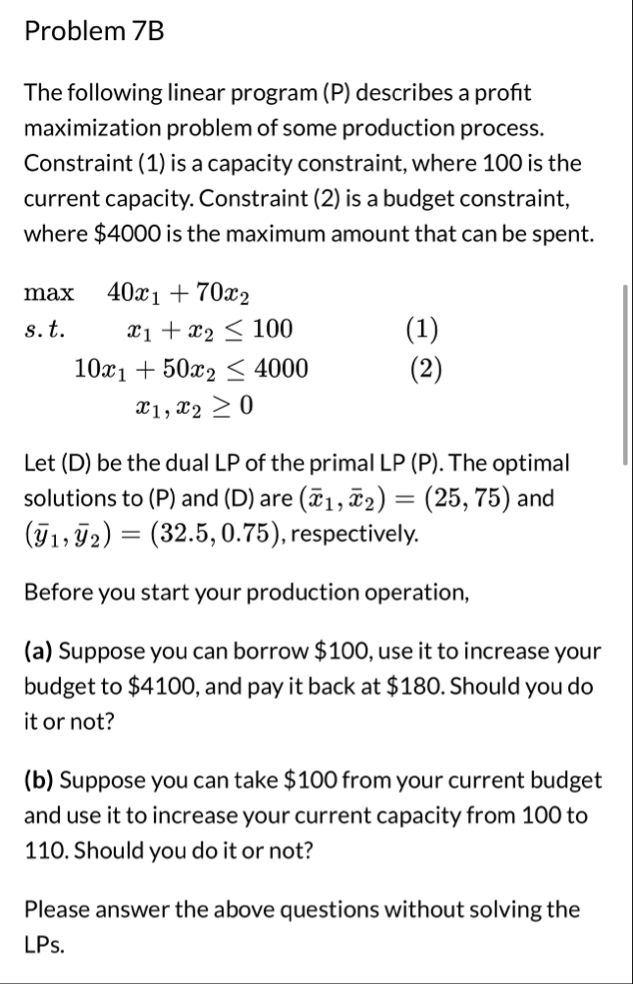
The following linear program (P) describes a profit
maximization problem of some production process.
Constraint (1) is a capacity constraint, where 100 is the
current capacity. Constraint (2) is a budget constraint,
where $4000 is the maximum amount that can be spent.
max 40x, + 70x,
s.t. zy + xp < 100 (1)
102; + 50x, < 4000 (2)
z1,22 > 0
Let (D) be the dual LP of the primal LP (P). The optimal
solutions to (P) and (D) are (Z1, Z2) = (25, 75) and
(91,92) = (32.5,0.75), respectively.
Before you start your production operation,
(a) Suppose you can borrow $100, use it to increase your
budget to $4100, and pay it back at $180. Should you do
it or not?
(b) Suppose you can take $100 from your current budget
and use it to increase your current capacity from 100 to
110. Should you do it or not?
Please answer the above questions without solving the
LPs.
Question:
give full answer with step by step answer and give final summaryProblem 7B
The following linear program (P) describes a profit
maximization problem of some production process.
Constraint (1) is a capacity constraint, where 100 is the
current capacity. Constraint (2) is a budget constraint,
where $4000 is the maximum amount that can be spent.
max 40x, + 70x,
s.t. zy + xp < 100 (1)
102; + 50x, < 4000 (2)
z1,22 > 0
Let (D) be the dual LP of the primal LP (P). The optimal
solutions to (P) and (D) are (Z1, Z2) = (25, 75) and
(91,92) = (32.5,0.75), respectively.
Before you start your production operation,
(a) Suppose you can borrow $100, use it to increase your
budget to $4100, and pay it back at $180. Should you do
it or not?
(b) Suppose you can take $100 from your current budget
and use it to increase your current capacity from 100 to
110. Should you do it or not?
Please answer the above questions without solving the
LPs.
This is AI generated Response.
Asked by: lincy
Created at: 2025-10-26 09:39:15
Final Answer:
RenderedRaw Text
Did you like this answer?
Let's analyze the problem step by step.
---
# **Given Data**
### Objective:
Maximize profit:
\[
\text{Max } Z = 40x_1 + 70x_2
\]
### Constraints:
1. Capacity constraint:
\[
x_1 + x_2 \leq 100
\]
2. Budget constraint:
\[
10x_1 + 50x_2 \leq 400
\]
3. Non-negativity:
\[
x_1, x_2 \geq
\]
### Known optimal solutions:
- Primal optimal solution: \(\mathbf{x} = (25, 75)\)
- Dual variables: \(\mathbf{y} = (32.5, .75)\)
---
# **Part (a): Borrowing to Increase Budget**
### Question:
Should you borrow \$100 to increase your budget to \$410, paying back \$180?
### Step-by-step analysis:
- **Current budget constraint:**
\[
10x_1 + 50x_2 \leq 400
\]
- **Increased budget:**
\[
10x_1 + 50x_2 \leq 410
\]
- **Cost of borrowing:**
Borrow \$100, pay back \$180, net cost:
\[
\$180 - \$100 = \$80
\]
- **Impact on profit:**
- Dual price (shadow price) of the budget constraint is the dual variable \( y_2 = .75 \).
- **This means** for each additional dollar of budget, the profit increases by approximately \$.75, assuming the solution remains feasible.
- **Additional budget:** \$100
- **Increase in profit (\( \Delta Z \)):**
\[
\Delta Z = y_2 \times \text{additional budget} = .75 \times 100 = \$75
\]
- **Net gain after repayment:**
Since the profit increases by \$75, but you pay \$180 in total, the net change is:
\[
\text{Net gain} = \$75 - \$180 = -\$105
\]
### **Conclusion for (a):**
- The net profit decreases by \$105 after accounting for repayment.
- **Thus, you should *not* borrow \$100 to increase the budget** because it results in a net loss.
---
# **Part (b): Using \$100 to Increase Capacity**
### Question:
Should you take \$100 from your current budget to increase capacity from 100 to 110 units?
### Step-by-step analysis:
- **Current capacity constraint:**
\[
x_1 + x_2 \leq 100
\]
- **Proposed new capacity:**
\[
x_1 + x_2 \leq 110
\]
- **Cost of reallocating \$100:**
- You are reducing your budget by \$100, which means you lose the ability to spend \$100 on production.
- **Impact on profit:**
- The dual variable \( y_1 = 32.5 \) (capacity constraint) indicates the marginal profit of increasing capacity by one unit.
- **Additional capacity:** 10 units (from 100 to 110)
- **Potential profit increase:**
\[
\Delta Z = y_1 \times \text{additional units} = 32.5 \times 10 = \$325
\]
- **Cost of reducing budget:**
- Removing \$100 from the budget reduces potential profit by approximately \( y_2 \times 100 \) (though the exact impact depends on the new optimal solution). But since the original dual variable for capacity is high, increasing capacity seems beneficial.
- **Trade-off:**
- You gain an approximate profit increase of \$325.
- You lose \$100 from your budget, which correspondingly reduces your ability to produce, but since the dual price \( y_2 \) is only .75, the profit loss from budget reduction is small.
### **Conclusion for (b):**
- Because the potential profit gain (\$325) exceeds the loss from reducing \$100 of budget, **it is advantageous to reallocate \$100 from current budget to increase capacity**.
---
# **Final Summary**
| Part | Decision | Explanation |
|---------|------------|--------------|
| **(a)** | **No** | Borrowing \$100 to increase budget results in a net loss of \$105 after repayment, so it is not profitable. |
| **(b)** | **Yes** | Reallocating \$100 from current budget to increase capacity yields a significant profit increase (approx. \$325), making it beneficial. |
---
Let me know if you want the detailed calculations or further clarification!
Question:
give 2 sentence summary in each steps
This is AI generated Response.
Asked by: lincy
Created at: 2025-10-26 09:41:38
Final Answer:
RenderedRaw Text
Did you like this answer?
# Summary of Each Step
---
## **Given Data**
The objective is to maximize profit with constraints on capacity and budget. The primal optimal solution is \( (25, 75) \) and dual variables are \( (32.5, 0.75) \).
---
## **Part (a): Borrowing to Increase Budget**
Borrowing \$100 to increase the budget results in a profit increase of \$75 but incurs a repayment cost of \$180. Thus, it leads to a net loss of \$105, making it unprofitable to borrow.
---
## **Part (b): Using \$100 to Increase Capacity**
Reallocating \$100 from the budget to increase capacity yields an estimated profit increase of \$325. Since this gain far exceeds the loss from reducing the budget, it is advisable to make the capacity increase.
---
## **Final Summary**
In part (a), borrowing is not recommended due to a net loss, while in part (b), reallocating funds for capacity increase is beneficial due to a significant profit gain. The analysis indicates a strategic decision-making approach to optimize production profits.
VIPSolutions focuses on clear, step‑by‑step explanations so you can learn quickly. Whether you need an AI‑generated walkthrough or a short hint to get unstuck, each solution is organized for fast reading and easy review later.
Search similar questions, compare approaches, and bookmark the best answers for revision. Our goal is simple: quick, reliable study help that feels natural—not noisy.
 VIPSolutions
 Problem 7B
The following linear program (P) describes a profit
maximization problem of some production process.
Constraint (1) is a capacity constraint, where 100 is the
current capacity. Constraint (2) is a budget constraint,
where $4000 is the maximum amount that can be spent.
max 40x, + 70x,
s.t. zy + xp < 100 (1)
102; + 50x, < 4000 (2)
z1,22 > 0
Let (D) be the dual LP of the primal LP (P). The optimal
solutions to (P) and (D) are (Z1, Z2) = (25, 75) and
(91,92) = (32.5,0.75), respectively.
Before you start your production operation,
(a) Suppose you can borrow $100, use it to increase your
budget to $4100, and pay it back at $180. Should you do
it or not?
(b) Suppose you can take $100 from your current budget
and use it to increase your current capacity from 100 to
110. Should you do it or not?
Please answer the above questions without solving the
LPs.