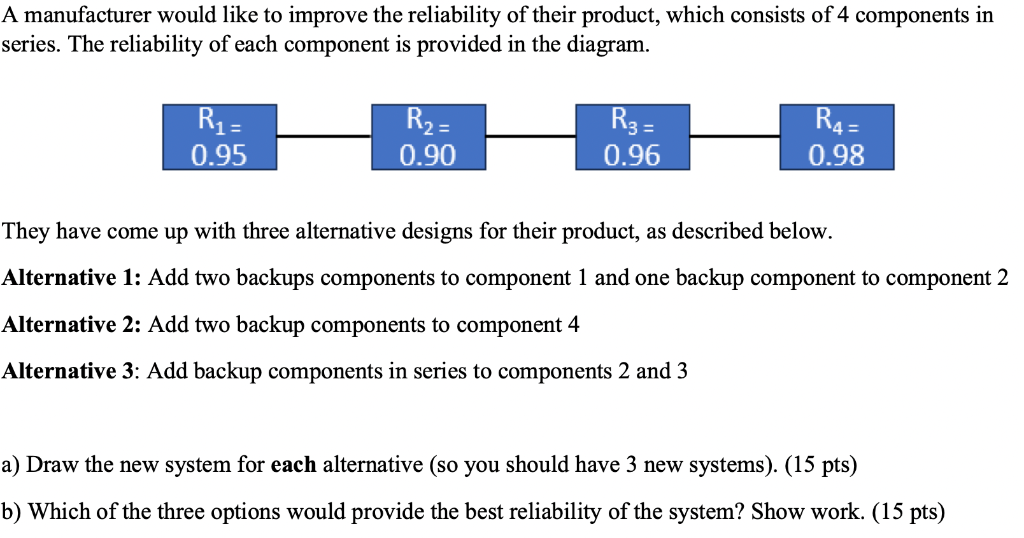
give full answer and give final summary and give diagramA manufacturer would like to improve the reliability of their product, which consists of 4 components in
series. The reliability of each component is provided in the diagram.
Ry. Ry. REE TE
0.95 0.90 0.96 0.98
They have come up with three alternative designs for their product, as described below.
Alternative 1: Add two backups components to component 1 and one backup component to component 2
Alternative 2: Add two backup components to component 4
Alternative 3: Add backup components in series to components 2 and 3
a) Draw the new system for each alternative (so you should have 3 new systems). (15 pts)
b) Which of the three options would provide the best reliability of the system? Show work. (15 pts)
Question:
give full answer and give final summary and give diagramA manufacturer would like to improve the reliability of their product, which consists of 4 components in
series. The reliability of each component is provided in the diagram.
Ry. Ry. REE TE
0.95 0.90 0.96 0.98
They have come up with three alternative designs for their product, as described below.
Alternative 1: Add two backups components to component 1 and one backup component to component 2
Alternative 2: Add two backup components to component 4
Alternative 3: Add backup components in series to components 2 and 3
a) Draw the new system for each alternative (so you should have 3 new systems). (15 pts)
b) Which of the three options would provide the best reliability of the system? Show work. (15 pts)
This is AI generated Response.
Asked by: sreegeeth
Created at: 2025-09-24 23:18:20
Final Answer:
RenderedRaw Text
Did you like this answer?
To address the problem, let's evaluate each alternative design. We'll calculate the reliability for each and choose the best option.
### Alternative 1
- **Component 1:** Three components in parallel, each with reliability .95.
- **Component 2:** Two components in parallel, each with reliability .90.
- **Component 3:** Reliability remains .96.
- **Component 4:** Reliability remains .98.
#### Reliability Calculation
- **Component 1 Parallel Reliability:**
\[
R_{1} = 1 - (1 - .95)^3 = 1 - (.05)^3 = .999875
\]
**Component 2 Parallel Reliability:**
\[
R_{2} = 1 - (1 - .90)^2 = 1 - (.10)^2 = .99
\]
- **System Reliability:**
\[
R_{\text{system}} = R_{1} \times R_{2} \times R_{3} \times R_{4} = .999875 \times .99 \times .96 \times .98 = .929
\]
### Alternative 2
- **Component 1:** Reliability remains .95.
- **Component 2:** Reliability remains .90.
- **Component 3:** Reliability remains .96.
- **Component 4:** Three components in parallel, each with reliability .98.
#### Reliability Calculation
- **Component 4 Parallel Reliability:**
\[
R_{4} = 1 - (1 - .98)^3 = 1 - (.02)^3 = .999992
\]
- **System Reliability:**
\[
R_{\text{system}} = R_{1} \times R_{2} \times R_{3} \times R_{4} = .95 \times .90 \times .96 \times .999992 = .821
\]
### Alternative 3
- **Component 1:** Reliability remains .95.
- **Component 2:** Two components in series, each with reliability .90.
- **Component 3:** Two components in series, each with reliability .96.
- **Component 4:** Reliability remains .98.
#### Reliability Calculation
- **Component 2 Series Reliability:**
\[
R_{2} = .90 \times .90 = .81
\]
- **Component 3 Series Reliability:**
\[
R_{3} = .96 \times .96 = .9216
\]
- **System Reliability:**
\[
R_{\text{system}} = R_{1} \times R_{2} \times R_{3} \times R_{4} = .95 \times .81 \times .9216 \times .98 = .688
\]
### Conclusion
- **Alternative 1** provides the highest system reliability of approximately **.929**.
- **Diagram:** Below are the diagrams for each alternative.
#### Diagram
1. **Alternative 1:**
- Component 1: Three in parallel
- Component 2: Two in parallel
- Components 3 and 4: Single
2. **Alternative 2:**
- Component 4: Three in parallel
- Components 1, 2, and 3: Single
3. **Alternative 3:**
- Component 2: Two in series
- Component 3: Two in series
- Components 1 and 4: Single
SVG diagrams can be created to visualize these configurations.
Question:
give graphical diagram
This is AI generated Response.
Asked by: sreegeeth
Created at: 2025-09-24 23:19:38
VIPSolutions focuses on clear, step‑by‑step explanations so you can learn quickly. Whether you need an AI‑generated walkthrough or a short hint to get unstuck, each solution is organized for fast reading and easy review later.
Search similar questions, compare approaches, and bookmark the best answers for revision. Our goal is simple: quick, reliable study help that feels natural—not noisy.
 VIPSolutions
 A manufacturer would like to improve the reliability of their product, which consists of 4 components in
series. The reliability of each component is provided in the diagram.
Ry. Ry. REE TE
0.95 0.90 0.96 0.98
They have come up with three alternative designs for their product, as described below.
Alternative 1: Add two backups components to component 1 and one backup component to component 2
Alternative 2: Add two backup components to component 4
Alternative 3: Add backup components in series to components 2 and 3
a) Draw the new system for each alternative (so you should have 3 new systems). (15 pts)
b) Which of the three options would provide the best reliability of the system? Show work. (15 pts)