 VIPSolutions
give full answer and give final summaryBudi is an overseas student in Jakarta preparing to go home (Mudik) to his village for Eid (Lebaran). He travels by train and has a strictly limited cabin suitcase capacity of § kg. He has bought 4 types of Souvenirs (Oleh-oleh) for his family. Each souvenir has a specific weight and a "Happiness Value" (a score of how happy his parents will be to receive it). Since the items are pre-packaged, Budi cannot take a portion; he must take the whole item or leave i A |) ETT TT — 2g Erm fin wp [Combe su wm] Determine the best combination of souvenirs to pack into the § kg suitcase to maximize Total Happiness Value. (using Dynamic Programming Knapsack Method)
Question:
give full answer and give final summary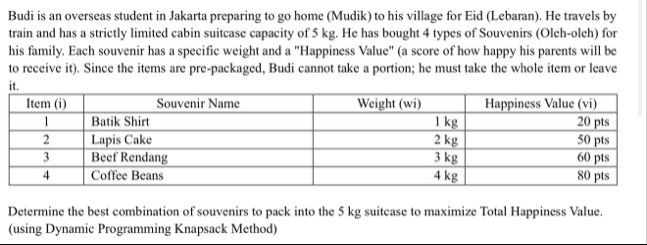 Budi is an overseas student in Jakarta preparing to go home (Mudik) to his village for Eid (Lebaran). He travels by
train and has a strictly limited cabin suitcase capacity of § kg. He has bought 4 types of Souvenirs (Oleh-oleh) for
his family. Each souvenir has a specific weight and a "Happiness Value" (a score of how happy his parents will be
to receive it). Since the items are pre-packaged, Budi cannot take a portion; he must take the whole item or leave
i
A |) ETT
TT — 2g Erm
fin wp
[Combe su wm]
Determine the best combination of souvenirs to pack into the § kg suitcase to maximize Total Happiness Value.
(using Dynamic Programming Knapsack Method)
This is AI generated Response.
Asked by: praseetha
Created at: 2025-12-05 22:43:25
Asked by: praseetha
Created at: 2025-12-05 22:43:25
Final Answer:
Rendered
Raw Text
Did you like this answer?
# Knapsack Problem (Dynamic Programming) Solution
Let's define:
- **n = 4** (number of items)
- **W = 5 kg** (maximum capacity of suitcase)
- **Items:**
1. Batik Shirt: Weight = 1 kg, Value = 20 pts
2. Lapis Cake: Weight = 2 kg, Value = 50 pts
3. Beef Rendang: Weight = 3 kg, Value = 60 pts
4. Coffee Beans: Weight = 4 kg, Value = 80 pts
## Step 1: Table Setup
Let `DP[i][w]` be the maximum happiness value for the first `i` items and suitcase capacity `w`.
Initialize a `(n+1) x (W+1)` table with all zeros.
## Step 2: Fill the DP Table
The recurrence relation:
If item i is not taken: `DP[i][w] = DP[i-1][w]`
If item i is taken: `DP[i][w] = max(DP[i-1][w], DP[i-1][w-wi] + vi)` if `w >= wi`
Let's fill the table step by step.
### DP Table Construction
| i (items) | kg | 1kg | 2kg | 3kg | 4kg | 5kg |
|-----------|------|-----|-----|-----|-----|-----|
| | | | | | | |
| 1 | | 20 | 20 | 20 | 20 | 20 |
| 2 | | 20 | 50 | 70 | 70 | 70 |
| 3 | | 20 | 50 | 70 | 80 | 110 |
| 4 | | 20 | 50 | 70 | 80 | 110 |
#### Filling Steps
- **Item 1 (Batik Shirt, 1kg, 20pts):**
For w >= 1, DP[1][w] = 20
- **Item 2 (Lapis Cake, 2kg,50pts):**
For w >= 2, consider taking Lapis Cake:
- w = 2: max(20, + 50) = 50
- w = 3: max(20, 20 + 50) = 70
- w = 4: max(20, 20 + 50) = 70
- w = 5: max(20, 20 + 50) = 70
- **Item 3 (Beef Rendang, 3kg, 60pts):**
For w >= 3, consider taking Beef Rendang:
- w = 3: max(70, + 60) = 70
- w = 4: max(70, 20 + 60) = 80
- w = 5: max(70, 50 + 60) = 110
- **Item 4 (Coffee Beans, 4kg, 80pts):**
For w >= 4, consider taking Coffee Beans:
- w = 4: max(80, + 80) = 80
- w = 5: max(110, 20 + 80) = 110
## Step 3: Traceback for Selected Items
Start from DP[4][5]=110:
- Did we use item 4? DP[4][5] = DP[3][5] → **No** (since 110 = 110)
- Did we use item 3? DP[3][5] ≠ DP[2][5] → **Yes** (110 ≠ 70)
- Subtract beef rendang's weight: 5 - 3 = 2
- DP[2][2] = 50;
- Did we use item 2? DP[2][2] ≠ DP[1][2] → **Yes** (50 ≠ 20)
- Subtract lapis cake's weight: 2 - 2 =
- DP[1][] =
So **selected items are:**
- Beef Rendang (3kg, 60pts)
- Lapis Cake (2kg, 50pts)
**Total Weight:** 3 + 2 = 5 kg
**Total Happiness Value:** 60 + 50 = **110 pts**
---
## Final Summary
**Best combination of souvenirs Budi should pack to maximize happiness while keeping within 5 kg:**
- **Lapis Cake** (2 kg, 50 pts)
- **Beef Rendang** (3 kg, 60 pts)
**Maximum Total Happiness Value:** **110 points**
**Total Weight:** **5 kg**
**Approach Used:** Dynamic Programming Knapsack Method.
Question:
give 2 sentence summary in each steps
This is AI generated Response.
Asked by: praseetha
Created at: 2025-12-05 22:45:00
Asked by: praseetha
Created at: 2025-12-05 22:45:00
Final Answer:
Rendered
Raw Text
Did you like this answer?
# Knapsack Problem (Dynamic Programming) Solution Summary
## Step 1: Table Setup
We define a DP table `DP[i][w]` to hold the maximum happiness value for the first `i` items with a suitcase capacity `w`. This table is initialized with zeros for all possible item and weight combinations.
## Step 2: Fill the DP Table
Using a recurrence relation, we fill in the DP table by considering whether to include each item based on its weight and value. This step involves iterating through each item and updating the table based on previously computed values.
## Step 3: Traceback for Selected Items
Starting from the maximum value found in the DP table, we trace back to determine which items were included in the optimal solution. This involves checking whether the value at each cell corresponds to including or excluding an item.
## Final Summary
The best combination of souvenirs for Budi to maximize happiness while adhering to the 5 kg limit consists of the Lapis Cake (2 kg, 50 pts) and Beef Rendang (3 kg, 60 pts). This selection yields a maximum happiness value of 110 points with a total weight of 5 kg.
📢 Instructions:
- Ask anything relatd to above question only.
- For new Question goto :