Give detailed for all subpartsSCS BC HM ww www El TEER Nw MOE x Beeel iel eieieielel
© 5 CG OF CyUsers/andre/Downloads/ME1528%20-%20Homework%201 pdf ax OIRO:
= MEI528 - Homework 1.pdf 1 - 5m + BDO |W +L 8
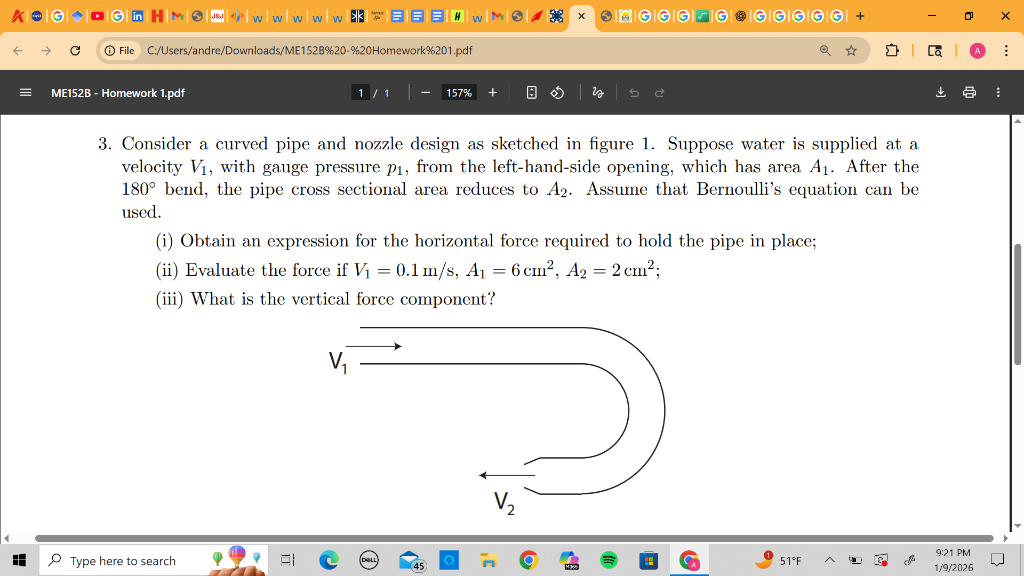
3. Consider a curved pipe and nozzle design as sketched in figure 1. Suppose water is supplied at a
velocity Vi, with gauge pressure py, from the left-hand-side opening, which has area Aj. After the
180° bend, the pipe cross sectional area reduces to Ap. Assume that Bernoulli's equation can be
used.
(i) Obtain an expression for the horizontal force required to hold the pipe in place;
(ii) Evaluate the force if Vi = 0.1m/s, Ay = 6cm?, Ap = 2cm?;
(iif) What is the vertical force component?
—
Vi
—
Vv,
e—————————————————————————————————————————————————————————)
BO Type here to search [3X 1 @® iE ~ ©6208 ® Isr Aw Es TMD
Question:
Give detailed for all subparts
This is AI generated Response. Asked by: manish kumar Created at: 2026-01-13 11:16:31
Did you like this answer?
👍 0
👎 0
# Solution to Curved Pipe & Nozzle Problem
Let's solve each subpart step-by-step.
---
## **Given Data**
- **Inlet velocity:** \( V_1 \)
- **Inlet area:** \( A_1 \)
- **Outlet velocity:** \( V_2 \)
- **Outlet area:** \( A_2 \)
- **Inlet pressure:** \( p_1 \)
- **The pipe is bent 180°.**
- **Bernoulli’s equation applies.**
---
## **(i) Expression for the Horizontal Force Required to Hold the Pipe in Place**
### **Step 1: Apply the Conservation of Mass (Continuity)**
\[
\rho A_1 V_1 = \rho A_2 V_2 \implies V_2 = \frac{A_1}{A_2} V_1
\]
---
### **Step 2: Apply the Linear Momentum Equation**
For a control volume around the pipe:
\[
\vec{F}_{\text{ext}} + \int p \vec{n}\, dA = \int \rho \vec{V} (\vec{V} \cdot \vec{n})\, dA
\]
- **Horizontal direction:** Take right as positive.
#### **Control Surfaces:**
- **Inlet:** Left to right (\(+x\))
- **Outlet:** Right to left (\(-x\)), because of the 180° bend
#### **Force Components:**
Let \( F_x \) be the required horizontal force (positive to the right).
#### **Pressure Forces:**
- Inlet: \( p_1 A_1 \) (to the right)
- Outlet: Atmospheric pressure, can be set to gauge (open to atmosphere)
#### **Momentum Flux:**
- Inlet: \( \rho Q V_1 \) (to the right)
- Outlet: \( \rho Q V_2 \) (to the left; negative in \( +x \))
#### **Total Horizontal Force:**
\[
F_x + p_1 A_1 = \rho Q V_1 - \rho Q V_2
\]
where \( Q = V_1 A_1 = V_2 A_2 \).
\[
F_x = \rho Q (V_1 - V_2) - p_1 A_1
\]
\[
\boxed{
F_x = \rho V_1 A_1 (V_1 - V_2) - p_1 A_1
}
\]
With \( V_2 = \frac{A_1}{A_2} V_1 \):
\[
F_x = \rho V_1 A_1 \left[V_1 - \left(\frac{A_1}{A_2} V_1\right)\right] - p_1 A_1
\]
\[
F_x = \rho V_1^2 A_1 \left(1 - \frac{A_1}{A_2}\right) - p_1 A_1
\]
---
## **(ii) Evaluate the Force for Given Values**
Given:
- \( V_1 = .1\ \text{m/s} \)
- \( A_1 = 6\ \text{cm}^2 = 6 \times 10^{-4}\ \text{m}^2 \)
- \( A_2 = 2\ \text{cm}^2 = 2 \times 10^{-4}\ \text{m}^2 \)
- \( p_1 = \) (gauge, assume open to atm)
- \( \rho_{\text{water}} = 100\ \text{kg/m}^3 \)
Calculate \( V_2 \):
\[
V_2 = \frac{A_1}{A_2} V_1 = \frac{6 \times 10^{-4}}{2 \times 10^{-4}} \times .1 = 3 \times .1 = .3\,\text{m/s}
\]
Now plug in:
\[
F_x = 100 \times .1^2 \times 6 \times 10^{-4} \left[1 - \frac{6 \times 10^{-4}}{2 \times 10^{-4}}\right]
\]
\[
= 100 \times .01 \times 6 \times 10^{-4} \left[1 - 3\right]
\]
\[
= 10 \times 6 \times 10^{-4} \times (-2)
\]
\[
= 6 \times 10^{-3} \times (-2)
\]
\[
= -12 \times 10^{-3} = -.012\ \text{N}
\]
**The negative sign means the force is to the left.**
\[
\boxed{F_x = -.012\ \text{N}}
\]
---
## **(iii) Vertical Force Component**
### **Analysis:**
- The fluid enters and exits horizontally.
- **There is no vertical momentum change** (assuming pipe is horizontal and neglecting gravity).
\[
F_y =
\]
\[
\boxed{F_y = }
\]
---
## **Summary Table**
| Part | Expression / Value |
|------|---------------------------------------------|
| (i) | \( F_x = \rho V_1^2 A_1 \left(1 - \frac{A_1}{A_2}\right) - p_1 A_1 \) |
| (ii) | \( F_x = -.012\ \text{N} \) |
| (iii)| \( F_y = \) |
Let me know if you need any clarifications or derivation details!
📢 Instructions:
Ask anything relatd to above question only.
For new Question goto :
🚀 Submit (-0.25 Credits🪙)
Study Help, Fast Answers
VIPSolutions focuses on clear, step‑by‑step explanations so you can learn quickly. Whether you need an AI‑generated walkthrough or a short hint to get unstuck, each solution is organized for fast reading and easy review later.
Search similar questions, compare approaches, and bookmark the best answers for revision. Our goal is simple: quick, reliable study help that feels natural—not noisy.
 VIPSolutions
 SCS BC HM ww www El TEER Nw MOE x Beeel iel eieieielel
© 5 CG OF CyUsers/andre/Downloads/ME1528%20-%20Homework%201 pdf ax OIRO:
= MEI528 - Homework 1.pdf 1 - 5m + BDO |W +L 8
3. Consider a curved pipe and nozzle design as sketched in figure 1. Suppose water is supplied at a
velocity Vi, with gauge pressure py, from the left-hand-side opening, which has area Aj. After the
180° bend, the pipe cross sectional area reduces to Ap. Assume that Bernoulli's equation can be
used.
(i) Obtain an expression for the horizontal force required to hold the pipe in place;
(ii) Evaluate the force if Vi = 0.1m/s, Ay = 6cm?, Ap = 2cm?;
(iif) What is the vertical force component?
—
Vi
—
Vv,
e—————————————————————————————————————————————————————————)
BO Type here to search [3X 1 @® iE ~ ©6208 ® Isr Aw Es TMD