This is AI generated Response.
Asked by: manish kumar
Created at: 2026-01-10 14:22:17
Final Answer:
RenderedRaw Text
Did you like this answer?
# Detailed Solution in English
## **Problem Statement**
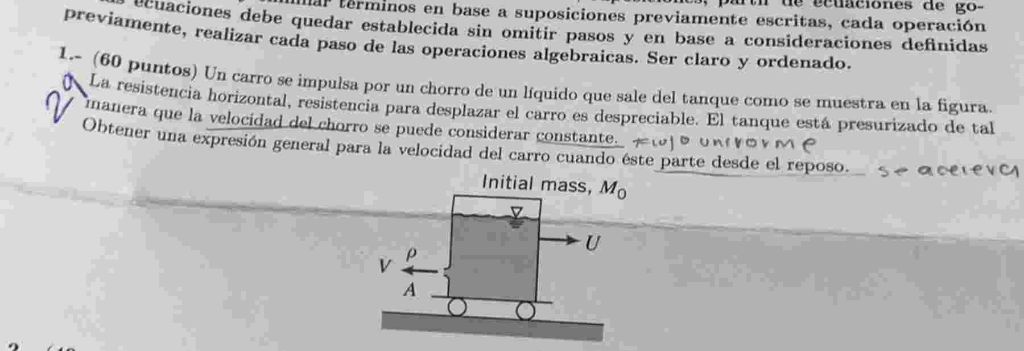
A cart is propelled by a jet of liquid coming out of a tank as shown in the figure. The horizontal resistance (friction) is negligible. The tank is pressurized so that the **jet velocity** is **constant**. Obtain a general expression for the velocity of the cart when it starts from rest.
---
## **Given Data and Variables**
- **Initial mass of the cart + tank + liquid:** \( M_ \)
- **Jet velocity (relative to the cart):** \( V \) (constant)
- **Liquid density:** \( \rho \)
- **Area of jet orifice:** \( A \)
- **Velocity of the cart (to be found):** \( U \)
- **Initial velocity of the cart:** \( \) (starts from rest)
- **No friction**
---
## **Approach**
This is a **variable mass system** (rocket-like problem). We'll use the **conservation of momentum**.
---
### **Step 1: Mass Flow Rate**
The **mass flow rate** of the liquid exiting:
\[
\dot{m} = \rho A V
\]
where:
- \( \rho \) = density of liquid,
- \( A \) = area of nozzle,
- \( V \) = jet velocity (relative to cart).
---
### **Step 2: Conservation of Momentum**
Let:
- \( M \) = mass of cart + remaining liquid at any instant,
- \( U \) = velocity of cart at that instant.
At a small time \( dt \):
- Mass loss: \( dM = -\dot{m} dt \)
- The ejected mass in time \( dt \) is \( dm = -dM \)
- The ejected mass leaves at velocity \( V \) **relative to the cart**.
#### **Total momentum before:**
\[
(M)U
\]
#### **Total momentum after:**
- Cart + tank: \( (M + dM)(U + dU) \)
- Ejected mass: \( dm \) at velocity \( U - V \) (absolute velocity is \( U - V \), since jet leaves backward).
So:
\[
\text{Total after} = (M + dM)(U + dU) + dm \cdot (U - V)
\]
---
### **Step 3: Apply Conservation of Momentum**
\[
(M)U = (M + dM)(U + dU) + dm (U - V)
\]
Neglecting second order terms and substituting \( dM = -dm \):
\[
MU = MU + MdU + UdM + dM dU + dm (U - V)
\]
Since \( dM dU \) is second order, neglect it:
\[
= M dU + U dM + dm (U - V)
\]
But \( dM = -dm \):
\[
= M dU + U dM + dM (U - V)
\]
\[
= M dU + U dM + dM U - dM V
\]
\[
= M dU + 2U dM - V dM
\]
But, since the cart's mass is decreasing (liquid is expelled), and the **ejected mass has already left, so only consider \( dU \) and \( dM \) terms**:
Better to use the standard rocket equation form:
\[
M \frac{dU}{dt} = V \frac{dM}{dt}
\]
But since the liquid is expelled **backwards** (relative velocity \( -V \)), the sign is negative:
\[
M \frac{dU}{dt} = -V \frac{dM}{dt}
\]
---
### **Step 4: Separate and Integrate**
\[
M \frac{dU}{dt} = -V \frac{dM}{dt}
\]
\[
M dU = -V dM
\]
\[
dU = -V \frac{dM}{M}
\]
Integrate both sides from \( U = \) (initial) to \( U \) (final), and from \( M = M_ \) (initial mass) to \( M \) (mass at time t):
\[
\int_{}^{U} dU = -V \int_{M_}^{M} \frac{dM}{M}
\]
\[
U = -V [\ln(M) - \ln(M_)]
\]
\[
U = -V \ln\left(\frac{M}{M_}\right)
\]
\[
U = V \ln\left(\frac{M_}{M}\right)
\]
---
## **Final General Expression**
\[
\boxed{
U = V \ln\left(\frac{M_}{M}\right)
}
\]
where:
- \( U \) = velocity of the cart at mass \( M \),
- \( V \) = jet velocity (relative to cart),
- \( M_ \) = initial mass (cart + tank + liquid),
- \( M \) = current mass (cart + tank + remaining liquid).
---
### **Notes**
- The answer is analogous to the rocket equation (Tsiolkovsky rocket equation).
- Assumes **constant jet velocity** and **no friction**.
- If you want the velocity when all liquid is expelled, set \( M = \) final mass (cart + empty tank).
---
## **Summary Table**
| Symbol | Meaning |
|--------|-------------------------------------|
| \( U \) | Velocity of cart (solution) |
| \( V \) | Jet velocity (relative to cart) |
| \( M_ \) | Initial total mass (cart + tank + fluid) |
| \( M \) | Mass at time \( t \) (cart + tank + remaining fluid) |
| \( \rho \) | Density of liquid |
| \( A \) | Area of nozzle |
---
**If you need the velocity as a function of time, you can relate \( M \) to time using:**
\[
M = M_ - \dot{m} t = M_ - \rho A V t
\]
Then:
\[
U(t) = V \ln \left( \frac{M_}{M_ - \rho A V t} \right)
\]
Let me know if you need this time-dependent version or further details!
VIPSolutions focuses on clear, step‑by‑step explanations so you can learn quickly. Whether you need an AI‑generated walkthrough or a short hint to get unstuck, each solution is organized for fast reading and easy review later.
Search similar questions, compare approaches, and bookmark the best answers for revision. Our goal is simple: quick, reliable study help that feels natural—not noisy.
 VIPSolutions
 SESE NRE © marbedie cf Ho
Ee dR - (M4 J TL debe quedar -, 08 e1 base a suposiciones previamente escritas, cada operacion
Previamenge, 21° debe quedar Suablecida sin omitir pasos y en base a consideraciones Aefiuices
ente, realizqp ada paso de las operaciones algebraicas. Ser claro y ordenado.
1. :
Jo, Puntos) Un carro ge jumpy ign por un chorro de un liquido que sale del tanque como se muestra en la figura,
ONL resistonciy horizontal, resistencin para desplagar of carro es despreciable. El tanque est presurizado de val
[14 inatiery Aue la velocidad del charro so puede considerar constante, Fw) untvoym
Pbtetier una exprosion goers] para In velocidad del carro cuando ste parte desde ef reposo, se acereves
Initial mass, My
i —————— Mga ;
1%
Pp
Ve
A
a