 VIPSolutions
Give detail step-by-step solution with explanation and final answer:8. A highly sophisticated photo-chemical reaction sequence is continuously initiated by a monochromatic ultraviolet ight source irradiating an annular homogeneous fluid domain. The quantum yield of the primary photochemical initiation step is strictly dependent upon the localized radial photon absorption rate, which continuously decays exponentially traversing radially outward through the absorbing fluid medium according to the established fundamental principles of the recognized exponential decay attenuation law. Formulate the rigorous integral mathematical expression required to accurately determine the volume-averaged apparent kinetic rate constant across the entire two-dimensional annular cross-section, establishing the final rigorous equation purely in terms of the fundamental material extinction coefficient, the incident central radiant intensity, and the strictly defined geometric radial boundaries, culminating in (k) = fz Ji ® 1 cr R) pdr 9. Anindustrial-scale fluidized bed reactor facilitates a highly exothermic, solid-catalyzed gas-phase oxidation sequence. The continuous vigorous fluidization of the solid particulate catalyst ensures exceptional thermal homogeneity throughout the expansive active reaction zone. The engineering design team must accurately evaluate the profound impact of differing catalyst particle diameter distributions on the overarching intraparticle mass transfer limitations and the consequent apparent localized kinetic performance. Case I: The catalytic bed operates utilizing a completely homogeneous distribution of ultra-fine microscopic catalyst particles. Calculate the apparent observed initial reaction rate assuming the system is completely devoid of any internal pore diffusion resistance, utilizing the established parametric value of exactly Kypparens = 8.5 1/5. Case Il: The catalytic bed operates utilizing a designated distribution of macro-scale highly porous catalyst pellets. Calculate the substantially reduced apparent observed reaction rate, meticulously incorporating the internal structural effectiveness factor derived from the provided physical characteristics, culminating in a required evaluation utilizing exactly D, = 1.2 x 10-° m/s and Rpter = 0.005 m.
Question:
Give detail step-by-step solution with explanation and final answer: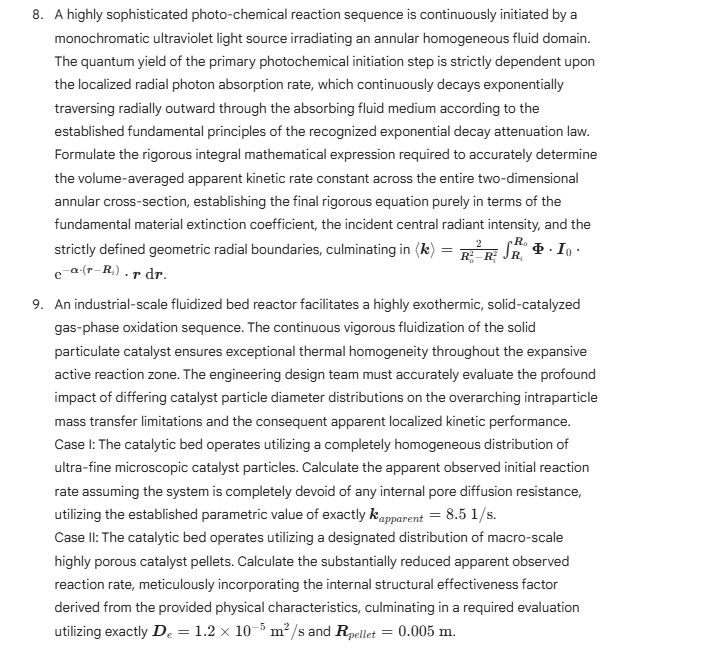 8. A highly sophisticated photo-chemical reaction sequence is continuously initiated by a
monochromatic ultraviolet ight source irradiating an annular homogeneous fluid domain.
The quantum yield of the primary photochemical initiation step is strictly dependent upon
the localized radial photon absorption rate, which continuously decays exponentially
traversing radially outward through the absorbing fluid medium according to the
established fundamental principles of the recognized exponential decay attenuation law.
Formulate the rigorous integral mathematical expression required to accurately determine
the volume-averaged apparent kinetic rate constant across the entire two-dimensional
annular cross-section, establishing the final rigorous equation purely in terms of the
fundamental material extinction coefficient, the incident central radiant intensity, and the
strictly defined geometric radial boundaries, culminating in (k) = fz Ji ® 1
cr R) pdr
9. Anindustrial-scale fluidized bed reactor facilitates a highly exothermic, solid-catalyzed
gas-phase oxidation sequence. The continuous vigorous fluidization of the solid
particulate catalyst ensures exceptional thermal homogeneity throughout the expansive
active reaction zone. The engineering design team must accurately evaluate the profound
impact of differing catalyst particle diameter distributions on the overarching intraparticle
mass transfer limitations and the consequent apparent localized kinetic performance.
Case I: The catalytic bed operates utilizing a completely homogeneous distribution of
ultra-fine microscopic catalyst particles. Calculate the apparent observed initial reaction
rate assuming the system is completely devoid of any internal pore diffusion resistance,
utilizing the established parametric value of exactly Kypparens = 8.5 1/5.
Case Il: The catalytic bed operates utilizing a designated distribution of macro-scale
highly porous catalyst pellets. Calculate the substantially reduced apparent observed
reaction rate, meticulously incorporating the internal structural effectiveness factor
derived from the provided physical characteristics, culminating in a required evaluation
utilizing exactly D, = 1.2 x 10-° m/s and Rpter = 0.005 m.
Asked by: Francis
Created at: 2026-03-05 09:05:46
Final Answer:
📢 Instructions:
- Ask anything relatd to above question only.
- For new Question goto :