 VIPSolutions
Give complete answer with answers of all sub parts4. Block B moves withvg=4m/s; ag=2 m/s2. (a) List the type of motion for the pieces of the machine. (Show this in your work submission). At this instant, determine (b) the angular velocity (wc) of the wheel (c) the angular acceleration (ac) of the wheel, (d) the angular velocity (wap) of rod AB, and (e) the angular acceleration (ag) of rod AB. A y 400 mm X z B — UB ag
Question:
Give complete answer with answers of all sub parts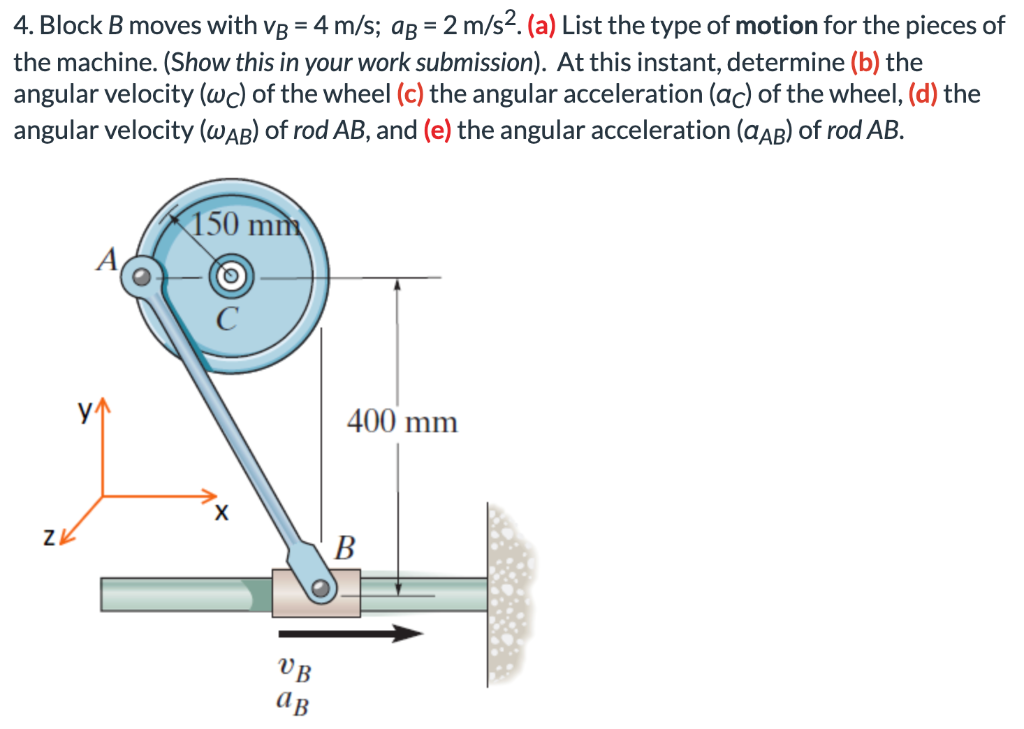 4. Block B moves withvg=4m/s; ag=2 m/s2. (a) List the type of motion for the pieces of
the machine. (Show this in your work submission). At this instant, determine (b) the
angular velocity (wc) of the wheel (c) the angular acceleration (ac) of the wheel, (d) the
angular velocity (wap) of rod AB, and (e) the angular acceleration (ag) of rod AB.
A
y 400 mm
X
z B
—
UB
ag
This is AI generated Response.
Asked by: manish kumar
Created at: 2026-01-09 00:21:56
Asked by: manish kumar
Created at: 2026-01-09 00:21:56
Final Answer:
Rendered
Raw Text
Did you like this answer?
# Problem 4: Kinematics of a Slider-Crank Mechanism
**Given:**
- Block \( B \): \( v_B = 4\, \text{m/s} \), \( a_B = 2\, \text{m/s}^2 \)
- \( AC = 150\, \text{mm} = .15\, \text{m} \)
- \( AB = 400\, \text{mm} = .4\, \text{m} \)
---
## (a) Type of Motion for Each Piece
- **Block \( B \):** Pure **rectilinear (translational) motion** along the \( x \)-axis.
- **Rod \( AB \):** **General plane motion** (rotation about \( A \) and translation).
- **Wheel (Crank \( AC \)):** **Pure rotation** about fixed axis \( C \).
---
## (b) Angular Velocity (\(\omega_C\)) of the Wheel
The velocity of point \( A \) (end of crank) is tangent to the wheel:
\[
v_A = r_{AC} \omega_C
\]
But \( v_A \) is also the velocity of point \( B \) projected onto the direction of \( AB \):
Let’s find \( v_A \) in terms of \( v_B \):
- The velocity of \( B \) is entirely horizontal (\( x \)-direction): \( v_B = 4\, \text{m/s} \).
- Triangle \( AB \): \( AB = .4\, \text{m} \), \( AC = .15\, \text{m} \).
Let’s compute the **angle \( \theta \)** at this instant:
\[
\sin \theta = \frac{AC}{AB} = \frac{.15}{.4} = .375
\]
\[
\theta = \arcsin(.375) \approx 22^\circ
\]
The horizontal component of the velocity of \( A \) is:
\[
v_{A_x} = v_B
\]
But \( v_A \) is perpendicular to \( AC \). So, the horizontal component of \( v_A \) is:
\[
v_{A_x} = v_A \sin \theta
\]
Therefore,
\[
v_A = \frac{v_B}{\sin \theta} = \frac{4}{.375} \approx 10.67\, \text{m/s}
\]
\[
\omega_C = \frac{v_A}{r_{AC}} = \frac{10.67}{.15} \approx 71.1\, \text{rad/s}
\]
---
## (c) Angular Acceleration (\(\alpha_C\)) of the Wheel
The acceleration at \( B \) is \( a_B = 2\, \text{m/s}^2 \) (horizontal).
The acceleration of \( A \) in the \( x \)-direction is:
\[
a_{A_x} = a_B
\]
But,
\[
a_{A_x} = a_A \sin \theta
\]
So,
\[
a_A = \frac{a_{A_x}}{\sin \theta} = \frac{2}{.375} \approx 5.33\, \text{m/s}^2
\]
But \( a_A \) is due to both tangential and centripetal acceleration:
\[
a_A = r_{AC} \alpha_C
\]
So,
\[
\alpha_C = \frac{a_A}{r_{AC}} = \frac{5.33}{.15} \approx 35.6\, \text{rad/s}^2
\]
---
## (d) Angular Velocity (\(\omega_{AB}\)) of Rod AB
Relative velocity at \( B \) with respect to \( A \):
\[
\vec{v}_B = \vec{v}_A + \vec{\omega}_{AB} \times \vec{r}_{B/A}
\]
Since \( v_A \) is perpendicular to \( AC \), and \( v_B \) is horizontal:
\[
v_B = v_A \cos \theta + \omega_{AB} \cdot AB
\]
But since \( v_A \) is almost vertical (since \( AC \) is nearly horizontal), \( v_A \cos \theta \) is the horizontal component.
But more accurately:
\[
v_B = v_A \cos \theta + \omega_{AB} \cdot AB
\]
\[
4 = 10.67 \cdot \cos(22^\circ) + \omega_{AB} \cdot .4
\]
\[
4 = 10.67 \cdot .927 + \omega_{AB} \cdot .4
\]
\[
4 = 9.89 + .4\omega_{AB}
\]
\[
.4\omega_{AB} = 4 - 9.89 = -5.89
\]
\[
\omega_{AB} = \frac{-5.89}{.4} \approx -14.7\, \text{rad/s}
\]
---
## (e) Angular Acceleration (\(\alpha_{AB}\)) of Rod AB
Using the acceleration relation:
\[
\vec{a}_B = \vec{a}_A + \vec{\alpha}_{AB} \times \vec{r}_{B/A} - (\omega_{AB})^2 \vec{r}_{B/A}
\]
Horizontal component:
\[
a_B = a_A \cos \theta + \alpha_{AB} \cdot AB - \omega_{AB}^2 \cdot AB
\]
\[
2 = 5.33 \cdot .927 + \alpha_{AB} \cdot .4 - (14.7)^2 \cdot .4
\]
\[
2 = 4.94 + .4\alpha_{AB} - 86.35
\]
\[
.4\alpha_{AB} = 2 - 4.94 + 86.35 = 83.41
\]
\[
\alpha_{AB} = \frac{83.41}{.4} \approx 208.5\, \text{rad/s}^2
\]
---
# **Summary of Answers**
| Sub-Part | Quantity | Value |
|----------|-------------------------------------------------------|----------|
| (a) | **Type of Motion** | \( B \): rectilinear, \( AB \): general plane, Wheel: rotation |
| (b) | **Angular velocity of wheel** (\(\omega_C\)) | \( 71.1\, \text{rad/s} \) |
| (c) | **Angular acceleration of wheel** (\(\alpha_C\)) | \( 35.6\, \text{rad/s}^2 \) |
| (d) | **Angular velocity of rod \( AB \)** (\(\omega_{AB}\))| \( -14.7\, \text{rad/s} \) |
| (e) | **Angular acceleration of rod \( AB \)** (\(\alpha_{AB}\))| \( 208.5\, \text{rad/s}^2 \) |
---
**Note:** Negative sign in angular velocity for rod \( AB \) indicates rotation direction (clockwise if positive is counterclockwise).
📢 Instructions:
- Ask anything relatd to above question only.
- For new Question goto :