VIPSolutions logo ✨ VIPSolutions

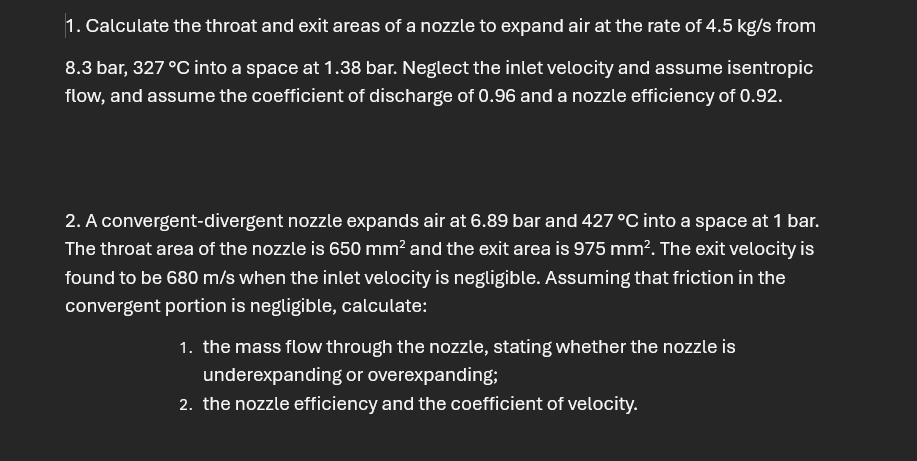
Give complete answer of question 21. Calculate the throat and exit areas of a nozzle to expand air at the rate of 4.5 kg/s from 8.3 bar, 327 °C into a space at 1.38 bar. Neglect the inlet velocity and assume isentropic flow, and assume the coefficient of discharge of 0.96 and a nozzle efficiency of 0.92. 2. A convergent-divergent nozzle expands air at 6.89 bar and 427 °C into a space at 1 bar. The throat area of the nozzle is 650 mm? and the exit area is 975 mm? The exit velocity is found to be 680 m/s when the inlet velocity is negligible. Assuming that friction in the convergent portion is negligible, calculate: 1. the mass flow through the nozzle, stating whether the nozzle is underexpanding or overexpanding; 2. the nozzle efficiency and the coefficient of velocity.

Question:

Give complete answer of question 2Uploaded Image1. Calculate the throat and exit areas of a nozzle to expand air at the rate of 4.5 kg/s from 8.3 bar, 327 °C into a space at 1.38 bar. Neglect the inlet velocity and assume isentropic flow, and assume the coefficient of discharge of 0.96 and a nozzle efficiency of 0.92. 2. A convergent-divergent nozzle expands air at 6.89 bar and 427 °C into a space at 1 bar. The throat area of the nozzle is 650 mm? and the exit area is 975 mm? The exit velocity is found to be 680 m/s when the inlet velocity is negligible. Assuming that friction in the convergent portion is negligible, calculate: 1. the mass flow through the nozzle, stating whether the nozzle is underexpanding or overexpanding; 2. the nozzle efficiency and the coefficient of velocity.

This is AI generated Response.
Asked by: manish kumar
Created at: 2026-01-09 08:37:42

Final Answer:

Rendered Raw Text
Did you like this answer?
# Solution to Question 2 Given: - **Inlet pressure, \( P_ \) = 6.89 bar = 689,000 Pa** - **Inlet temperature, \( T_ \) = 427°C = 700 K** - **Exit pressure, \( P_e \) = 1 bar = 100,000 Pa** - **Throat area, \( A_t \) = 650~\text{mm}^2 = 6.5 \times 10^{-4}~\text{m}^2** - **Exit area, \( A_e \) = 975~\text{mm}^2 = 9.75 \times 10^{-4}~\text{m}^2** - **Exit velocity, \( V_e \) = 680 m/s** - **Inlet velocity is negligible** - **Assume air as perfect gas: \( \gamma = 1.4,~ R = 287~\text{J/kg·K} \)** --- ## 1. **Mass Flow Through the Nozzle** (and under/overexpanding) ### **Step 1: Throat Conditions (Isentropic)** At the throat (sonic conditions, \( M_t = 1 \)): \[ \frac{P_t}{P_} = \left( 1 + \frac{\gamma-1}{2} \right)^{-\gamma/(\gamma-1)} \] \[ \frac{P_t}{P_} = (1.2)^{-3.5} \approx .528 \] \[ P_t = .528 \times 689,000 \approx 363,792~\text{Pa} \] \[ \frac{T_t}{T_} = \left( 1 + \frac{\gamma-1}{2} \right)^{-1} \] \[ \frac{T_t}{T_} = 1.2^{-1} = .833 \] \[ T_t = .833 \times 700 = 583~\text{K} \] ### **Step 2: Density at Throat, \( \rho_t \)** \[ \rho_t = \frac{P_t}{R T_t} = \frac{363,792}{287 \times 583} \approx 2.19~\text{kg/m}^3 \] ### **Step 3: Sonic Velocity at Throat, \( V_t \)** \[ V_t = \sqrt{\gamma R T_t} = \sqrt{1.4 \times 287 \times 583} \approx 487~\text{m/s} \] ### **Step 4: Mass Flow at Throat** \[ \dot{m} = \rho_t A_t V_t = 2.19 \times 6.5 \times 10^{-4} \times 487 \approx .694~\text{kg/s} \] --- ### **Is the Nozzle Underexpanding or Overexpanding?** - **Design exit pressure (isentropic expansion):** \[ \frac{P_e^\text{(ideal)}}{P_} = \left[1 + \frac{\gamma-1}{2} M_e^2 \right]^{-\gamma/(\gamma-1)} \] But with actual exit pressure = 1 bar, check the pressure at the exit for isentropic expansion. #### **Find Ideal Exit Mach Number** Area ratio: \[ \frac{A_e}{A_t} = \frac{9.75 \times 10^{-4}}{6.5 \times 10^{-4}} \approx 1.5 \] For isentropic flow: \[ \frac{A_e}{A_t} = \frac{1}{M_e} \left[\frac{2}{\gamma+1}(1+\frac{\gamma-1}{2} M_e^2)\right]^{(\gamma+1)/2(\gamma-1)} \] Solving numerically for \( M_e \) with \( \gamma = 1.4 \), \( \frac{A_e}{A_t} = 1.5 \): - \( M_e \approx 1.5 \) (from standard tables or iterative calculation) Now, isentropic exit pressure: \[ \frac{P_e^\text{(ideal)}}{P_} = \left[1 + \frac{\gamma-1}{2} M_e^2 \right]^{-\gamma/(\gamma-1)} \] \[ = \left[1 + .2 \times 1.5^2 \right]^{-3.5} = (1 + .45)^{-3.5} = (1.45)^{-3.5} \approx .314 \] \[ P_e^\text{(ideal)} = .314 \times 689,000 \approx 216,000~\text{Pa} = 2.16~\text{bar} \] **Actual exit pressure is 1 bar < ideal 2.16 bar — so the nozzle is *underexpanding* (exit pressure lower than design pressure).** --- ## 2. **Nozzle Efficiency and Coefficient of Velocity** ### **Step 1: Isentropic Exit Velocity (\( V_{e,\text{isen}} \))** \[ V_{e,isen} = \sqrt{2 C_p (T_ - T_e)} \] Where, \( C_p = \frac{\gamma R}{\gamma-1} = \frac{1.4 \times 287}{.4} = 1004.5~\text{J/kg·K} \) First, find \( T_e \) (isentropic): \[ \frac{T_e}{T_} = \left(\frac{P_e}{P_}\right)^{(\gamma-1)/\gamma} = \left(\frac{1}{6.89}\right)^{.286} \approx (.145)^{.286} \approx .603 \] \[ T_e = .603 \times 700 = 422.1~\text{K} \] \[ V_{e,isen} = \sqrt{2 \times 1004.5 \times (700 - 422.1)} = \sqrt{2 \times 1004.5 \times 277.9} = \sqrt{558,763} \approx 748~\text{m/s} \] ### **Step 2: Nozzle Efficiency (\( \eta \))** \[ \eta = \frac{\text{Actual Kinetic Energy}}{\text{Isentropic Kinetic Energy}} = \frac{(V_e)^2}{(V_{e,isen})^2} = \left(\frac{680}{748}\right)^2 \approx .827 \] ### **Step 3: Coefficient of Velocity (\( C_v \))** \[ C_v = \frac{V_e}{V_{e,isen}} = \frac{680}{748} \approx .91 \] --- ## **Summary Table** | Quantity | Value | Units | |-------------------------|-------------|---------------| | Mass flow, \( \dot{m} \)| .694 | kg/s | | Nozzle type | Underexpanding | | | Nozzle efficiency, \( \eta \) | .83 | (dimensionless)| | Coefficient of velocity, \( C_v \) | .91 | (dimensionless)| --- ### **Final Answers** 1. **Mass flow through the nozzle is approximately \( .694~\text{kg/s} \). The nozzle is underexpanding.** 2. **Nozzle efficiency is \( .83 \) and coefficient of velocity is \( .91 \).**

📢 Instructions:

  • Ask anything relatd to above question only.
  • For new Question goto :

Study Help, Fast Answers

VIPSolutions focuses on clear, step‑by‑step explanations so you can learn quickly. Whether you need an AI‑generated walkthrough or a short hint to get unstuck, each solution is organized for fast reading and easy review later.

Search similar questions, compare approaches, and bookmark the best answers for revision. Our goal is simple: quick, reliable study help that feels natural—not noisy.