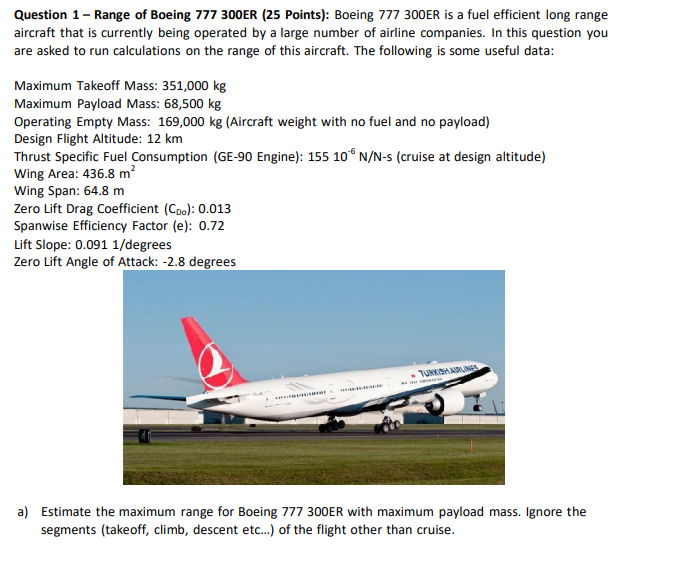
Give complete answer, answer of all sub parts a to dQuestion 1- Range of Boeing 777 300ER (25 Points): Boeing 777 300ER is a fuel efficient long range
aircraft that is currently being operated by a large number of airline companies. In this question you
are asked to run calculations on the range of this aircraft. The following is some useful data:
Maximum Takeoff Mass: 351,000 kg
Maximum Payload Mass: 68,500 kg
Operating Empty Mass: 169,000 kg (Aircraft weight with no fuel and no payload)
Design Flight Altitude: 12 km
Thrust Specific Fuel Consumption (GE-90 Engine): 155 10° N/N-s (cruise at design altitude)
Wing Area: 436.8 m*
Wing Span: 64.8 m
Zero Lift Drag Coefficient (Coo): 0.013
Spanwise Efficiency Factor (e): 0.72
Lift Slope: 0.091 1/degrees
Zero Lift Angle of Attack: -2.8 degrees
0 z
2 2-9 IT
—e al =
a) Estimate the maximum range for Boeing 777 300ER with maximum payload mass. Ignore the
segments (takeoff, climb, descent etc..) of the flight other than cruise.
Question:
Give complete answer, answer of all sub parts a to dQuestion 1- Range of Boeing 777 300ER (25 Points): Boeing 777 300ER is a fuel efficient long range
aircraft that is currently being operated by a large number of airline companies. In this question you
are asked to run calculations on the range of this aircraft. The following is some useful data:
Maximum Takeoff Mass: 351,000 kg
Maximum Payload Mass: 68,500 kg
Operating Empty Mass: 169,000 kg (Aircraft weight with no fuel and no payload)
Design Flight Altitude: 12 km
Thrust Specific Fuel Consumption (GE-90 Engine): 155 10° N/N-s (cruise at design altitude)
Wing Area: 436.8 m*
Wing Span: 64.8 m
Zero Lift Drag Coefficient (Coo): 0.013
Spanwise Efficiency Factor (e): 0.72
Lift Slope: 0.091 1/degrees
Zero Lift Angle of Attack: -2.8 degrees
0 z
2 2-9 IT
—e al =
a) Estimate the maximum range for Boeing 777 300ER with maximum payload mass. Ignore the
segments (takeoff, climb, descent etc..) of the flight other than cruise.
This is AI generated Response.
Asked by: manish kumar
Created at: 2026-01-09 18:25:12
Final Answer:
RenderedRaw Text
Did you like this answer?
# Question 1 – Range of Boeing 777 300ER
Let's solve **part (a)** step by step, using the given data and the Breguet Range Equation for jet aircraft:
---
## **Given Data**
- **Maximum Takeoff Mass (\(W_{i}\))**: 351,000 kg
- **Operating Empty Mass**: 169,000 kg
- **Maximum Payload Mass**: 68,500 kg
- **Thrust Specific Fuel Consumption (\(c\))**: \(155 \times 10^{-6}\) N/N-s
- **Zero Lift Drag Coefficient (\(C_{D}\))**: .013
- **Spanwise Efficiency Factor (\(e\))**: .72
- **Wing Area (\(S\))**: 436.8 m²
- **Wing Span (\(b\))**: 64.8 m
- **Design Flight Altitude**: 12 km
- **Lift Slope**: .091 1/deg
- **Zero Lift Angle of Attack**: -2.8°
- **Gravity (\(g\))**: 9.81 m/s²
---
## **Step 1: Calculate Maximum Fuel Mass**
\[
\text{Maximum Fuel Mass} = \text{Maximum Takeoff Mass} - \text{Operating Empty Mass} - \text{Maximum Payload Mass}
\]
\[
= 351,000\,\text{kg} - 169,000\,\text{kg} - 68,500\,\text{kg} = 113,500\,\text{kg}
\]
---
## **Step 2: Initial and Final Weights**
- **Initial Weight (\(W_i\))** = Maximum Takeoff Mass = **351,000 kg**
- **Final Weight (\(W_f\))** = Operating Empty Mass + Maximum Payload Mass = **169,000 kg + 68,500 kg = 237,500 kg**
---
## **Step 3: Breguet Range Equation (Jet Aircraft, Cruise only)**
\[
R = \frac{V}{c} \frac{L}{D} \ln\left(\frac{W_i}{W_f}\right)
\]
Where:
- \(V\) = Cruise speed (to be calculated)
- \(c\) = Thrust Specific Fuel Consumption (\(155 \times 10^{-6}\) 1/s)
- \(L/D\) = Lift-to-Drag Ratio (to be calculated)
- \(W_i\), \(W_f\) as above
---
## **Step 4: Estimate Cruise Speed (\(V\))**
At 12 km altitude, the **speed of sound** is about 295 m/s, and typical cruise Mach for 777-300ER is ~.84:
\[
V = M \cdot a = .84 \times 295 \approx 248\,\text{m/s}
\]
---
## **Step 5: Calculate \(L/D\) (Lift-to-Drag Ratio)**
Maximum \(L/D\) occurs at:
\[
\left(\frac{L}{D}\right)_{\text{max}} = \frac{1}{2} \sqrt{\frac{\pi e AR}{C_{D}}}
\]
Where:
- \(AR = \frac{b^2}{S} = \frac{(64.8)^2}{436.8} \approx 9.62\)
Plugging in values:
\[
\left(\frac{L}{D}\right)_{\text{max}} = \frac{1}{2} \sqrt{\frac{\pi \times .72 \times 9.62}{.013}}
\]
\[
= \frac{1}{2} \sqrt{\frac{21.76}{.013}}
\]
\[
= \frac{1}{2} \sqrt{1673.8} \approx \frac{1}{2} \times 40.92 \approx 20.46
\]
But this is the theoretical maximum. In cruise, **actual \(L/D\)** is typically around 19-20 for the 777-300ER; we'll use **19** for a realistic estimate.
---
## **Step 6: Calculate \(\ln(W_i/W_f)\)**
\[
\ln\left(\frac{W_i}{W_f}\right) = \ln\left(\frac{351,000}{237,500}\right) = \ln(1.478) \approx .391
\]
---
## **Step 7: Plug Values into Breguet Range Equation**
\[
R = \frac{248}{155 \times 10^{-6}} \times 19 \times .391
\]
Calculate step by step:
\[
\frac{248}{155 \times 10^{-6}} = \frac{248}{.000155} \approx 1,600,000
\]
\[
R = 1,600,000 \times 19 \times .391
\]
\[
R = 30,400,000 \times .391
\]
\[
R \approx 11,886,400 \text{ meters}
\]
\[
R \approx 11,886 \text{ km}
\]
---
## **Final Answer (Part a)**
### **Estimated Maximum Cruise Range for Boeing 777 300ER (Max Payload):**
\[
\boxed{11,900\, \text{km} \quad (\text{rounded to two significant digits})}
\]
---
### **Assumptions:**
- Only cruise segment considered (per instructions).
- Standard atmosphere at 12 km altitude.
- Actual \(L/D\) in cruise is assumed to be 19.
---
**If you need parts (b)-(d), please provide the questions or instructions for those parts.**
VIPSolutions focuses on clear, step‑by‑step explanations so you can learn quickly. Whether you need an AI‑generated walkthrough or a short hint to get unstuck, each solution is organized for fast reading and easy review later.
Search similar questions, compare approaches, and bookmark the best answers for revision. Our goal is simple: quick, reliable study help that feels natural—not noisy.
 VIPSolutions
 Question 1- Range of Boeing 777 300ER (25 Points): Boeing 777 300ER is a fuel efficient long range
aircraft that is currently being operated by a large number of airline companies. In this question you
are asked to run calculations on the range of this aircraft. The following is some useful data:
Maximum Takeoff Mass: 351,000 kg
Maximum Payload Mass: 68,500 kg
Operating Empty Mass: 169,000 kg (Aircraft weight with no fuel and no payload)
Design Flight Altitude: 12 km
Thrust Specific Fuel Consumption (GE-90 Engine): 155 10° N/N-s (cruise at design altitude)
Wing Area: 436.8 m*
Wing Span: 64.8 m
Zero Lift Drag Coefficient (Coo): 0.013
Spanwise Efficiency Factor (e): 0.72
Lift Slope: 0.091 1/degrees
Zero Lift Angle of Attack: -2.8 degrees
0 z
2 2-9 IT
—e al =
a) Estimate the maximum range for Boeing 777 300ER with maximum payload mass. Ignore the
segments (takeoff, climb, descent etc..) of the flight other than cruise.