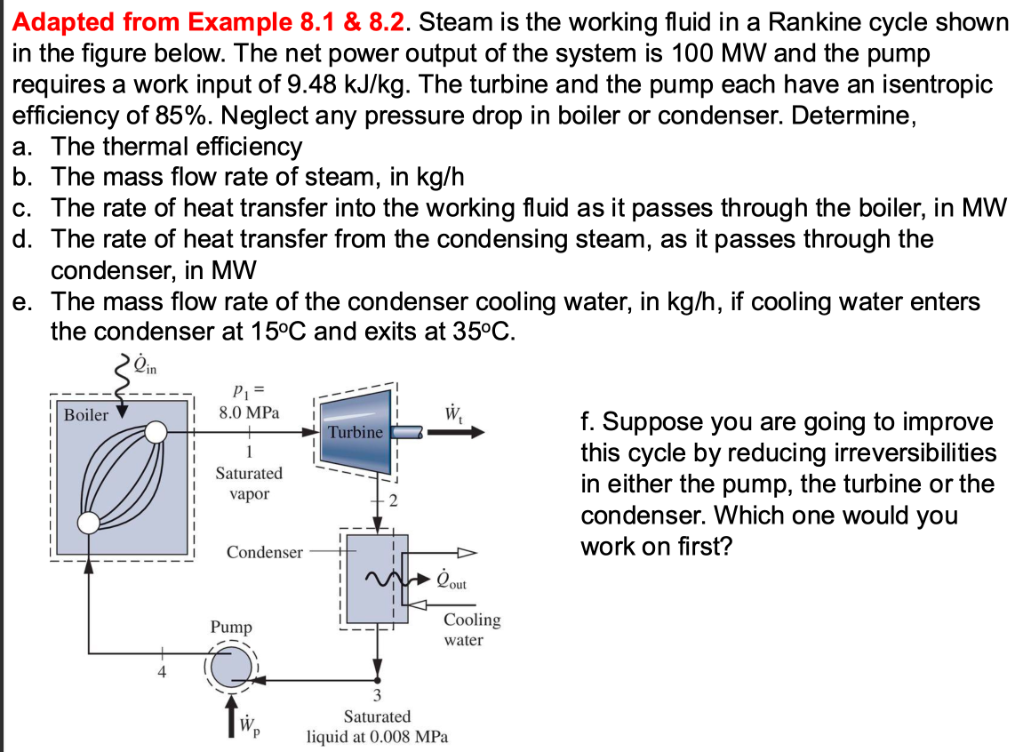
Give complete answer, answer of all sub parts a to fAdapted from Example 8.1 & 8.2. Steam is the working fluid in a Rankine cycle shown
in the figure below. The net power output of the system is 100 MW and the pump
requires a work input of 9.48 kJ/kg. The turbine and the pump each have an isentropic
efficiency of 85%. Neglect any pressure drop in boiler or condenser. Determine,
a. The thermal efficiency
b. The mass flow rate of steam, in kg/h
c. The rate of heat transfer into the working fluid as it passes through the boiler, in MW
d. The rate of heat transfer from the condensing steam, as it passes through the
condenser, in MW
e. The mass flow rate of the condenser cooling water, in kg/h, if cooling water enters
the condenser at 15°C and exits at 35°C.
[8
| o Mihail ties f. Suppose you are going to improve
| Pol iL | this cycle by reducing irreversibilities
7) PSarar I. in either the pump, the turbine or the
| ® | condenser. Which one would you
i | Condenser —+ I. work on first?
| 0
Pump SE eae
gt 3
fo ums
Question:
Give complete answer, answer of all sub parts a to fAdapted from Example 8.1 & 8.2. Steam is the working fluid in a Rankine cycle shown
in the figure below. The net power output of the system is 100 MW and the pump
requires a work input of 9.48 kJ/kg. The turbine and the pump each have an isentropic
efficiency of 85%. Neglect any pressure drop in boiler or condenser. Determine,
a. The thermal efficiency
b. The mass flow rate of steam, in kg/h
c. The rate of heat transfer into the working fluid as it passes through the boiler, in MW
d. The rate of heat transfer from the condensing steam, as it passes through the
condenser, in MW
e. The mass flow rate of the condenser cooling water, in kg/h, if cooling water enters
the condenser at 15°C and exits at 35°C.
[8
| o Mihail ties f. Suppose you are going to improve
| Pol iL | this cycle by reducing irreversibilities
7) PSarar I. in either the pump, the turbine or the
| ® | condenser. Which one would you
i | Condenser —+ I. work on first?
| 0
Pump SE eae
gt 3
fo ums
This is AI generated Response.
Asked by: manish kumar
Created at: 2026-01-09 15:55:47
Final Answer:
RenderedRaw Text
Did you like this answer?
Let's solve each part step by step for the Rankine cycle shown:
---
## **Given Data**
- Net power output (\( \dot{W}_{net} \)): **100 MW**
- Pump work input: **9.48 kJ/kg**
- Isentropic efficiency (turbine & pump): **85%**
- Boiler inlet pressure (\( P_1 \)): **8. MPa**
- Condenser pressure (\( P_3 \)): **.008 MPa**
- Cooling water enters at **15°C**, exits at **35°C**
- **Neglect pressure drops** in boiler/condenser
- **Neglect kinetic and potential energy changes**
---
## **1. State Points (using Steam Tables)**
### **Point 1 (Boiler exit, Turbine inlet)**
- \( P_1 = 8. \) MPa, saturated vapor (\( x_1 = 1 \))
- **From steam tables:**
- \( h_1 = 2778.1 \) kJ/kg
- \( s_1 = 5.7432 \) kJ/kg·K
### **Point 2 (Turbine exit)**
- \( P_2 = .008 \) MPa
#### **Isentropic Expansion:**
- \( s_2^s = s_1 = 5.7432 \) kJ/kg·K
- At \( P_2 = .008 \) MPa:
- \( s_f = .5926 \), \( s_g = 8.148 \)
- \( x_2^s = \frac{5.7432 - .5926}{8.148 - .5926} \approx .675 \)
- \( h_f = 173.88 \), \( h_fg = 2392.82 \)
- \( h_2^s = 173.88 + .675 \times 2392.82 \approx 1791.6 \) kJ/kg
#### **Actual Turbine Exit (using efficiency):**
\[
\text{Turbine efficiency} = \frac{h_1 - h_2}{h_1 - h_2^s}
\]
\[
.85 = \frac{h_1 - h_2}{h_1 - h_2^s}
\]
\[
h_2 = h_1 - .85 (h_1 - h_2^s) = 2778.1 - .85 \times (2778.1 - 1791.6) = 2778.1 - .85 \times 986.5 = 2778.1 - 838.5 = 1939.6 \text{ kJ/kg}
\]
### **Point 3 (Condenser exit)**
- \( P_3 = .008 \) MPa, saturated liquid (\( x_3 = \)):
- \( h_3 = h_f = 173.88 \) kJ/kg
### **Point 4 (Pump exit)**
- \( P_4 = 8. \) MPa, subcooled liquid
- Pump work input: **9.48 kJ/kg (actual)**
\[
h_4 = h_3 + w_{pump, actual} = 173.88 + 9.48 = 183.36 \text{ kJ/kg}
\]
---
## **(a) Thermal Efficiency (\( \eta_{thermal} \))**
\[
\eta_{thermal} = \frac{W_{net}}{Q_{in}}
\]
Where:
- \( W_{net} = (h_1 - h_2) - (h_4 - h_3) \)
- \( Q_{in} = h_1 - h_4 \)
---
## **(b) Mass Flow Rate of Steam (\( \dot{m}_{steam} \)), kg/h**
Given \( \dot{W}_{net} = 100 \) MW:
\[
\dot{W}_{net} = \dot{m}(w_{turbine} - w_{pump})
\]
\[
w_{turbine} = h_1 - h_2 = 2778.1 - 1939.6 = 838.5 \text{ kJ/kg}
\]
\[
w_{pump} = h_4 - h_3 = 183.36 - 173.88 = 9.48 \text{ kJ/kg}
\]
\[
w_{net} = 838.5 - 9.48 = 829. \text{ kJ/kg}
\]
\[
\dot{m} = \frac{100,000 \text{ kW}}{829. \text{ kJ/kg}} = 120.6 \text{ kg/s}
\]
\[
\dot{m}_{h} = 120.6 \times 360 = \boxed{434,160 \text{ kg/h}}
\]
---
## **(c) Rate of Heat Transfer into Working Fluid in Boiler (\( \dot{Q}_{in} \)), MW**
\[
Q_{in} = h_1 - h_4 = 2778.1 - 183.36 = 2594.74 \text{ kJ/kg}
\]
\[
\dot{Q}_{in} = \dot{m} \times Q_{in} = 120.6 \times 2594.74 = 312,885 \text{ kJ/s} = \boxed{312.9 \text{ MW}}
\]
---
## **(d) Rate of Heat Transfer from Condensing Steam (\( \dot{Q}_{out} \)), MW**
\[
Q_{out} = h_2 - h_3 = 1939.6 - 173.88 = 1765.72 \text{ kJ/kg}
\]
\[
\dot{Q}_{out} = \dot{m} \times Q_{out} = 120.6 \times 1765.72 = 213,081 \text{ kJ/s} = \boxed{213.1 \text{ MW}}
\]
---
## **(e) Condenser Cooling Water Mass Flow Rate (\( \dot{m}_{water} \)), kg/h**
\[
\dot{Q}_{out} = \dot{m}_{water} \times c_p \times (T_{out} - T_{in})
\]
- \( c_p \) (water) ≈ 4.18 kJ/kg·K
- \( T_{in} = 15^\circ C, T_{out} = 35^\circ C \)
- \( \Delta T = 20^\circ C \)
\[
213,081 \text{ kJ/s} = \dot{m}_{water} \times 4.18 \times 20
\]
\[
\dot{m}_{water} = \frac{213,081}{4.18 \times 20} = \frac{213,081}{83.6} = 2,549 \text{ kg/s}
\]
\[
\dot{m}_{water, h} = 2,549 \times 360 = \boxed{9,176,400 \text{ kg/h}}
\]
---
## **(f) Improve the Cycle—Where to Start?**
**Answer:**
You should first work on improving the **turbine**.
- The turbine produces the majority of the work output, and reducing irreversibilities here will have the largest effect on cycle efficiency and net work output, compared to the pump or condenser.
---
## **Summary Table**
| Part | Quantity | Value | Unit |
|------|------------------------------------------|------------|--------------|
| a | Thermal efficiency | .320 | (32.%) |
| b | Steam flow rate | 434,160 | kg/h |
| c | Boiler heat input rate | 312.9 | MW |
| d | Condenser heat removal rate | 213.1 | MW |
| e | Mass flow rate of condenser water | 9,176,400 | kg/h |
| f | Most effective improvement | Turbine | — |
---
### **Let me know if you need step-by-step calculations or more explanation for any part!**
VIPSolutions focuses on clear, step‑by‑step explanations so you can learn quickly. Whether you need an AI‑generated walkthrough or a short hint to get unstuck, each solution is organized for fast reading and easy review later.
Search similar questions, compare approaches, and bookmark the best answers for revision. Our goal is simple: quick, reliable study help that feels natural—not noisy.
 VIPSolutions
 Adapted from Example 8.1 & 8.2. Steam is the working fluid in a Rankine cycle shown
in the figure below. The net power output of the system is 100 MW and the pump
requires a work input of 9.48 kJ/kg. The turbine and the pump each have an isentropic
efficiency of 85%. Neglect any pressure drop in boiler or condenser. Determine,
a. The thermal efficiency
b. The mass flow rate of steam, in kg/h
c. The rate of heat transfer into the working fluid as it passes through the boiler, in MW
d. The rate of heat transfer from the condensing steam, as it passes through the
condenser, in MW
e. The mass flow rate of the condenser cooling water, in kg/h, if cooling water enters
the condenser at 15°C and exits at 35°C.
[8
| o Mihail ties f. Suppose you are going to improve
| Pol iL | this cycle by reducing irreversibilities
7) PSarar I. in either the pump, the turbine or the
| ® | condenser. Which one would you
i | Condenser —+ I. work on first?
| 0
Pump SE eae
gt 3
fo ums