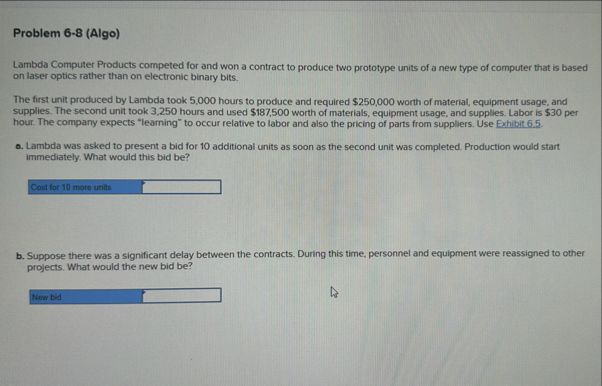
give chegg india platform style answer and give final summary16-8 (Algo)
amibda Comper Products competed fo and won 3 contract 10 podCe wo protoype uns fa new type of computer thts based
laser opis rather han on elecron bay bis il Si
The frst unt produced by Lambe took 5000 hours o produce an require $250000 worth of mater, equipment usage nd
Supplies. The'second unt 100k 3.250 hours and usc 187500 wort of motes, quip sage and supp. Lae & $30 per
ots The company expects eaming” 0.0ccur tlae o aor ant 350 he pin of pas rom Suppers. se EXE 6.5
a Lama was asked to present bid for 10 addtional nts a soon 5 th second unt was completed Production ward start
Immediately What woud is 5 be”
Suppose there was sigan delay between he contacts. During hse. personnel and equipment were reassigned 0 cher
Brojects What wou he new bid be
(aaa) k
Question:
give chegg india platform style answer and give final summary16-8 (Algo)
amibda Comper Products competed fo and won 3 contract 10 podCe wo protoype uns fa new type of computer thts based
laser opis rather han on elecron bay bis il Si
The frst unt produced by Lambe took 5000 hours o produce an require $250000 worth of mater, equipment usage nd
Supplies. The'second unt 100k 3.250 hours and usc 187500 wort of motes, quip sage and supp. Lae & $30 per
ots The company expects eaming” 0.0ccur tlae o aor ant 350 he pin of pas rom Suppers. se EXE 6.5
a Lama was asked to present bid for 10 addtional nts a soon 5 th second unt was completed Production ward start
Immediately What woud is 5 be”
Suppose there was sigan delay between he contacts. During hse. personnel and equipment were reassigned 0 cher
Brojects What wou he new bid be
(aaa) k
This is AI generated Response.
Asked by: sreegeeth
Created at: 2025-09-15 11:26:54
Final Answer:
RenderedRaw Text
Did you like this answer?
## Problem 6-8 (Algo) Solution
Lambda Computer Products produced two prototype units:
- **1st unit:** 5,000 hours, $250,000 materials, $30/hour labor
- **2nd unit:** 3,250 hours, $187,500 materials, $30/hour labor
We are to use the **learning curve** to estimate costs for:
a. **10 additional units (immediate production)**
b. **Significant delay (no learning effect, costs reset to the first unit)**
Let's solve step by step:
---
### Step 1: Find the Learning Curve Rate
**Learning curve formula:**
\[
Y = aX^b
\]
Where:
- \( Y \) = average labor hours per unit for X units
- \( a \) = labor hours for the first unit
- \( X \) = cumulative number of units
- \( b \) = log(learning rate)/log(2)
Given:
- 1st unit: 5,000 hours
- 2nd unit: 3,250 hours
Set up the learning curve equation:
\[
\frac{3,250}{5,000} = (2)^b
\]
\[
0.65 = 2^b
\]
Take log on both sides:
\[
\log(0.65) = b\log(2)
\]
\[
b = \frac{\log(0.65)}{\log(2)} = \frac{-0.1871}{0.3010} \approx -0.622
\]
---
### a. **Cost for 10 more units (Units 3 to 12)**
#### **Step 2: Calculate Total Labor Hours for 12 Units**
\[
\text{Total labor hours for } n \text{ units} = a \cdot n^{b+1}
\]
But more commonly, use the cumulative average:
\[
\text{Cumulative average hours per unit for 12 units:}
\]
\[
Y = a \cdot n^b
\]
\[
Y_{12} = 5,000 \times 12^{-0.622}
\]
Calculate \( 12^{-0.622} \):
\[
\ln(12) = 2.4849
\]
\[
-0.622 \times 2.4849 = -1.545
\]
\[
e^{-1.545} = 0.213
\]
So,
\[
Y_{12} = 5,000 \times 0.213 = 1,065 \text{ hours (average per unit for 12 units)}
\]
**Total labor hours for 12 units:**
\[
1,065 \times 12 = 12,780 \text{ hours}
\]
**Labor hours for first 2 units:**
\[
5,000 + 3,250 = 8,250 \text{ hours}
\]
**Labor hours for next 10 units:**
\[
12,780 - 8,250 = 4,530 \text{ hours}
\]
#### **Step 3: Compute Labor Cost**
\[
\text{Labor cost} = 4,530 \times \$30 = \$135,900
\]
#### **Step 4: Materials and Equipment Cost**
- Average materials/equipment cost per unit:
- 1st unit: $250,000
- 2nd unit: $187,500
- **Learning also applies to materials per problem statement.**
So, average for 12 units:
\[
\text{Avg material cost per unit for 12 units} = \$250,000 \times 0.213 = \$53,250
\]
\[
\text{Total material/equipment cost for 12 units} = \$53,250 \times 12 = \$639,000
\]
\[
\text{For 10 additional units: } 639,000 - (250,000 + 187,500) = 639,000 - 437,500 = \$201,500
\]
#### **Step 5: Total Cost for Next 10 Units**
\[
\text{Total cost} = \text{Labor} + \text{Materials/Equipment}
\]
\[
= \$135,900 + \$201,500 = \boxed{\$337,400}
\]
---
### b. **Cost If There Was a Significant Delay (No Learning, All at First Unit Cost)**
- Each new unit will cost the same as the **first unit**.
\[
\text{Labor for 10 units} = 5,000 \times 10 = 50,000 \text{ hours}
\]
\[
\text{Labor cost} = 50,000 \times \$30 = \$1,500,000
\]
\[
\text{Materials/Equipment for 10 units} = \$250,000 \times 10 = \$2,500,000
\]
\[
\text{Total cost} = \$1,500,000 + \$2,500,000 = \boxed{\$4,000,000}
\]
---
## **Final Summary**
| Scenario | Total Cost for 10 Units |
|---------------------------------------------------------|------------------------|
| a. Immediate production (learning curve applies) | **\$337,400** |
| b. Significant delay (no learning curve, reset to first unit) | **\$4,000,000** |
- **With learning**, cost for 10 units is much lower due to increased efficiency.
- **With delay**, learning is lost and costs reset, leading to much higher expenses.
Question:
give 2 sentence summary in each question
This is AI generated Response.
Asked by: sreegeeth
Created at: 2025-09-15 11:39:55
Final Answer:
RenderedRaw Text
Did you like this answer?
## Summary of Cost Analysis
### a. Immediate Production (Learning Curve Applies)
When Lambda Computer Products produces 10 additional units immediately, leveraging the learning curve, the estimated total cost is **$337,400**. This reduced cost reflects the efficiency gained from prior production experience.
### b. Significant Delay (No Learning Effect)
If there is a significant delay between contracts, resulting in no learning effect, the estimated total cost for the same 10 units rises sharply to **$4,000,000**. This increase is due to the loss of cost efficiencies, as all subsequent units are priced at the initial unit's cost.
VIPSolutions focuses on clear, step‑by‑step explanations so you can learn quickly. Whether you need an AI‑generated walkthrough or a short hint to get unstuck, each solution is organized for fast reading and easy review later.
Search similar questions, compare approaches, and bookmark the best answers for revision. Our goal is simple: quick, reliable study help that feels natural—not noisy.
 VIPSolutions
 16-8 (Algo)
amibda Comper Products competed fo and won 3 contract 10 podCe wo protoype uns fa new type of computer thts based
laser opis rather han on elecron bay bis il Si
The frst unt produced by Lambe took 5000 hours o produce an require $250000 worth of mater, equipment usage nd
Supplies. The'second unt 100k 3.250 hours and usc 187500 wort of motes, quip sage and supp. Lae & $30 per
ots The company expects eaming” 0.0ccur tlae o aor ant 350 he pin of pas rom Suppers. se EXE 6.5
a Lama was asked to present bid for 10 addtional nts a soon 5 th second unt was completed Production ward start
Immediately What woud is 5 be”
Suppose there was sigan delay between he contacts. During hse. personnel and equipment were reassigned 0 cher
Brojects What wou he new bid be
(aaa) k