This is AI generated Response.
Asked by: amu
Created at: 2025-08-01 16:45:41
Final Answer:
RenderedRaw Text
Did you like this answer?
Let's solve each part step by step:
---
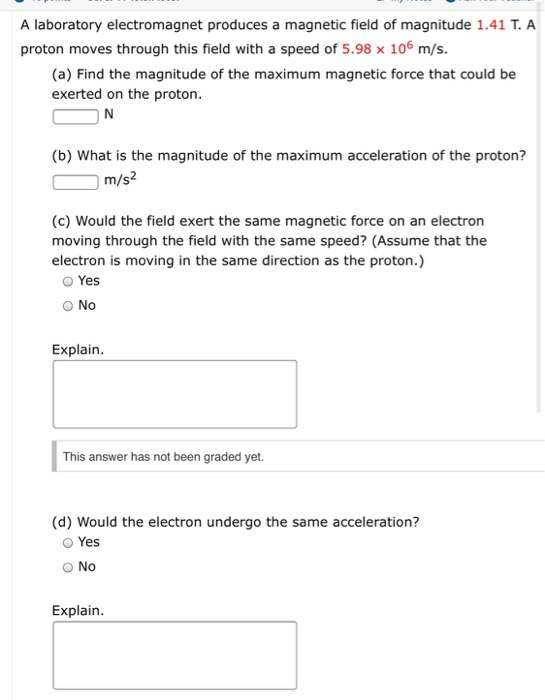
### **(a) Find the magnitude of the maximum magnetic force that could be exerted on the proton.**
The maximum magnetic force on a charged particle moving perpendicular to a magnetic field is:
\[ F = qvB \]
Where:
- \( q \) = charge of the proton = \( 1.60 \times 10^{-19} \) C
- \( v \) = speed = \( 5.98 \times 10^6 \) m/s
- \( B \) = magnetic field = \( 1.41 \) T
**Plug in the values:**
\[
F = (1.60 \times 10^{-19} \, \text{C}) \times (5.98 \times 10^6 \, \text{m/s}) \times (1.41 \, \text{T})
\]
\[
F = 1.60 \times 5.98 \times 1.41 \times 10^{-19 + 6}
\]
\[
F = 13.4848 \times 1.41 \times 10^{-13}
\]
\[
F = 19.010568 \times 10^{-13}
\]
\[
F = 1.90 \times 10^{-12} \, \text{N}
\]
**Explanation:**
The force is calculated using \( F = qvB \) where all quantities are substituted with their given values.
---
### **(b) What is the magnitude of the maximum acceleration of the proton?**
Acceleration \( a \) is given by Newton's second law:
\[
a = \frac{F}{m}
\]
Where the mass of a proton \( m_p = 1.67 \times 10^{-27} \) kg.
**Plug in the values:**
\[
a = \frac{1.90 \times 10^{-12} \, \text{N}}{1.67 \times 10^{-27} \, \text{kg}}
\]
\[
a = \frac{1.90}{1.67} \times 10^{-12 + 27}
\]
\[
a = 1.137 \times 10^{15} \, \text{m/s}^2
\]
**Explanation:**
The acceleration is found using \( a = F/m \), substituting the force from part (a) and the known mass of a proton.
---
### **(c) Would the field exert the same magnetic force on an electron moving through the field with the same speed?**
- **Yes**
**Explanation:**
The magnitude of the magnetic force depends on the magnitude of the charge, speed, and magnetic field (\( F = |q|vB \)). The electron has the same magnitude of charge as the proton, so the force magnitude will be the same even though the sign (direction) will be opposite.
---
### **(d) Would the electron undergo the same acceleration?**
- **No**
**Explanation:**
Acceleration depends on both the force and the mass (\( a = F/m \)). Although the force magnitude is the same, the electron has a much smaller mass (\( m_e = 9.11 \times 10^{-31} \) kg). Therefore, the acceleration of the electron would be much greater than that of the proton.
---
## **Final Answers:**
**(a)** \( 1.90 \times 10^{-12} \) N
**(b)** \( 1.14 \times 10^{15} \) m/s²
**(c)** Yes, because the charge magnitude is the same.
**(d)** No, because the electron's mass is much smaller, so its acceleration would be much greater.
Question:
tell concept used in answering the question in paragraph form in very brief
This is AI generated Response.
Asked by: amu
Created at: 2025-08-01 16:47:32
Final Answer:
RenderedRaw Text
Did you like this answer?
The problem primarily uses the concepts of magnetic force and Newton's second law. The magnetic force on a moving charge is given by \( F = qvB \), which applies when the particle moves perpendicular to the magnetic field for maximum force. To find acceleration, Newton's second law \( a = F/m \) is used, relating force to mass. Comparing forces and accelerations for particles with different charges and masses helps determine how the magnetic field affects each particle differently.
VIPSolutions focuses on clear, step‑by‑step explanations so you can learn quickly. Whether you need an AI‑generated walkthrough or a short hint to get unstuck, each solution is organized for fast reading and easy review later.
Search similar questions, compare approaches, and bookmark the best answers for revision. Our goal is simple: quick, reliable study help that feels natural—not noisy.
 VIPSolutions
 A laboratory electromagnet produces a magnetic field of magnitude 1.41 T. A
proton moves through this field with a speed of 5.98 x 10⁶ m/s.
(a) Find the magnitude of the maximum magnetic force that could be
exerted on the proton.
oN
(b) What is the magnitude of the maximum acceleration of the proton?
ms?
(c) Would the field exert the same magnetic force on an electron
moving through the field with the same speed? (Assume that the
electron is moving in the same direction as the proton.)
© Yes
© No
Explain.
“This answer has not been graded yet.
(d) Would the electron undergo the same acceleration?
© Yes
© No
Explain.