 VIPSolutions
GIVE ANSWER WITH EXPLANATION at the end of each step and final answer at the end4-24. In some laser-fusion experiments in which a plasma is created by a pulse of 1.06-4m light impinging on a solid target, very large magnetic fields are generated by ther moelectric currents. These fields can be measured by Faraday rotation of frequency-doubled light (Aq = 0.53 u m) derived from the same laser. 168=100T, n = 10m, and the path length in the plasma is 30 sm. what is the Faraday rotation angle in degrees? (Assume KIB.)
Question:
GIVE ANSWER WITH EXPLANATION at the end of each step and final answer at the end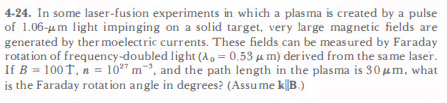 4-24. In some laser-fusion experiments in which a plasma is created by a pulse
of 1.06-4m light impinging on a solid target, very large magnetic fields are
generated by ther moelectric currents. These fields can be measured by Faraday
rotation of frequency-doubled light (Aq = 0.53 u m) derived from the same laser.
168=100T, n = 10m, and the path length in the plasma is 30 sm. what
is the Faraday rotation angle in degrees? (Assume KIB.)
This is AI generated Response.
Asked by: amu
Created at: 2025-07-27 05:25:34
Asked by: amu
Created at: 2025-07-27 05:25:34
Final Answer:
Rendered
Raw Text
Did you like this answer?
Let's solve the problem **step by step** and explain each step:
---
### **Given Data**
- Wavelength of probe light, \( \lambda_0 = 0.53 \, \mu m = 0.53 \times 10^{-6} \) m
- Magnetic field, \( B = 100 \) T
- Electron density, \( n = 10^{27} \) m\(^{-3}\)
- Path length, \( L = 30 \, \mu m = 30 \times 10^{-6} \) m
- Assume \( \vec{k} \parallel \vec{B} \)
---
### **Step 1: Write the Faraday Rotation Formula**
The Faraday rotation angle \( \theta \) (in radians) in a plasma is given by:
\[
\theta = \frac{e^3 \lambda_0^2}{8 \pi^2 \epsilon_0 m_e^2 c^3} n B L
\]
#### **Explanation:**
- This formula relates the rotation angle of a plane-polarized light as it propagates through a plasma in the presence of a magnetic field parallel to the direction of light.
- \(e\) is the elementary charge, \(m_e\) is the electron mass, \(\epsilon_0\) is the vacuum permittivity, \(c\) is the speed of light.
---
### **Step 2: Insert Known Constants**
- \( e = 1.602 \times 10^{-19} \) C
- \( m_e = 9.109 \times 10^{-31} \) kg
- \( \epsilon_0 = 8.854 \times 10^{-12} \) F/m
- \( c = 3.00 \times 10^8 \) m/s
---
### **Step 3: Plug in Values**
\[
\theta = \frac{(1.602 \times 10^{-19})^3 \times (0.53 \times 10^{-6})^2}{8 \pi^2 \times 8.854 \times 10^{-12} \times (9.109 \times 10^{-31})^2 \times (3.00 \times 10^8)^3}
\times (10^{27}) \times (100) \times (30 \times 10^{-6})
\]
---
### **Step 4: Calculate Numerator and Denominator Separately**
#### **Numerator:**
\[
(1.602 \times 10^{-19})^3 = 4.108 \times 10^{-57}
\]
\[
(0.53 \times 10^{-6})^2 = 0.2809 \times 10^{-12} = 2.809 \times 10^{-13}
\]
\[
\text{So, Numerator} = 4.108 \times 10^{-57} \times 2.809 \times 10^{-13} = 1.154 \times 10^{-69}
\]
#### **Denominator:**
\[
8 \pi^2 = 8 \times 9.8696 = 78.9568
\]
\[
(9.109 \times 10^{-31})^2 = 8.299 \times 10^{-61}
\]
\[
(3.00 \times 10^8)^3 = 2.7 \times 10^{25}
\]
\[
\text{So, Denominator} = 78.9568 \times 8.854 \times 10^{-12} \times 8.299 \times 10^{-61} \times 2.7 \times 10^{25}
\]
Calculate step by step:
- \( 78.9568 \times 8.854 \times 10^{-12} = 698.775 \times 10^{-12} = 6.98775 \times 10^{-10} \)
- \( 6.98775 \times 10^{-10} \times 8.299 \times 10^{-61} = 57.973 \times 10^{-71} = 5.7973 \times 10^{-70} \)
- \( 5.7973 \times 10^{-70} \times 2.7 \times 10^{25} = 15.6527 \times 10^{-45} = 1.565 \times 10^{-44} \)
---
### **Step 5: Evaluate the Fraction**
Now,
\[
\theta = \frac{1.154 \times 10^{-69}}{1.565 \times 10^{-44}} \times (10^{27}) \times (100) \times (30 \times 10^{-6})
\]
\[
= (7.375 \times 10^{-26}) \times (10^{27}) \times (100) \times (30 \times 10^{-6})
\]
\[
= (7.375 \times 10^1) \times (30 \times 10^{-6})
\]
\[
= 73.75 \times 30 \times 10^{-6}
\]
\[
= 2212.5 \times 10^{-6}
\]
\[
= 2.2125 \times 10^{-3} \text{ radians}
\]
---
### **Step 6: Convert Radians to Degrees**
\[
\theta (\text{degrees}) = \theta (\text{radians}) \times \frac{180}{\pi}
\]
\[
= 2.2125 \times 10^{-3} \times 57.2958
\]
\[
= 0.1267^\circ
\]
---
## **Final Answer**
### **The Faraday rotation angle is approximately** \( \boxed{0.13^\circ} \).
---
### **Summary of Steps**
1. Wrote down the Faraday rotation formula for a plasma.
2. Plugged in all known constants and values.
3. Calculated numerator, denominator, and combined.
4. Converted the final answer to degrees.
**Let me know if you need further clarification or the answer in a different form!**
Question:
tell concept used in answering the question in paragraph form in very brief
This is AI generated Response.
Asked by: amu
Created at: 2025-07-27 05:29:52
Asked by: amu
Created at: 2025-07-27 05:29:52
Final Answer:
Rendered
Raw Text
Did you like this answer?
The concept used in answering this question is the Faraday rotation effect in a plasma, which causes the plane of polarization of light passing through a magnetized plasma to rotate. The rotation angle depends on the strength of the magnetic field, the electron density, the wavelength of the probing light, and the path length through the plasma. By applying the known formula for Faraday rotation—derived from electromagnetic theory and plasma physics—and substituting the given parameters along with fundamental constants, we can calculate the expected rotation angle in degrees.
📢 Instructions:
- Ask anything relatd to above question only.
- For new Question goto :