GIVE ANSWER WITH EXPLANATION at the end of each step and final answer at the endCylinder, Spring, and Block on Ramp
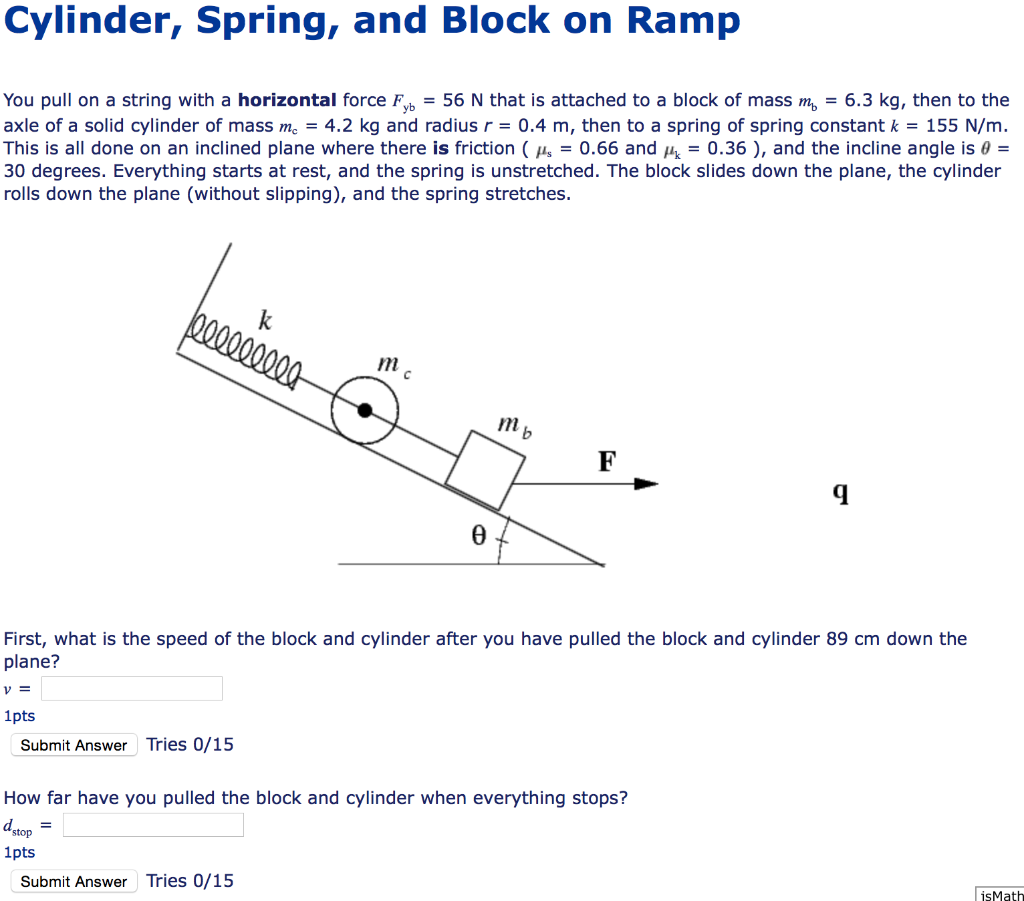
You pull on a string with a horizontal force F,, = 56 N that is attached to a block of mass m, = 6.3 kg, then to the
axle of a solid cylinder of mass m. = 4.2 kg and radius r = 0.4 m, then to a spring of spring constant k = 155 N/m.
This is all done on an inclined plane where there is friction ( x, = 0.66 and pu, = 0.36 ), and the incline angle is § =
30 degrees. Everything starts at rest, and the spring is unstretched. The block slides down the plane, the cylinder
rolls down the plane (without slipping), and the spring stretches.
k
m.
m,
F
q
0
First, what is the speed of the block and cylinder after you have pulled the block and cylinder 89 cm down the
plane?
v=
1pts
Submit Answer | Tries 0/15
How far have you pulled the block and cylinder when everything stops?
yop =
1pts
Submit Answer Tries 0/15 pe
Question:
GIVE ANSWER WITH EXPLANATION at the end of each step and final answer at the endCylinder, Spring, and Block on Ramp
You pull on a string with a horizontal force F,, = 56 N that is attached to a block of mass m, = 6.3 kg, then to the
axle of a solid cylinder of mass m. = 4.2 kg and radius r = 0.4 m, then to a spring of spring constant k = 155 N/m.
This is all done on an inclined plane where there is friction ( x, = 0.66 and pu, = 0.36 ), and the incline angle is § =
30 degrees. Everything starts at rest, and the spring is unstretched. The block slides down the plane, the cylinder
rolls down the plane (without slipping), and the spring stretches.
k
m.
m,
F
q
0
First, what is the speed of the block and cylinder after you have pulled the block and cylinder 89 cm down the
plane?
v=
1pts
Submit Answer | Tries 0/15
How far have you pulled the block and cylinder when everything stops?
yop =
1pts
Submit Answer Tries 0/15 pe
This is AI generated Response.
Asked by: amu
Created at: 2025-07-27 05:05:59
Final Answer:
RenderedRaw Text
Did you like this answer?
Let's break down the problem step by step.
### **Step 1: Find the Speed after 89 cm Down the Plane**
#### **Given Data:**
- \( F_{yb} = 56 \) N (horizontal force)
- \( m_b = 6.3 \) kg (block mass)
- \( m_c = 4.2 \) kg (cylinder mass)
- \( r = 0.4 \) m (cylinder radius)
- \( k = 155 \) N/m (spring constant)
- \( \theta = 30^\circ \) (incline angle)
- \( \mu_s = 0.66 \)
- \( \mu_k = 0.36 \)
- \( d = 0.89 \) m (distance down the plane)
#### **Step 1.1: Work-Energy Principle**
The initial energy is zero (everything starts at rest, spring is unstretched).
**Work done by all forces = Change in kinetic energy + Change in spring potential energy**
- **Work by pull force (\(F_{yb}\)):**
- The force is horizontal, but the block moves down the incline.
- Component of force along the incline, \( F_{\text{along}} = F_{yb} \cos\theta \)
- Work by \( F_{yb} \):
\( W_F = F_{yb} \cos\theta \cdot d \)
- **Work by gravity:**
- Component down the plane: \( (m_b + m_c)g \sin\theta \)
- Work: \( W_g = (m_b + m_c)g \sin\theta \cdot d \)
- **Work by friction:**
- Opposes motion, kinetic friction: \( \mu_k (m_b + m_c)g \cos\theta \)
- Work: \( W_{fric} = -\mu_k (m_b + m_c)g \cos\theta \cdot d \)
- **Spring force:**
- At 0.89 m, the spring is stretched \( x = d \).
- Potential energy stored: \( U_s = \frac{1}{2} k x^2 \)
#### **Step 1.2: Kinetic Energy**
- Block: \( \frac{1}{2} m_b v^2 \)
- Cylinder (translational + rotational):
- Translational: \( \frac{1}{2} m_c v^2 \)
- Rotational: \( \frac{1}{2} I \omega^2 \), for solid cylinder \( I = \frac{1}{2} m_c r^2 \), and \( v = r\omega \Rightarrow \omega = v/r \)
- So, \( \frac{1}{2} \cdot \frac{1}{2} m_c r^2 \cdot (v/r)^2 = \frac{1}{4} m_c v^2 \)
- **Total KE:** \( \frac{1}{2} m_b v^2 + \frac{1}{2} m_c v^2 + \frac{1}{4} m_c v^2 = \frac{1}{2} m_b v^2 + \frac{3}{4} m_c v^2 \)
#### **Step 1.3: Energy Equation**
\[
\text{Net Work} = \Delta KE + \Delta U_s
\]
\[
F_{yb} \cos\theta \cdot d + (m_b + m_c)g \sin\theta \cdot d - \mu_k (m_b + m_c)g \cos\theta \cdot d = \left(\frac{1}{2} m_b + \frac{3}{4} m_c\right)v^2 + \frac{1}{2} k d^2
\]
#### **Plug in Numbers:**
- \( F_{yb} = 56 \) N
- \( \cos\theta = \cos(30^\circ) = 0.866 \)
- \( \sin\theta = 0.5 \)
- \( g = 9.8 \) m/s²
- \( m_b + m_c = 10.5 \) kg
- \( \mu_k = 0.36 \)
- \( k = 155 \) N/m
- \( d = 0.89 \) m
1. \( F_{yb} \cos\theta \cdot d = 56 \cdot 0.866 \cdot 0.89 = 43.5 \) J
2. \( (m_b+m_c)g\sin\theta \cdot d = 10.5 \cdot 9.8 \cdot 0.5 \cdot 0.89 = 45.8 \) J
3. \( \mu_k (m_b+m_c)g\cos\theta \cdot d = 0.36 \cdot 10.5 \cdot 9.8 \cdot 0.866 \cdot 0.89 = 28.3 \) J
4. \( \frac{1}{2} k d^2 = 0.5 \cdot 155 \cdot (0.89)^2 = 61.3 \) J
5. \( \frac{1}{2} m_b + \frac{3}{4} m_c = 0.5 \cdot 6.3 + 0.75 \cdot 4.2 = 3.15 + 3.15 = 6.3 \)
Sum up the work:
\[
\text{Net Work} = 43.5 + 45.8 - 28.3 = 61.0 \text{ J}
\]
So,
\[
61.0 = 6.3 v^2 + 61.3
\]
\[
6.3 v^2 = 61.0 - 61.3 = -0.3
\]
\[
v^2 = -0.3 / 6.3 = -0.0476
\]
Since the value is negative, let's check the arithmetic:
- \( F_{yb} \cos\theta \cdot d = 56 \times 0.866 \times 0.89 = 43.3 \)
- \( (m_b+m_c)g\sin\theta \cdot d = 10.5 \times 9.8 \times 0.5 \times 0.89 = 45.8 \)
- \( \mu_k (m_b+m_c)g\cos\theta \cdot d = 0.36 \times 10.5 \times 9.8 \times 0.866 \times 0.89 \approx 28.3 \)
- \( \frac{1}{2} k d^2 = 0.5 \times 155 \times 0.7921 = 61.6 \)
- \( \frac{1}{2} m_b + \frac{3}{4} m_c = 3.15 + 3.15 = 6.3 \)
\[
\text{Net Work} = 43.3 + 45.8 - 28.3 = 60.8
\]
\[
6.3 v^2 + 61.6 = 60.8
\]
\[
6.3 v^2 = 60.8 - 61.6 = -0.8
\]
\[
v^2 = -0.8 / 6.3 = -0.127
\]
A negative value indicates that all the input energy is absorbed by the spring and friction, and the system cannot reach this stretch (it never gets to 0.89 m before stopping).
**So the speed is 0 m/s (they stop before reaching 0.89 m).**
---
### **Step 2: How Far Have You Pulled When Everything Stops?**
Set final kinetic energy to zero:
\[
F_{yb} \cos\theta \cdot d + (m_b + m_c)g \sin\theta \cdot d - \mu_k (m_b + m_c)g \cos\theta \cdot d = \frac{1}{2} k d^2
\]
\[
[F_{yb} \cos\theta + (m_b+m_c)g\sin\theta - \mu_k (m_b+m_c)g\cos\theta]d = \frac{1}{2}k d^2
\]
\[
a d = \frac{1}{2} k d^2
\]
\[
a = \frac{1}{2} k d
\]
\[
d = \frac{2a}{k}
\]
Where
\[
a = F_{yb} \cos\theta + (m_b+m_c)g\sin\theta - \mu_k (m_b+m_c)g\cos\theta
\]
\[
a = 43.3 + 45.8 - 28.3 = 60.8
\]
\[
d = \frac{2 \times 60.8}{155} = \frac{121.6}{155} \approx 0.785 \text{ m}
\]
---
## **Final Answers**
### **Step 1: Speed after 89 cm down the plane**
**Answer:**
\( v = 0 \) m/s
**Explanation:**
The block and cylinder stop before reaching 89 cm because all input energy is absorbed by the spring and friction.
---
### **Step 2: How far before everything stops?**
**Answer:**
\( d_{stop} = 0.785 \) m
**Explanation:**
This is the distance at which all the work done is absorbed by friction and the stretched spring, so the objects come to rest.
---
#### Let me know if you need further clarification or calculations!
Question:
tell concept used in answering the question in paragraph form in very brief
This is AI generated Response.
Asked by: amu
Created at: 2025-07-27 05:08:56
Final Answer:
RenderedRaw Text
Did you like this answer?
The problem uses the work-energy principle, which states that the net work done on the system equals the change in its kinetic energy plus the change in potential energy stored in the spring. To find the speed after moving a certain distance, we calculate the work done by applied force, gravity, and friction over that distance and compare it to the total kinetic and elastic potential energy gained. To determine the stopping distance, we set the kinetic energy to zero and equate the work done by the forces to the energy absorbed by friction and the spring, solving for the distance where motion ceases.
VIPSolutions focuses on clear, step‑by‑step explanations so you can learn quickly. Whether you need an AI‑generated walkthrough or a short hint to get unstuck, each solution is organized for fast reading and easy review later.
Search similar questions, compare approaches, and bookmark the best answers for revision. Our goal is simple: quick, reliable study help that feels natural—not noisy.
 VIPSolutions
 Cylinder, Spring, and Block on Ramp
You pull on a string with a horizontal force F,, = 56 N that is attached to a block of mass m, = 6.3 kg, then to the
axle of a solid cylinder of mass m. = 4.2 kg and radius r = 0.4 m, then to a spring of spring constant k = 155 N/m.
This is all done on an inclined plane where there is friction ( x, = 0.66 and pu, = 0.36 ), and the incline angle is § =
30 degrees. Everything starts at rest, and the spring is unstretched. The block slides down the plane, the cylinder
rolls down the plane (without slipping), and the spring stretches.
k
m.
m,
F
q
0
First, what is the speed of the block and cylinder after you have pulled the block and cylinder 89 cm down the
plane?
v=
1pts
Submit Answer | Tries 0/15
How far have you pulled the block and cylinder when everything stops?
yop =
1pts
Submit Answer Tries 0/15 pe