GIVE ANSWER WITH EXPLANATION at the end of each step and final answer at the end~ PartD
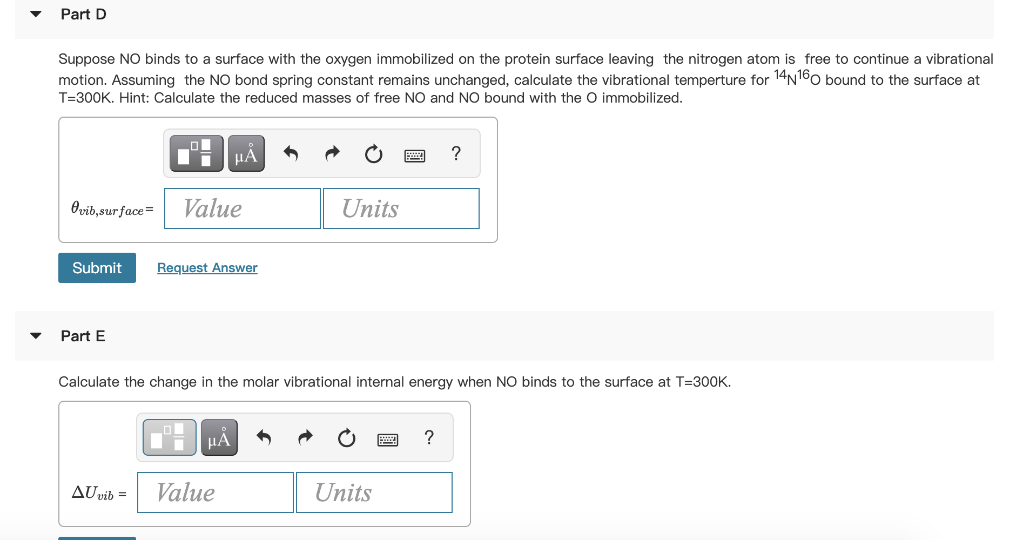
Suppose NO binds to a surface with the oxygen immobilized on the protein surface leaving the nitrogen atom is free to continue a vibrational
motion. Assuming the NO bond spring constant remains unchanged, calculate the vibrational temperture for ¥N'60 bound to the surface at
T=300K. Hint: Calculate the reduced masses of free NO and NO bound with the O immobilized.
Elo -
Buis,surace= | Value Units
v PartE
Calculate the change in the molar vibrational internal energy when NO binds to the surface at T=300K.
EB os"
AUw= | Value Units
wv PartF
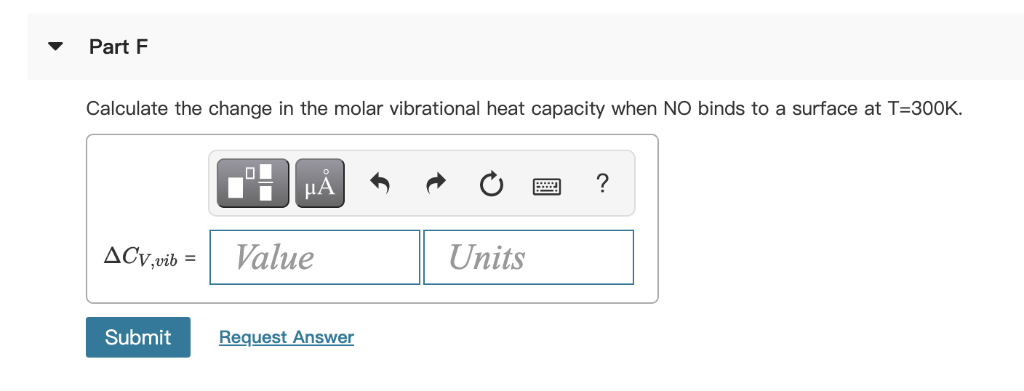
Calculate the change in the molar vibrational heat capacity when NO binds to a surface at T=300K.
ams » 0 ?
Request Answer
Question:
GIVE ANSWER WITH EXPLANATION at the end of each step and final answer at the end~ PartD
Suppose NO binds to a surface with the oxygen immobilized on the protein surface leaving the nitrogen atom is free to continue a vibrational
motion. Assuming the NO bond spring constant remains unchanged, calculate the vibrational temperture for ¥N'60 bound to the surface at
T=300K. Hint: Calculate the reduced masses of free NO and NO bound with the O immobilized.
Elo -
Buis,surace= | Value Units
v PartE
Calculate the change in the molar vibrational internal energy when NO binds to the surface at T=300K.
EB os"
AUw= | Value Units
wv PartF
Calculate the change in the molar vibrational heat capacity when NO binds to a surface at T=300K.
ams » 0 ?
Request Answer
This is AI generated Response.
Asked by: amu
Created at: 2025-07-27 04:35:22
Final Answer:
RenderedRaw Text
Did you like this answer?
Let's go step-by-step through each part.
---
### **Part D:**
**Calculate the vibrational temperature for \( ^{14}N^{16}O \) bound to the surface at \( T=300K \) (with O immobilized).**
#### **Step 1: Reduced Mass Calculation**
- **For free NO:**
Reduced mass,
\[
\mu_{\text{free}} = \frac{m_N m_O}{m_N + m_O}
\]
where \( m_N = 14 \) u, \( m_O = 16 \) u.
\[
\mu_{\text{free}} = \frac{14 \times 16}{14+16} = \frac{224}{30} = 7.47 \text{ u}
\]
- **For NO with O immobilized:**
Reduced mass (since O is fixed, only N moves):
\[
\mu_{\text{surface}} = m_N = 14 \text{ u}
\]
#### **Step 2: Vibrational Temperature (\( \theta_{\text{vib}} \))**
The vibrational temperature is:
\[
\theta_{\text{vib}} = \frac{h\nu}{k_B}
\]
And,
\[
\nu = \frac{1}{2\pi} \sqrt{\frac{k}{\mu}}
\]
Since spring constant \( k \) is unchanged, the ratio of vibrational temperatures is:
\[
\frac{\theta_{\text{vib,surface}}}{\theta_{\text{vib,free}}} = \sqrt{\frac{\mu_{\text{free}}}{\mu_{\text{surface}}}}
\]
\[
\theta_{\text{vib,surface}} = \theta_{\text{vib,free}} \sqrt{\frac{\mu_{\text{free}}}{\mu_{\text{surface}}}}
\]
- For NO, \( \theta_{\text{vib,free}} \approx 2740 \) K (you can look this up in a constants table).
\[
\theta_{\text{vib,surface}} = 2740 \times \sqrt{\frac{7.47}{14}}
\]
\[
\sqrt{\frac{7.47}{14}} = \sqrt{0.534} = 0.731
\]
\[
\theta_{\text{vib,surface}} = 2740 \times 0.731 \approx 2002 \text{ K}
\]
**Explanation:**
We first found the new reduced mass (since O is immobilized, only N vibrates). Then, knowing vibrational temperature depends inversely on the square root of reduced mass, we scaled the standard value for free NO by the ratio of reduced masses.
**Final Answer (Part D):**
\[
\boxed{2002 \ \text{K}}
\]
---
### **Part E:**
**Calculate the change in the molar vibrational internal energy when NO binds to the surface at T=300K.**
- Vibrational energy per mole:
\[
U_{\text{vib}} = R \frac{\theta_{\text{vib}}}{e^{\theta_{\text{vib}}/T}-1}
\]
So,
\[
\Delta U_{\text{vib}} = U_{\text{vib,surface}} - U_{\text{vib,free}}
\]
Let's calculate:
#### For free NO:
\[
U_{\text{vib,free}} = R \frac{2740}{e^{2740/300}-1}
\]
\[
\frac{2740}{300} = 9.13
\]
\[
e^{9.13} \approx 9233
\]
\[
U_{\text{vib,free}} = 8.314 \times \frac{2740}{9233-1} = 8.314 \times \frac{2740}{9232} = 8.314 \times 0.2966 = 2.465 \text{ J/mol}
\]
#### For surface-bound NO:
\[
U_{\text{vib,surface}} = R \frac{2002}{e^{2002/300}-1}
\]
\[
\frac{2002}{300} = 6.673
\]
\[
e^{6.673} \approx 790.6
\]
\[
U_{\text{vib,surface}} = 8.314 \times \frac{2002}{790.6-1} = 8.314 \times \frac{2002}{789.6} = 8.314 \times 2.536 = 21.10 \text{ J/mol}
\]
#### **Change:**
\[
\Delta U_{\text{vib}} = 21.10 - 2.465 = 18.64 \text{ J/mol}
\]
**Explanation:**
We used the formula for vibrational energy, plugged in the vibrational temperatures for both free and surface-bound NO, and subtracted to find the change.
**Final Answer (Part E):**
\[
\boxed{18.6 \ \text{J/mol}}
\]
---
### **Part F:**
**Calculate the change in the molar vibrational heat capacity at T=300 K.**
- Vibrational heat capacity,
\[
C_{V,\text{vib}} = R \left( \frac{\theta_{\text{vib}}}{T} \right)^2 \frac{e^{\theta_{\text{vib}}/T}}{(e^{\theta_{\text{vib}}/T} - 1)^2}
\]
#### For free NO:
\[
\left( \frac{2740}{300} \right)^2 \frac{e^{9.13}}{(e^{9.13}-1)^2}
\]
\[
(9.13)^2 = 83.39
\]
\[
\frac{e^{9.13}}{(e^{9.13}-1)^2} = \frac{9233}{(9232)^2} = \frac{9233}{85230824} = 1.08 \times 10^{-4}
\]
\[
C_{V,\text{vib,free}} = 8.314 \times 83.39 \times 1.08 \times 10^{-4} = 8.314 \times 0.00901 = 0.0749 \text{ J/mol K}
\]
#### For surface-bound NO:
\[
\left( \frac{2002}{300} \right)^2 \frac{e^{6.673}}{(e^{6.673}-1)^2}
\]
\[
(6.673)^2 = 44.53
\]
\[
\frac{e^{6.673}}{(e^{6.673}-1)^2} = \frac{790.6}{(789.6)^2} = \frac{790.6}{623507} = 0.001268
\]
\[
C_{V,\text{vib,surface}} = 8.314 \times 44.53 \times 0.001268 = 8.314 \times 0.0565 = 0.470 \text{ J/mol K}
\]
#### **Change:**
\[
\Delta C_{V,\text{vib}} = 0.470 - 0.0749 = 0.395 \text{ J/mol K}
\]
**Explanation:**
We calculated the vibrational heat capacity for both free and surface-bound NO, then subtracted to find the change.
**Final Answer (Part F):**
\[
\boxed{0.40 \ \text{J/mol K}}
\]
---
## **Summary of Final Answers:**
- **Part D:** \( \boxed{2002 \ \text{K}} \)
- **Part E:** \( \boxed{18.6 \ \text{J/mol}} \)
- **Part F:** \( \boxed{0.40 \ \text{J/mol K}} \)
Let me know if you need any clarification or further explanation!
VIPSolutions focuses on clear, step‑by‑step explanations so you can learn quickly. Whether you need an AI‑generated walkthrough or a short hint to get unstuck, each solution is organized for fast reading and easy review later.
Search similar questions, compare approaches, and bookmark the best answers for revision. Our goal is simple: quick, reliable study help that feels natural—not noisy.
 VIPSolutions
 ~ PartD
Suppose NO binds to a surface with the oxygen immobilized on the protein surface leaving the nitrogen atom is free to continue a vibrational
motion. Assuming the NO bond spring constant remains unchanged, calculate the vibrational temperture for ¥N'60 bound to the surface at
T=300K. Hint: Calculate the reduced masses of free NO and NO bound with the O immobilized.
Elo -
Buis,surace= | Value Units
v PartE
Calculate the change in the molar vibrational internal energy when NO binds to the surface at T=300K.
EB os"
AUw= | Value Units
wv PartF
Calculate the change in the molar vibrational heat capacity when NO binds to a surface at T=300K.
ams » 0 ?
Request Answer