 VIPSolutions
give ANSWER with explanation at the end of each step and final answer at the endHere we use a statistical approach to calculate how the vibrational internal energy and heat capacity change when NO binds to a surface. Assume the vibrational motion of 14N80 can be treated as a quantum mechanical linear harmonic oscillation. In the gas phase the vibrational temperature of NO is 8,;,=2719K. v PartA Assuming T=300K, calculate the vibrational partition function of NO in the gas phase. 0 “eos Quit - rT] Request Answer v PartB Calculate the molar vibrational internal energy of NO in the gas phase at T=300K. EB oo Uas= | Value Units Request Answer v PartC Using your results from parts A and B, calculate the molar vibrational heat capacity for CO in the gas phase at T=300K. vi] RR Cvuiv=| Value Units ~ PartD Suppose NO binds to a surface with the oxygen immobilized on the protein surface leaving the nitrogen atom is free to continue a vibrational motion. Assuming the NO bond spring constant remains unchanged, calculate the vibrational temperture for ¥N'60 bound to the surface at T=300K. Hint: Calculate the reduced masses of free NO and NO bound with the O immobilized. Elo - Buis,surace= | Value Units v PartE Calculate the change in the molar vibrational internal energy when NO binds to the surface at T=300K. EB os" AUw= | Value Units wv PartF Calculate the change in the molar vibrational heat capacity when NO binds to a surface at T=300K. ams » 0 ? Request Answer
Question:
give ANSWER with explanation at the end of each step and final answer at the end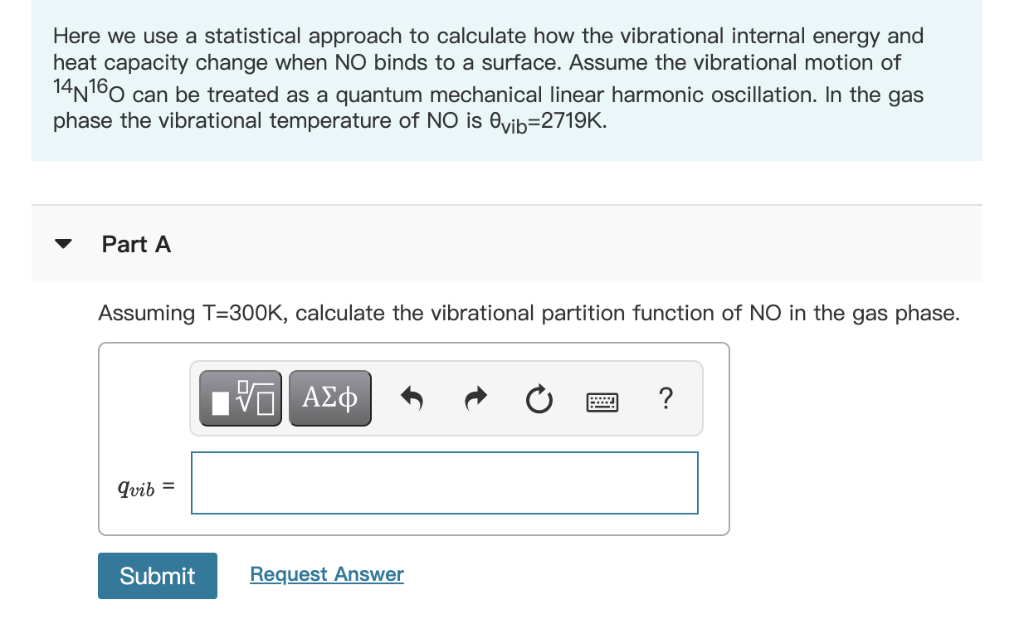
 Here we use a statistical approach to calculate how the vibrational internal energy and
heat capacity change when NO binds to a surface. Assume the vibrational motion of
14N80 can be treated as a quantum mechanical linear harmonic oscillation. In the gas
phase the vibrational temperature of NO is 8,;,=2719K.
v PartA
Assuming T=300K, calculate the vibrational partition function of NO in the gas phase.
0
“eos
Quit - rT]
Request Answer
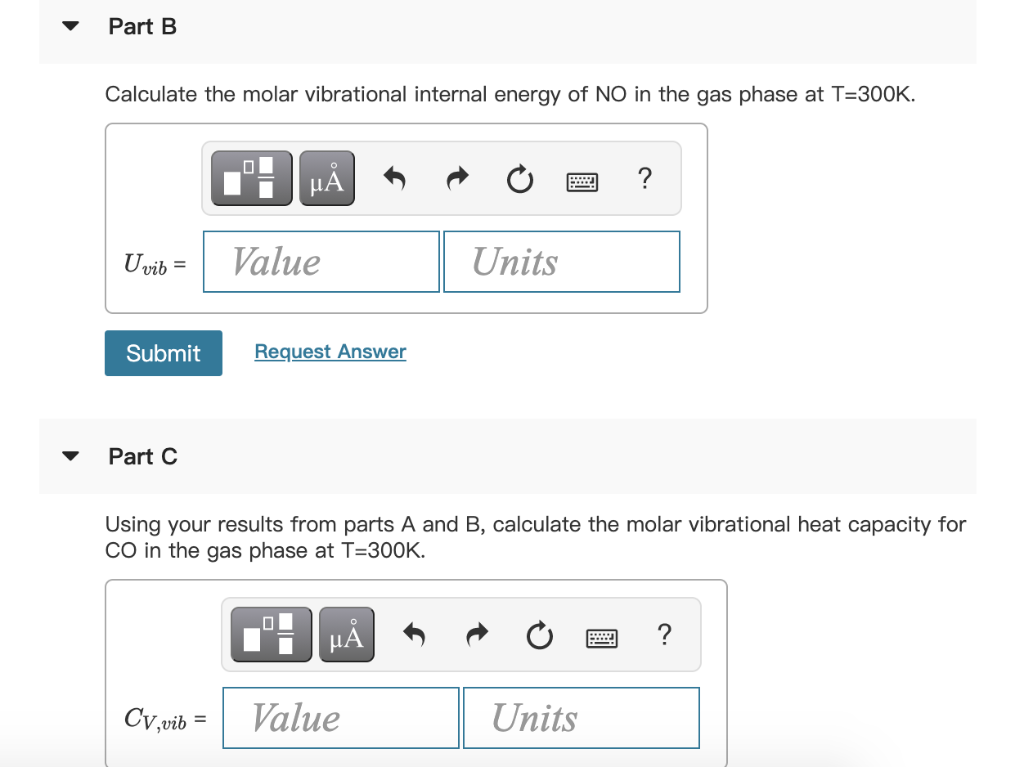
v PartB
Calculate the molar vibrational internal energy of NO in the gas phase at T=300K.
EB oo
Uas= | Value Units
Request Answer
v PartC
Using your results from parts A and B, calculate the molar vibrational heat capacity for
CO in the gas phase at T=300K.
vi] RR
Cvuiv=| Value Units
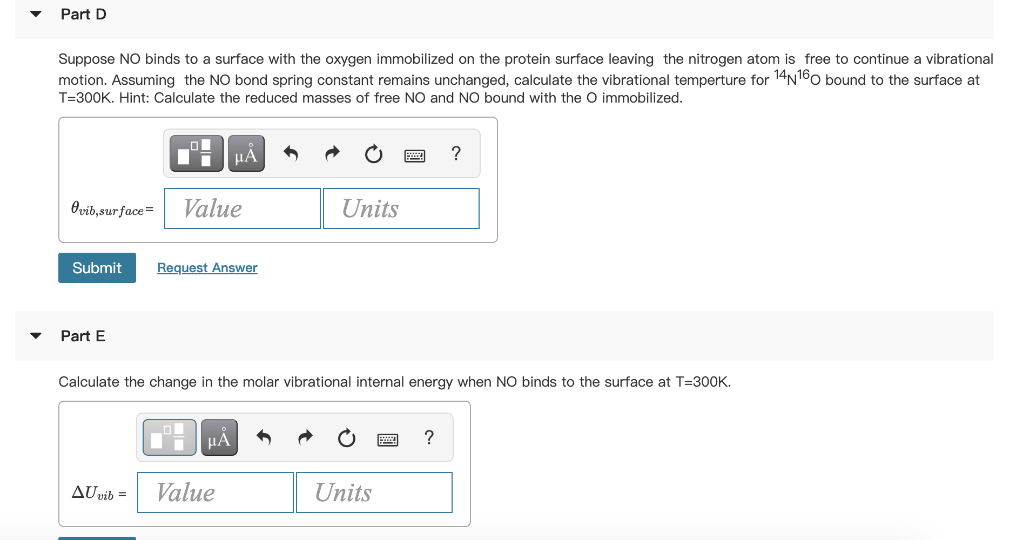
~ PartD
Suppose NO binds to a surface with the oxygen immobilized on the protein surface leaving the nitrogen atom is free to continue a vibrational
motion. Assuming the NO bond spring constant remains unchanged, calculate the vibrational temperture for ¥N'60 bound to the surface at
T=300K. Hint: Calculate the reduced masses of free NO and NO bound with the O immobilized.
Elo -
Buis,surace= | Value Units
v PartE
Calculate the change in the molar vibrational internal energy when NO binds to the surface at T=300K.
EB os"
AUw= | Value Units
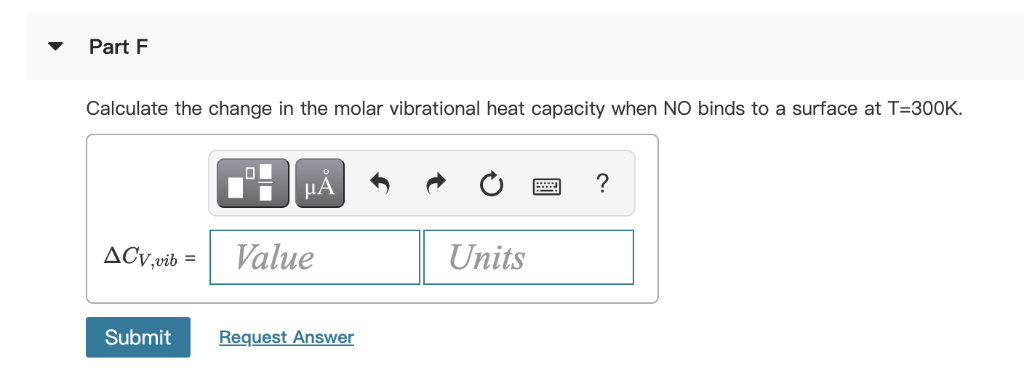
wv PartF
Calculate the change in the molar vibrational heat capacity when NO binds to a surface at T=300K.
ams » 0 ?
Request Answer
Asked by: amu
Created at: 2025-07-27 04:31:36
Final Answer:
📢 Instructions:
- Ask anything relatd to above question only.
- For new Question goto :