This is AI generated Response.
Asked by: amu
Created at: 2025-07-25 08:15:19
Final Answer:
RenderedRaw Text
Did you like this answer?
Let's answer each question step by step, with explanations:
---
### **Question 1**
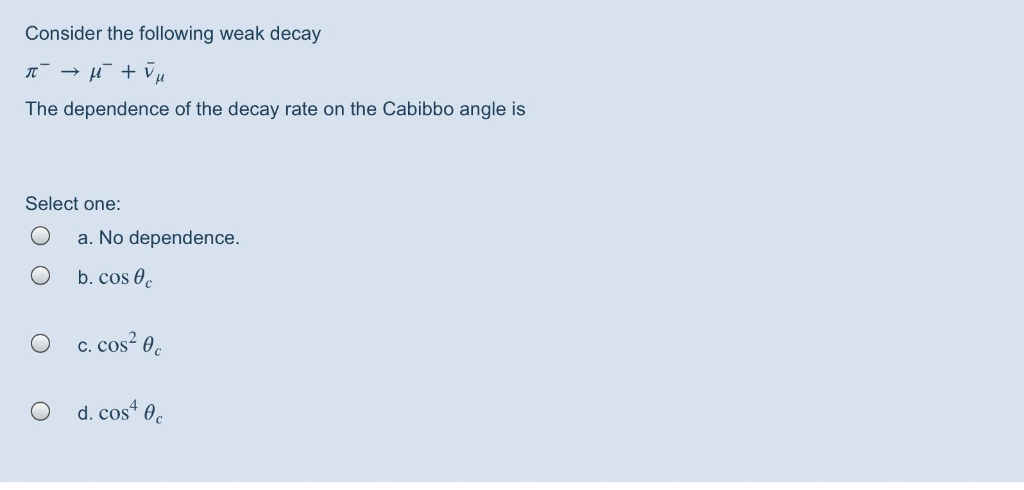
#### π⁻ → μ⁻ + ν̅_μ: Dependence of decay rate on Cabibbo angle
- **Step 1:** The π⁻ (pion) is made of a \( \bar{u} \) and \( d \) quark. The decay process is:
\( d \rightarrow u + W^- \rightarrow u + \mu^- + \bar{\nu}_\mu \)
- **Step 2:** The transition \( d \rightarrow u \) is a weak interaction, and its strength is proportional to \( \cos \theta_c \) (Cabibbo angle).
- **Step 3:** The decay rate depends on the square of the amplitude, so it's proportional to \( \cos^2 \theta_c \).
**Final Answer:**
**c. cos² θ_c**
*The decay rate is proportional to \( \cos^2 \theta_c \) for this process.*
---
### **Question 2**
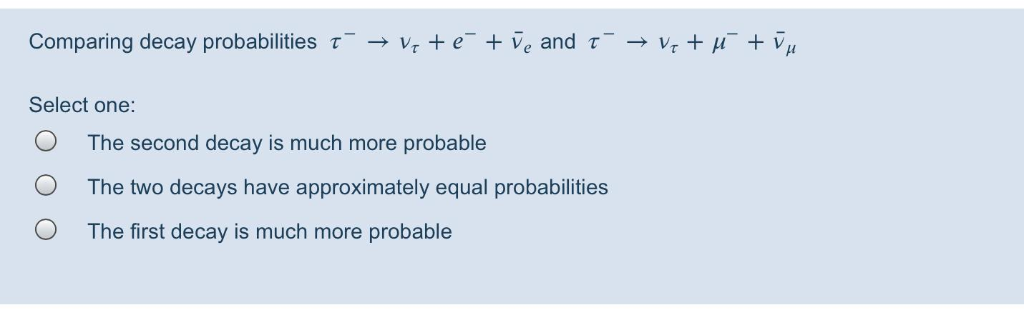
#### Comparing decay probabilities:
τ⁻ → ν_τ + e⁻ + ν̅_e
τ⁻ → ν_τ + μ⁻ + ν̅_μ
- **Step 1:** Both decays are leptonic, and the weak interaction does not distinguish between electrons and muons (ignoring small phase space differences due to mass).
- **Step 2:** The only difference is the mass of the muon vs. electron, but the phase space suppression for the muon channel is small for the τ lepton.
**Final Answer:**
**The two decays have approximately equal probabilities**
*Both processes are mediated by the same weak interaction and are nearly equally probable.*
---
### **Question 3**
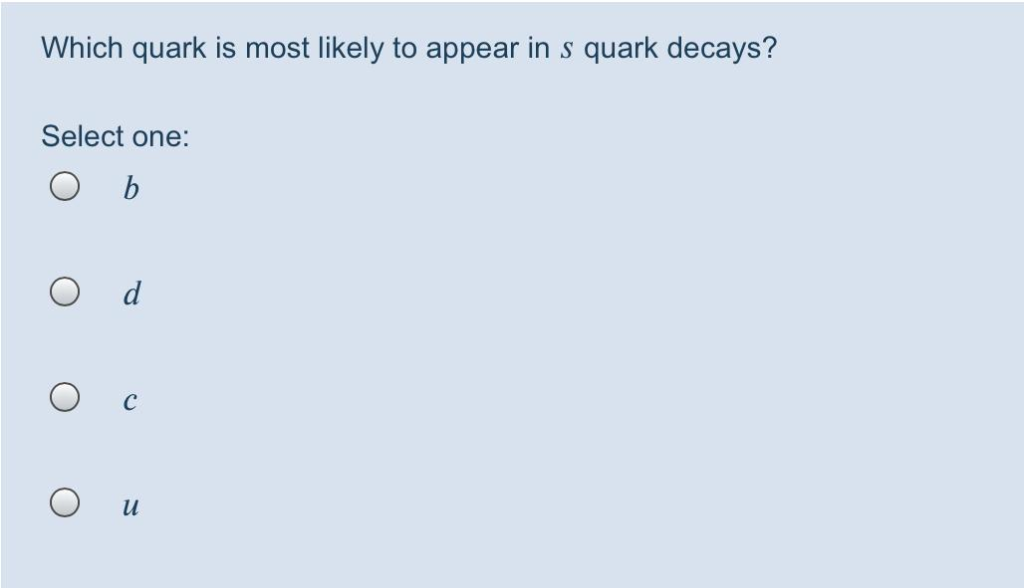
#### Which quark is most likely to appear in s quark decays?
- **Step 1:** The s quark (strange) decays via the weak interaction, predominantly to a u quark (since s → u is CKM suppressed, but s → d is dominant).
- **Step 2:** In reality, the dominant decay is \( s \rightarrow u + W^- \), but since the answer choices are about which appears most likely, we look at which quark is produced directly via weak decay.
- **Step 3:** The s quark most commonly decays into a u quark (Cabibbo-favored).
**Final Answer:**
**u**
*The u quark is most likely to appear in s quark decays.*
---
### **Question 4**
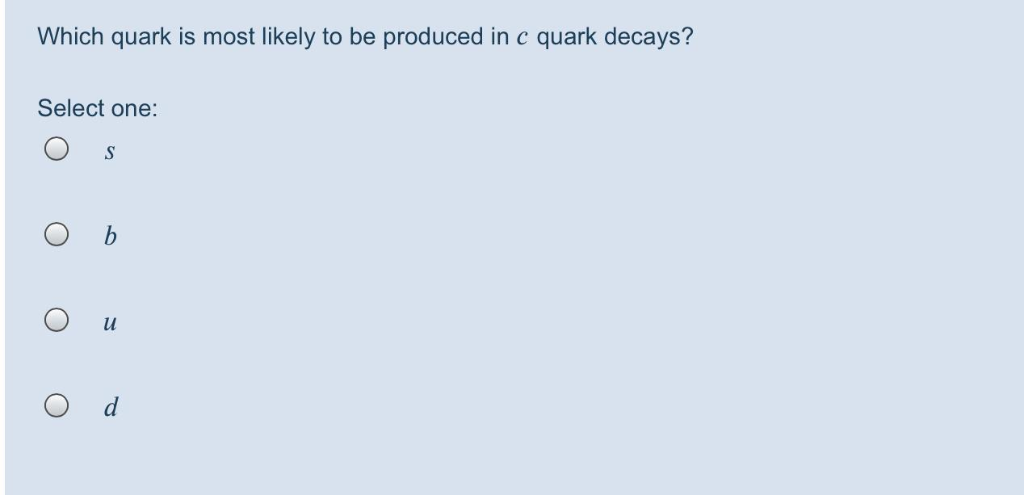
#### Which quark is most likely to be produced in c quark decays?
- **Step 1:** The c (charm) quark decays via the weak interaction, predominantly to a s quark.
- **Step 2:** This is due to the CKM matrix elements: \( c \rightarrow s \) is the most favored.
**Final Answer:**
**s**
*The s quark is most likely to be produced in c quark decays.*
---
### **Question 5**
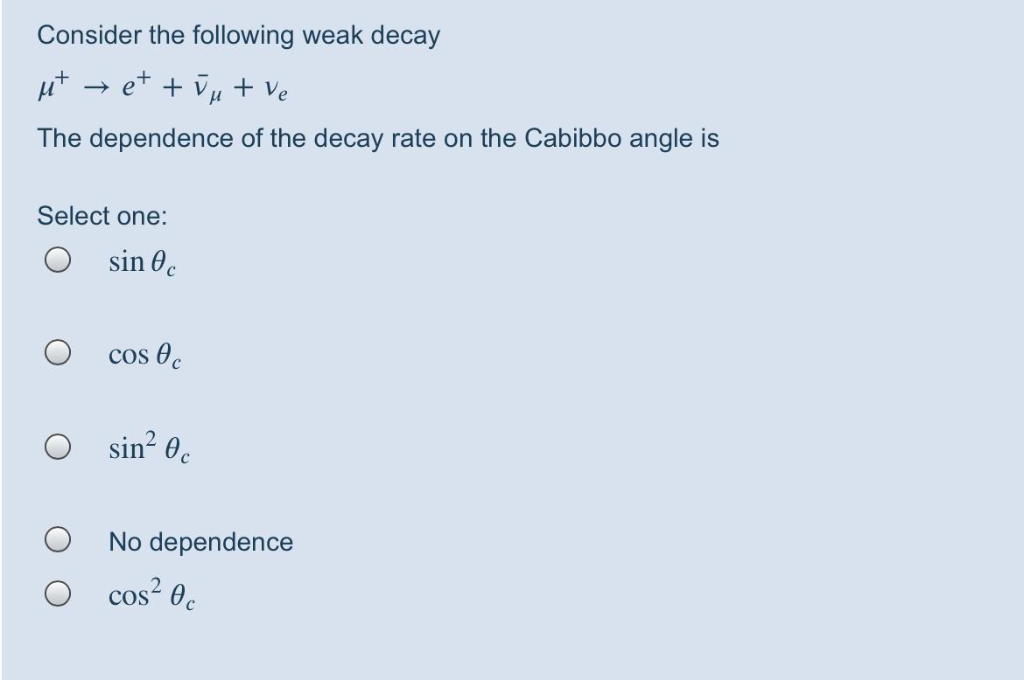
#### μ⁺ → e⁺ + ν̅_μ + ν_e: Dependence of decay rate on Cabibbo angle
- **Step 1:** This decay is purely leptonic, involving only leptons (no quarks).
- **Step 2:** The Cabibbo angle only affects weak decays involving quark flavor transitions, not purely leptonic decays.
**Final Answer:**
**No dependence**
*The decay rate does not depend on the Cabibbo angle for purely leptonic decays.*
---
### **Question 6**
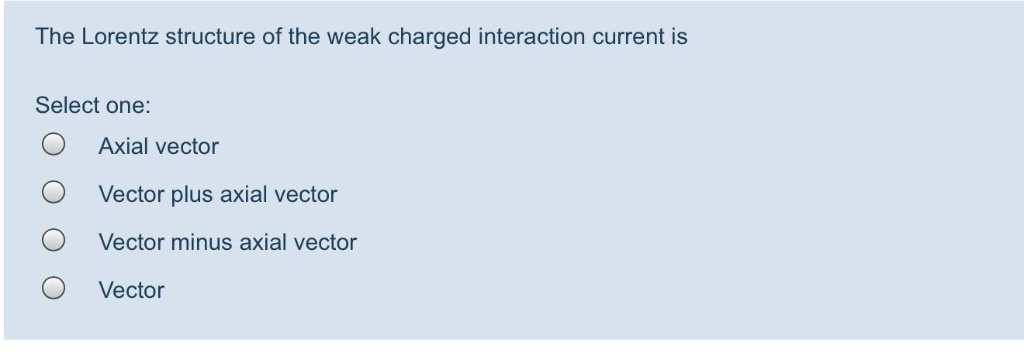
#### Lorentz structure of the weak charged interaction current
- **Step 1:** The weak charged current is described by the V–A (Vector minus Axial Vector) structure in the Standard Model.
- **Step 2:** This means the current is a combination: \( \text{Vector} - \text{Axial Vector} \).
**Final Answer:**
**Vector minus axial vector**
*The Lorentz structure is V–A (Vector minus Axial Vector).*
---
## **Summary of Answers**
1. **c. cos² θ_c**
2. **The two decays have approximately equal probabilities**
3. **u**
4. **s**
5. **No dependence**
6. **Vector minus axial vector**
VIPSolutions focuses on clear, step‑by‑step explanations so you can learn quickly. Whether you need an AI‑generated walkthrough or a short hint to get unstuck, each solution is organized for fast reading and easy review later.
Search similar questions, compare approaches, and bookmark the best answers for revision. Our goal is simple: quick, reliable study help that feels natural—not noisy.
 VIPSolutions
 Consider the following weak decay
Ta IE
The dependence of the decay rate on the Cabibbo angle is
Select one:
O a. No dependence.
O b.cosb.
O c.cos?6,
O d.cos*d,
Comparing decay probabilities 7~ — v; +e” + Voand 7° = v. + pu” +,
Select one:
O The second decay is much more probable
O The two decays have approximately equal probabilities
© The first decay is much more probable
Which quark is most likely to appear in s quark decays?
Select one:
@ Bb
® d
@ c
O wu
Which quark is most likely to be produced in ¢ quark decays?
Select one:
O
O »b
O u
O d
Consider the following weak decay
tot +9, +0,
The dependence of the decay rate on the Cabibbo angle is
Select one:
O sind,
O cosé,
O sin®6,
© No dependence
O cos?6,
The Lorentz structure of the weak charged interaction current is
Select one:
O Axial vector
O Vector plus axial vector
O Vector minus axial vector
O Vector