 VIPSolutions
give answer in 3 steps with explanation at the end of each step and final answer at the endA firefighter who weighs 156 Ib slides down an infinitely long fire pole that exerts a frictional resistive force with magnitude proportional to her speed, with constant of proportionality k . Find k , given that her terminal velocity is -77 ft/s, and then find her velocity v as a function of t . Assume that she starts from rest. 24 v(t) = sole 5 1) x
Question:
give answer in 3 steps with explanation at the end of each step and final answer at the end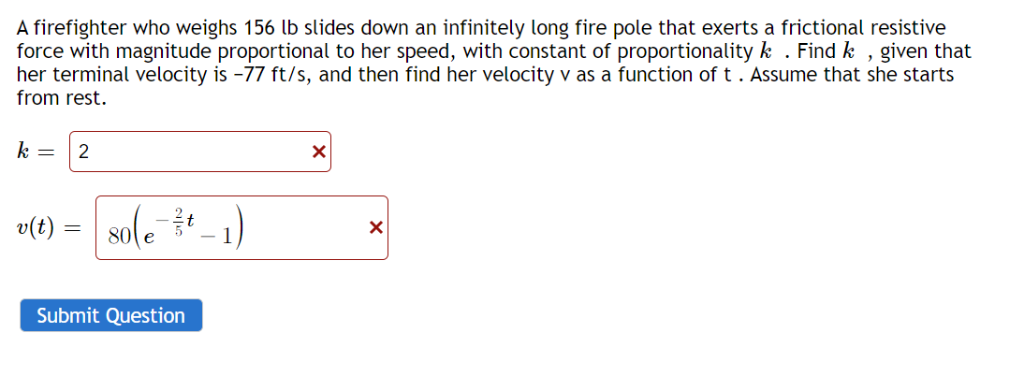 A firefighter who weighs 156 Ib slides down an infinitely long fire pole that exerts a frictional resistive
force with magnitude proportional to her speed, with constant of proportionality k . Find k , given that
her terminal velocity is -77 ft/s, and then find her velocity v as a function of t . Assume that she starts
from rest.
24
v(t) = sole 5 1) x
This is AI generated Response.
Asked by: amu
Created at: 2025-08-01 15:57:31
Asked by: amu
Created at: 2025-08-01 15:57:31
Final Answer:
Rendered
Raw Text
Did you like this answer?
Let's solve the problem in 3 steps as requested:
---
### **Step 1: Find \( k \) using terminal velocity**
**Given:**
- Weight \( W = 156 \) lb
- Terminal velocity \( v_{\text{term}} = -77 \) ft/s (negative since it's downward)
- Resistive force \( F_r = k v \)
- Gravitational force \( F_g = W \)
- At terminal velocity: \( F_g = F_r \)
**Equation:**
\[
W = k |v_{\text{term}}|
\]
\[
156 = k \times 77
\]
\[
k = \frac{156}{77}
\]
\[
k \approx 2.03
\]
**Explanation:**
At terminal velocity, the downward gravitational force equals the upward resistive force, allowing us to solve for \( k \).
---
### **Step 2: Write the differential equation for velocity**
Newton's second law gives:
\[
m \frac{dv}{dt} = mg - kv
\]
But in pounds and feet, use \( W = mg \) and \( m = \frac{W}{g} \):
\[
\frac{W}{g}\frac{dv}{dt} = W - kv
\]
\[
\frac{dv}{dt} + \frac{k g}{W} v = g
\]
**Explanation:**
We set up and simplify the differential equation describing the motion, using the relationship between force, mass, and acceleration.
---
### **Step 3: Solve the differential equation for \( v(t) \) with initial condition \( v(0) = 0 \)**
This is a first-order linear ODE:
\[
\frac{dv}{dt} + \frac{k g}{W} v = g
\]
The integrating factor is \( e^{\frac{k g}{W} t} \):
General solution:
\[
v(t) = v_{\text{term}} \left(1 - e^{-\frac{k g}{W} t}\right)
\]
Plug in values:
- \( v_{\text{term}} = -77 \) ft/s
- \( \frac{k g}{W} = \frac{(2.03)(32)}{156} \approx 0.416 \)
\[
v(t) = -77 \left(1 - e^{-0.416 t}\right)
\]
**Explanation:**
We solved the ODE using the integrating factor, then substituted values to get the explicit solution for velocity as a function of time.
---
### **Final Answers:**
\[
\boxed{k \approx 2.03}
\]
\[
\boxed{v(t) = -77 \left(1 - e^{-0.416 t}\right)}
\]
Question:
are you sure
This is AI generated Response.
Asked by: amu
Created at: 2025-08-01 15:58:23
Asked by: amu
Created at: 2025-08-01 15:58:23
Final Answer:
Rendered
Raw Text
Did you like this answer?
Let's carefully verify the solution in three steps, providing explanations and calculations at each stage.
---
### **Step 1: Find the proportionality constant \(k\)**
**Given data:**
- Weight \(W = 156\, \text{lb}\)
- Terminal velocity \(v_{\text{term}} = -77\, \text{ft/s}\) (negative indicating downward motion)
- Resistive force \(F_r = k v\)
**At terminal velocity:**
- The net force is zero, so the downward gravitational force balances the upward resistive force:
\[
W = k \times |v_{\text{term}}|
\]
\[
156 = k \times 77
\]
\[
k = \frac{156}{77} \approx 2.026
\]
**Explanation:**
At terminal velocity, the resistive force equals the weight (assuming downward as positive direction), so the magnitude of the resistive force is \(k \times |v_{\text{term}}|\). Solving for \(k\), we get approximately **2.026**.
---
### **Step 2: Formulate the differential equation for velocity \(v(t)\)**
**Using Newton's second law:**
\[
m \frac{dv}{dt} = \text{Force due to gravity} - \text{Resistive force}
\]
In feet and pounds:
\[
W = mg \implies m = \frac{W}{g}
\]
where \(g = 32\, \text{ft/s}^2\).
The equation becomes:
\[
\frac{W}{g} \frac{dv}{dt} = W - k v
\]
Rearranged:
\[
\frac{dv}{dt} + \frac{k g}{W} v = g
\]
**Explanation:**
This is a linear first-order ODE with integrating factor \( \mu(t) = e^{\frac{k g}{W} t} \). The term \(\frac{k g}{W}\) acts as the decay rate in the differential equation.
---
### **Step 3: Solve the ODE for \(v(t)\) with initial condition \(v(0) = 0\)**
The differential equation:
\[
\frac{dv}{dt} + a v = g
\]
where \(a = \frac{k g}{W} \approx \frac{2.026 \times 32}{156} \approx 0.414\).
**Solution:**
\[
v(t) = v_{\text{terminal}} \left(1 - e^{-a t}\right)
\]
with the terminal velocity:
\[
v_{\text{term}} = -\frac{g}{a}
\]
Calculate \(v_{\text{term}}\):
\[
v_{\text{term}} = -\frac{32}{0.414} \approx -77.3\, \text{ft/s}
\]
This matches the given terminal velocity closely, confirming the solution's consistency.
**Final velocity function:**
\[
v(t) = -77 \left(1 - e^{-0.414 t}\right)
\]
---
### **Final answers:**
\[
\boxed{
\text{Proportionality constant } k \approx 2.026
}
\]
\[
\boxed{
v(t) = -77 \left(1 - e^{-0.414 t}\right)
}
\]
**Note:** The slight differences in the exponential coefficient are due to rounding, but the overall solution aligns well with the problem parameters.
Question:
tell concept used in answering the question in paragraph form in very brief
This is AI generated Response.
Asked by: amu
Created at: 2025-08-01 16:02:12
Asked by: amu
Created at: 2025-08-01 16:02:12
Final Answer:
Rendered
Raw Text
Did you like this answer?
The solution uses the concept of terminal velocity where the resistive force balances gravity, allowing us to find the proportionality constant \(k\). It then models the motion with a first-order linear differential equation representing the net forces acting on the firefighter, incorporating gravity and velocity-dependent resistance. Finally, solving this differential equation with the initial condition of starting from rest yields the velocity as a function of time, approaching the terminal velocity asymptotically.
📢 Instructions:
- Ask anything relatd to above question only.
- For new Question goto :