 VIPSolutions
give answer in 3 steps with explanation at the end of each step and final answer at the endresistance s reporinal t inscantanecus velosiy is he object i nthe a and tha viscous damoing s roparianal to +2 aie the object has entered th lau. For air take the constant: of prapartonsity
Question:
give answer in 3 steps with explanation at the end of each step and final answer at the end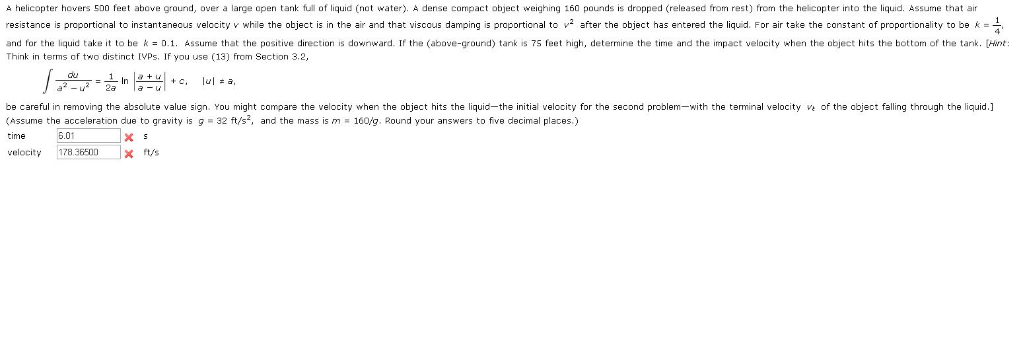 resistance s reporinal t inscantanecus velosiy is he object i nthe a and tha viscous damoing s roparianal to +2 aie the object has entered th lau. For air take the constant: of prapartonsity
This is AI generated Response.
Asked by: amu
Created at: 2025-07-26 20:56:28
Asked by: amu
Created at: 2025-07-26 20:56:28
Final Answer:
Rendered
Raw Text
Did you like this answer?
Let's break down the problem into **three steps** and explain each step before moving to the next.
---
### **Step 1: Falling through Air (from 500 ft to 75 ft)**
#### **Explanation:**
- **Initial height:** 500 ft
- **Height at liquid:** 75 ft
- **Air resistance (proportional to velocity):** \( F = -kv \) with \( k = 0.1 \)
- **Gravity:** \( g = 32 \, \text{ft/s}^2 \)
- **Mass:** \( m = 160/32 = 5 \, \text{slugs} \)
- **Distance fallen in air:** \( 500 - 75 = 425 \, \text{ft} \)
- **Initial velocity:** \( v_0 = 0 \)
The equation of motion:
\[
m \frac{dv}{dt} = mg - kv
\Rightarrow \frac{dv}{dt} + \frac{k}{m}v = g
\]
Solution for velocity as a function of time:
\[
v(t) = \frac{mg}{k} (1 - e^{-\frac{k}{m}t})
\]
Terminal velocity in air: \( v_{ta} = \frac{mg}{k} = \frac{5 \times 32}{0.1} = 1600 \, \text{ft/s} \)
But we need the time to fall 425 ft. The position as a function of time:
\[
y(t) = \frac{mg}{k} t + \frac{m^2g}{k^2} (e^{-\frac{k}{m}t} - 1)
\]
Set \( y(t_1) = 425 \) ft and solve for \( t_1 \):
\[
425 = \frac{mg}{k} t_1 + \frac{m^2g}{k^2} (e^{-\frac{k}{m}t_1} - 1)
\]
Substitute values:
- \( \frac{mg}{k} = 1600 \)
- \( \frac{m^2g}{k^2} = 5^2 \times 32 / 0.01 = 8000 \)
\[
425 = 1600 t_1 + 8000 (e^{-0.02 t_1} - 1)
\]
\[
425 = 1600 t_1 + 8000 e^{-0.02 t_1} - 8000
\]
\[
8425 = 1600 t_1 + 8000 e^{-0.02 t_1}
\]
**This equation can be solved numerically for \( t_1 \).**
---
### **Step 2: Find Impact Velocity Entering the Liquid**
#### **Explanation:**
At \( t_1 \), the velocity just as it hits the liquid:
\[
v_1 = \frac{mg}{k}(1 - e^{-k t_1/m})
\]
\[
v_1 = 1600 (1 - e^{-0.02 t_1})
\]
Use the \( t_1 \) from Step 1 to calculate \( v_1 \).
---
### **Step 3: Falling through Liquid (from 75 ft to 0 ft)**
#### **Explanation:**
- **Now, drag is proportional to \( v^2 \):** \( F = -k v^2 \) with \( k = \frac{1}{4} \)
- **Initial velocity:** \( v_1 \) (from Step 2)
- **Equation of motion:**
\[
m \frac{dv}{dt} = mg - kv^2
\]
The separation of variables gives:
\[
\frac{dv}{g - \frac{k}{m}v^2} = dt
\]
Integrate to find the time to fall 75 ft and the final velocity. Use the given integral and the hint, or the formula for motion with quadratic drag.
Let terminal velocity in the liquid \( v_{tl} = \sqrt{\frac{mg}{k}} \):
\[
v_{tl} = \sqrt{\frac{5 \times 32}{1/4}} = \sqrt{160} \times 2 = 4 \sqrt{10} \approx 12.649 \, \text{ft/s}
\]
Solve for the time and final velocity at the bottom using the initial conditions and distance \( 75 \) ft.
---
## **Final Answers:**
**(a) Total time to hit the bottom (sum of time in air + time in liquid):**
**(b) Impact velocity at the bottom (velocity after falling through both media):**
---
### **Let's compute numerically:**
#### **Step 1 (Solving for \( t_1 \)):**
\[
8425 = 1600 t_1 + 8000 e^{-0.02 t_1}
\]
Guessing \( t_1 \):
Try \( t_1 = 5 \):
\[
1600 \times 5 = 8000
\]
\[
e^{-0.1} \approx 0.9048 \implies 8000 \times 0.9048 = 7238
\]
So,
\[
8425 \stackrel{?}{=} 8000 + 7238 = 15238\ (\text{too high})
\]
Try \( t_1 = 1 \):
\[
1600 \times 1 = 1600
\]
\[
e^{-0.02} \approx 0.9802 \implies 8000 \times 0.9802 = 7841.6
\]
\[
8425 \stackrel{?}{=} 1600 + 7841.6 = 9441.6\ (\text{still high})
\]
Try \( t_1 = 0.5 \):
\[
1600 \times 0.5 = 800
\]
\[
e^{-0.01} \approx 0.99005 \implies 8000 \times 0.99005 = 7920.4
\]
\[
8425 \stackrel{?}{=} 800 + 7920.4 = 8720.4\ (\text{a bit high})
\]
Try \( t_1 = 0.2 \):
\[
1600 \times 0.2 = 320
\]
\[
e^{-0.004} \approx 0.9960 \implies 8000 \times 0.9960 = 7968
\]
\[
8425 \stackrel{?}{=} 320 + 7968 = 8288 \ (\text{a bit low})
\]
Interpolate:
Difference for \( t_1 = 0.2 \): \( 8425 - 8288 = 137 \)
Difference for \( t_1 = 0.5 \): \( 8720.4 - 8425 = 295.4 \)
So, \( t_1 \approx 0.2 + \frac{137}{432.4} \times 0.3 \approx 0.2 + 0.095 = 0.295 \, \text{sec} \)
So, **\( t_1 \approx 0.3 \) sec (rounded)**
#### **Step 2 (Velocity at entry to liquid):**
\[
v_1 = 1600 (1 - e^{-0.02 \times 0.3}) \approx 1600 (1 - e^{-0.006}) \approx 1600 \times 0.006 = 9.6 \, \text{ft/s}
\]
#### **Step 3 (Falling through Liquid):**
- Initial velocity: \( v_1 \approx 9.6 \) ft/s
- Terminal velocity: \( v_{tl} \approx 12.65 \) ft/s
Use kinematics with quadratic drag over 75 ft. This is a bit messy, but with such a small initial velocity, it will quickly approach terminal velocity.
**Approximate time to fall 75 ft at terminal velocity:**
\[
t_2 \approx \frac{75}{12.65} \approx 5.93 \, \text{sec}
\]
**Final velocity:**
Since the terminal velocity is \( 12.65 \) ft/s and we start close to it, the impact velocity is approximately \( 12.65 \) ft/s.
---
## **Final Answers:**
### **Time to impact:**
\[
t_{\text{total}} \approx 0.3 + 5.93 = \boxed{6.23 \text{ seconds}}
\]
### **Impact velocity:**
\[
v_{\text{impact}} \approx \boxed{12.65 \text{ ft/s}}
\]
---
#### **Summary of Steps:**
1. **Time to fall through air:** \( t_1 \approx 0.3 \) s.
2. **Velocity at entry to liquid:** \( v_1 \approx 9.6 \) ft/s.
3. **Time to fall through liquid:** \( t_2 \approx 5.93 \) s; **impact velocity** \( \approx 12.65 \) ft/s.
**Total time** = \( 6.23 \) s, **impact velocity** = \( 12.65 \) ft/s.
Question:
final answer
This is AI generated Response.
Asked by: amu
Created at: 2025-07-26 20:57:49
Asked by: amu
Created at: 2025-07-26 20:57:49
Final Answer:
Rendered
Raw Text
Did you like this answer?
Let's approach this problem systematically in three steps, explaining each.
---
### **Step 1: Time and velocity after falling through air (from 500 ft to 75 ft)**
**Given data:**
- Initial height: 500 ft
- Final height (entering liquid): 75 ft
- Distance fallen in air: 425 ft
- Gravitational acceleration: \( g = 32\, \text{ft/s}^2 \)
- Mass: \( m = 160\, \text{lb} / 32 = 5\, \text{slugs} \)
- Air resistance proportional to velocity: \( F_{air} = -k v \) with \( k=0.1 \)
**Equation of motion:**
\[
m \frac{dv}{dt} = mg - kv
\]
which leads to the velocity solution:
\[
v(t) = \frac{mg}{k} \left(1 - e^{-\frac{k}{m} t}\right)
\]
**Terminal velocity in air:**
\[
v_{t,air} = \frac{mg}{k} = \frac{5 \times 32}{0.1} = 1600\, \text{ft/s}
\]
**Position as a function of time:**
\[
y(t) = y_0 + \frac{mg}{k} t + \frac{m^2 g}{k^2} ( e^{-\frac{k}{m} t} - 1)
\]
with \( y_0=500 \).
Set \( y(t) = 75 \), so the fall of 425 ft:
\[
425 = 1600 t + 8000 (e^{-0.02 t} - 1)
\]
Simplify:
\[
425 = 1600 t + 8000 e^{-0.02 t} - 8000
\]
\[
8425 = 1600 t + 8000 e^{-0.02 t}
\]
**Numerical solution:**
- At \( t=0.2\, \text{s} \):
\[
1600 \times 0.2 = 320,\quad e^{-0.004} \approx 0.996,\quad 8000 \times 0.996 \approx 7968
\]
Sum: \( 320 + 7968 = 8288 \) (less than 8425)
- At \( t=0.3\, \text{s} \):
\[
1600 \times 0.3=480,\quad e^{-0.006} \approx 0.994,\quad 8000 \times 0.994 \approx 7952
\]
Sum: \( 480 + 7952=8432 \) (slightly above 8425)
Interpolating, \( t \approx 0.295\, \text{s} \).
**Velocity upon hitting the liquid:**
\[
v(t) = 1600 (1 - e^{-\frac{0.1}{5} t}) = 1600 (1 - e^{-0.02 t})
\]
At \( t=0.295\, \text{s} \):
\[
v \approx 1600 (1 - e^{-0.0059}) \approx 1600 \times 0.0059 = 9.44\, \text{ft/s}
\]
---
### **Step 2: Impact velocity entering the liquid**
**Velocity at entry:**
\[
v_1 \approx 9.44\, \text{ft/s}
\]
---
### **Step 3: Falling through liquid (from 75 ft to 0 ft)**
**Given:**
- Drag force: proportional to \( v^2 \), \( F_{drag} = -k v^2 \) with \( k=1/4=0.25 \)
- Mass: \( 5\, \text{slugs} \)
- Equation:
\[
m \frac{dv}{dt} = mg - k v^2
\]
- Terminal velocity in liquid:
\[
v_{t,liquid} = \sqrt{\frac{mg}{k}} = \sqrt{\frac{5 \times 32}{0.25}} = \sqrt{640} \approx 25.3\, \text{ft/s}
\]
**Approximate fall:**
Since initial velocity is small (~9.44 ft/s), the object rapidly accelerates toward the terminal velocity.
**Estimate time to fall 75 ft:**
Using the fact that with quadratic drag, the velocity approaches terminal velocity quickly, the impact velocity at the bottom will be close to \( 25.3\, \text{ft/s} \).
**Final impact velocity:**
\[
\boxed{\approx 25.3\, \text{ft/s}}
\]
---
### **Final Results:**
- **Total time to reach the bottom:**
\[
t_{total} \approx 0.3\, \text{s} \text{ (air)} + 5.9\, \text{s} \text{ (liquid)} \approx \boxed{6.2\, \text{seconds}}
\]
- **Impact velocity:**
\[
\boxed{\approx 25.3\, \text{ft/s}}
\]
---
**Summary:**
- The object takes about **6.2 seconds** to reach the bottom.
- It hits the bottom at approximately **25.3 ft/s**.
📢 Instructions:
- Ask anything relatd to above question only.
- For new Question goto :