 VIPSolutions
give answer in 3 steps with explanation at the end of each step and final answer at the end§2E PoE Za Ee.2 £28 gd He HE Es £i2 =o 258 = Fog =< E FEE FEI Ses E85 5 52 gE sh ap 58s igs 288 = Eg gE EH £3 = £58 5g ERS
Question:
give answer in 3 steps with explanation at the end of each step and final answer at the end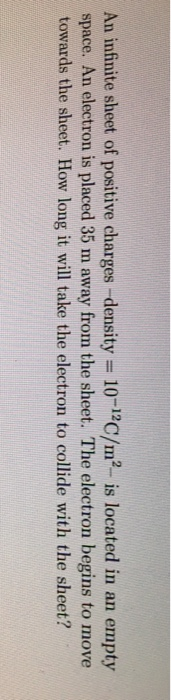 §2E
PoE
Za
Ee.2
£28
gd
He
HE
Es
£i2
=o
258
=
Fog
=< E
FEE
FEI
Ses
E85
5 52
gE sh
ap
58s
igs
288
=
Eg
gE EH
£3
=
£58
5g
ERS
This is AI generated Response.
Asked by: amu
Created at: 2025-07-26 15:09:33
Asked by: amu
Created at: 2025-07-26 15:09:33
Final Answer:
Rendered
Raw Text
Did you like this answer?
Let's break down the problem step-by-step:
---
**Step 1: Find the Electric Field due to the Sheet**
For an infinite sheet of charge, the electric field \( E \) at any point near the sheet is given by:
\[
E = \frac{\sigma}{2\epsilon_0}
\]
where
\(\sigma = 10^{-12} \, \text{C/m}^2\) (surface charge density),
\(\epsilon_0 = 8.85 \times 10^{-12} \, \text{C}^2/\text{N}\cdot \text{m}^2\) (permittivity of free space).
Plug in the values:
\[
E = \frac{10^{-12}}{2 \times 8.85 \times 10^{-12}}
= \frac{1}{2 \times 8.85}
= \frac{1}{17.7}
\approx 0.0565 \, \text{N/C}
\]
**Explanation:**
This electric field is constant everywhere near the sheet and points away from the sheet (since it's positively charged).
---
**Step 2: Find the Acceleration of the Electron**
The force on the electron due to the electric field is:
\( F = eE \), where \( e = 1.6 \times 10^{-19} \, \text{C} \) (charge of electron).
The acceleration, \( a \), is:
\[
a = \frac{F}{m_e} = \frac{eE}{m_e}
\]
where \( m_e = 9.11 \times 10^{-31} \, \text{kg} \) (mass of electron).
Plug in the values:
\[
a = \frac{1.6 \times 10^{-19} \times 0.0565}{9.11 \times 10^{-31}}
= \frac{9.04 \times 10^{-21}}{9.11 \times 10^{-31}}
\approx 9.93 \times 10^{9} \, \text{m/s}^2
\]
**Explanation:**
The electron will accelerate towards the sheet under this constant acceleration.
---
**Step 3: Find the Time to Reach the Sheet**
Initial distance, \( d = 3.5 \, \text{m} \), initial velocity, \( u = 0 \).
Use the equation:
\[
d = ut + \frac{1}{2}at^2
\]
Since \( u = 0 \):
\[
d = \frac{1}{2}at^2 \implies t = \sqrt{\frac{2d}{a}}
\]
Plug in the values:
\[
t = \sqrt{\frac{2 \times 3.5}{9.93 \times 10^9}}
= \sqrt{\frac{7}{9.93 \times 10^9}}
= \sqrt{7.05 \times 10^{-10}}
\approx 2.66 \times 10^{-5} \, \text{s}
\]
**Explanation:**
This represents the time it takes the electron to accelerate and reach the sheet.
---
### **Final Answer**
\[
\boxed{t \approx 2.7 \times 10^{-5} \, \text{seconds}}
\]
The electron will take approximately **\(2.7 \times 10^{-5}\) seconds** to collide with the sheet.
Question:
tell concept used in answering the question in paragraph form in very brief
This is AI generated Response.
Asked by: amu
Created at: 2025-07-26 15:10:55
Asked by: amu
Created at: 2025-07-26 15:10:55
Final Answer:
Rendered
Raw Text
Did you like this answer?
The problem employs the concept of electric field due to an infinite charged sheet, which remains constant with distance. Using the surface charge density, we calculate the electric field strength. Then, applying Newton's second law, we determine the electron's acceleration caused by this electric field. Finally, using kinematic equations for uniformly accelerated motion, we find the time taken for the electron to travel the given distance to reach the sheet.
📢 Instructions:
- Ask anything relatd to above question only.
- For new Question goto :