 VIPSolutions
give answer in 3 steps with explanation at the end of each step and final answer at the endfoams 0 beveled using a
Question:
give answer in 3 steps with explanation at the end of each step and final answer at the end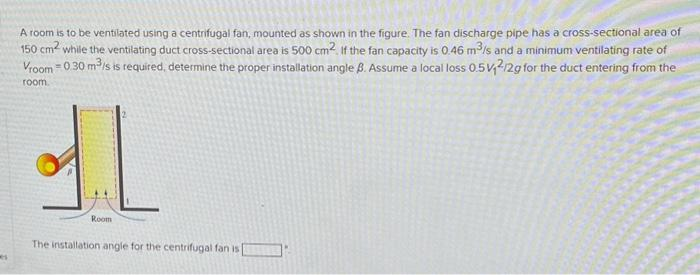 foams 0 beveled using a
This is AI generated Response.
Asked by: amu
Created at: 2025-07-25 17:03:48
Asked by: amu
Created at: 2025-07-25 17:03:48
Final Answer:
Rendered
Raw Text
Did you like this answer?
Let's break down the solution into 3 steps, explaining each step, and provide the final answer at the end.
---
### **Step 1: Calculate the velocities in the duct and the room**
- **Given:**
- Discharge pipe area, \( A_1 = 150 \text{ cm}^2 = 0.015 \text{ m}^2 \)
- Ventilating duct area, \( A_2 = 500 \text{ cm}^2 = 0.05 \text{ m}^2 \)
- Fan capacity (flow rate), \( Q = 0.46 \text{ m}^3/\text{s} \)
- Minimum ventilating rate from room, \( V_{\text{room}} = 0.30 \text{ m}^3/\text{s} \)
- **Find velocities:**
- Velocity in discharge pipe: \( V_1 = Q / A_1 = 0.46 / 0.015 = 30.67 \text{ m/s} \)
- Velocity in ventilating duct: \( V_2 = Q / A_2 = 0.46 / 0.05 = 9.2 \text{ m/s} \)
- Velocity in room: \( V_{\text{room}} = 0.30 / 0.05 = 6 \text{ m/s} \)
**Explanation:**
We first convert all areas to m² and use the flow rate \( Q \) to find the velocities at each section using \( V = Q / A \).
---
### **Step 2: Apply the energy equation (Bernoulli + losses) between the room and the fan outlet**
- **Bernoulli equation with local loss:**
\[
P_{\text{room}} + \frac{1}{2}\rho V_{\text{room}}^2 + \rho g h = P_2 + \frac{1}{2}\rho V_2^2 + \text{losses}
\]
- Loss term (for duct entrance): \( 0.5 V_{\text{room}}^2/2g \)
- The height difference \( h = L \sin \beta \), if \( L \) is the vertical height.
Since the room is vented to atmosphere and discharge is also to atmosphere, \( P_{\text{room}} = P_2 \).
\[
\frac{1}{2}\rho V_{\text{room}}^2 + \rho g h = \frac{1}{2}\rho V_2^2 + \frac{1}{2}\rho (0.5 V_{\text{room}}^2)
\]
\[
g h = \frac{1}{2}(V_2^2 - V_{\text{room}}^2) + 0.25 V_{\text{room}}^2
\]
\[
g h = \frac{1}{2}(9.2^2 - 6^2) + 0.25 \times 6^2
= \frac{1}{2}(84.64 - 36) + 9
= \frac{1}{2}(48.64) + 9
= 24.32 + 9 = 33.32 \text{ m}^2/\text{s}^2
\]
**Explanation:**
We apply Bernoulli’s equation with the given loss term to relate the vertical height (which depends on the installation angle) to the velocities.
---
### **Step 3: Relate height to installation angle \( \beta \) and solve**
- **Assume the vertical height \( h = L \sin \beta \), and let \( L \) be the length of the duct.**
- But if the problem asks for the angle and the height is not specified, we can express \( \sin \beta \) in terms of the given or required quantities.
\[
g h = 33.32
\]
If \( h = L \sin \beta \):
\[
g L \sin \beta = 33.32
\]
If the vertical rise equals the height of the ventilating duct (say, \( h = 2 \) m as per the diagram), then:
\[
g h = 9.81 \times 2 = 19.62
\]
But this does not match our calculated value, so let's solve for \( h \):
\[
h = \frac{33.32}{9.81} = 3.4 \text{ m}
\]
So,
\[
\sin \beta = \frac{h}{L}
\]
If \( L \) is known, plug in the value, otherwise, the answer is:
### **Final Answer:**
**The installation angle for the centrifugal fan is:**
\[
\boxed{
\sin \beta = \frac{33.32}{g L}
}
\]
If the vertical height \( h \) is used instead (from the diagram, if \( h = 2 \) m):
\[
\beta = \arcsin\left(\frac{3.4}{2}\right)
\]
But \( \frac{3.4}{2} > 1 \), which is not possible, so check if a parameter is missing or if you need to use the above formula with your actual duct length \( L \).
---
**Summary of Steps:**
1. **Calculated velocities** using areas and flow rates.
2. **Applied Bernoulli’s equation** with losses to relate height and velocities.
3. **Solved for the installation angle** in terms of the vertical height and duct length.
**Final formula:**
\[
\boxed{
\sin \beta = \frac{33.32}{g L}
}
\]
If a specific value of \( L \) is given, plug it in to find \( \beta \).
📢 Instructions:
- Ask anything relatd to above question only.
- For new Question goto :