 VIPSolutions
give answer in 3 steps with explanation at the end of each step and final answer at the endYou want to make a lens with a focal length of 100 cm out of diamond, with index of refraction 2.4. If one surface is convex with radius of curvature = 50 cm, what should the radius of the other surface be, in cm? You want to make a lens with a focal length of 100 cm out of diamond, with index of refraction 2.4. If one surface is concave with radius of curvature = 50 cm, what should the radius of the other surface be, in cm?
Question:
give answer in 3 steps with explanation at the end of each step and final answer at the end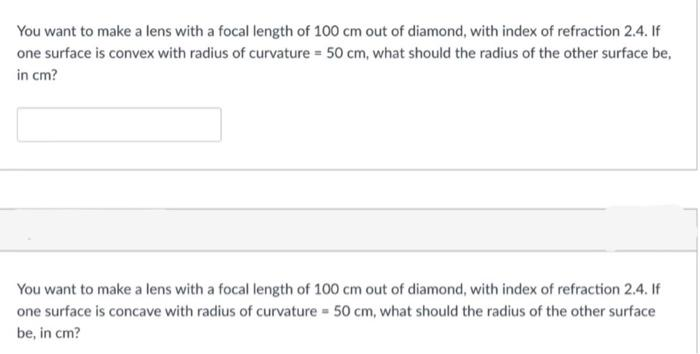 You want to make a lens with a focal length of 100 cm out of diamond, with index of refraction 2.4. If
one surface is convex with radius of curvature = 50 cm, what should the radius of the other surface be,
in cm?
You want to make a lens with a focal length of 100 cm out of diamond, with index of refraction 2.4. If
one surface is concave with radius of curvature = 50 cm, what should the radius of the other surface
be, in cm?
This is AI generated Response.
Asked by: amu
Created at: 2025-07-25 16:18:24
Asked by: amu
Created at: 2025-07-25 16:18:24
Final Answer:
Rendered
Raw Text
Did you like this answer?
Let's solve **both questions step by step** using the **Lens Maker's Formula**:
\[
\frac{1}{f} = (n - 1) \left[ \frac{1}{R_1} - \frac{1}{R_2} \right]
\]
where:
- \( f \) = focal length
- \( n \) = refractive index of material
- \( R_1 \) = radius of curvature of first surface (positive for convex, negative for concave)
- \( R_2 \) = radius of curvature of second surface (positive if the center of curvature is to the right of the surface)
---
### **First Question:**
**One surface is convex with \( R_1 = +50 \) cm.**
#### **Step 1: Write the Lens Maker's Formula with values**
Given:
- \( f = 100 \) cm
- \( n = 2.4 \)
- \( R_1 = +50 \) cm
- \( R_2 = ? \)
\[
\frac{1}{100} = (2.4 - 1) \left[ \frac{1}{50} - \frac{1}{R_2} \right]
\]
**Explanation:**
Substituted given values into the lens maker's formula.
---
#### **Step 2: Simplify the Equation**
\[
\frac{1}{100} = 1.4 \left[ \frac{1}{50} - \frac{1}{R_2} \right]
\]
\[
\frac{1}{100} \div 1.4 = \frac{1}{50} - \frac{1}{R_2}
\]
\[
\frac{1}{140} = \frac{1}{50} - \frac{1}{R_2}
\]
**Explanation:**
Divided both sides by 1.4 to isolate the bracket.
---
#### **Step 3: Solve for \( R_2 \)**
\[
\frac{1}{R_2} = \frac{1}{50} - \frac{1}{140}
\]
\[
\frac{1}{R_2} = \frac{140 - 50}{7000}
\]
\[
\frac{1}{R_2} = \frac{90}{7000} = \frac{9}{700}
\]
\[
R_2 = \frac{700}{9} \approx 77.8 \text{ cm}
\]
**Explanation:**
Found the value for \( R_2 \) by calculating the difference.
---
### **Final Answer (First Question):**
**The radius of curvature of the other surface should be approximately \( \boxed{77.8\ \text{cm}} \).**
---
---
### **Second Question:**
**One surface is concave with \( R_1 = -50 \) cm.**
#### **Step 1: Write the Lens Maker's Formula with values**
Given:
- \( f = 100 \) cm
- \( n = 2.4 \)
- \( R_1 = -50 \) cm
- \( R_2 = ? \)
\[
\frac{1}{100} = (2.4 - 1) \left[ \frac{1}{-50} - \frac{1}{R_2} \right]
\]
**Explanation:**
Substituted given values into the formula.
---
#### **Step 2: Simplify the Equation**
\[
\frac{1}{100} = 1.4 \left[ -\frac{1}{50} - \frac{1}{R_2} \right]
\]
\[
\frac{1}{100} \div 1.4 = -\frac{1}{50} - \frac{1}{R_2}
\]
\[
\frac{1}{140} = -\frac{1}{50} - \frac{1}{R_2}
\]
\[
\frac{1}{R_2} = -\frac{1}{50} - \frac{1}{140}
\]
**Explanation:**
Distributed the negative sign and isolated \(\frac{1}{R_2}\).
---
#### **Step 3: Solve for \( R_2 \)**
\[
\frac{1}{R_2} = -\left( \frac{1}{50} + \frac{1}{140} \right)
\]
\[
\frac{1}{R_2} = -\left( \frac{140 + 50}{7000} \right)
\]
\[
\frac{1}{R_2} = -\frac{190}{7000}
\]
\[
R_2 = -\frac{7000}{190} \approx -36.8 \text{ cm}
\]
**Explanation:**
Solved for \( R_2 \) as a negative value (which means the center of curvature is on the same side as the incoming light).
---
### **Final Answer (Second Question):**
**The radius of curvature of the other surface should be approximately \( \boxed{-36.8\ \text{cm}} \).**
📢 Instructions:
- Ask anything relatd to above question only.
- For new Question goto :