 VIPSolutions
GIVE answer in 3 steps with explanation at the end of each step and final answer at the endQuestion 5 (1 point) P P C -D A B = 4.5m 1.5m 15m Assuming the upward reaction of the ground to be uniformly distributed and P = 3.5 KN, determine the maximum absolute value of the bending moment in kN.m.
Question:
GIVE answer in 3 steps with explanation at the end of each step and final answer at the end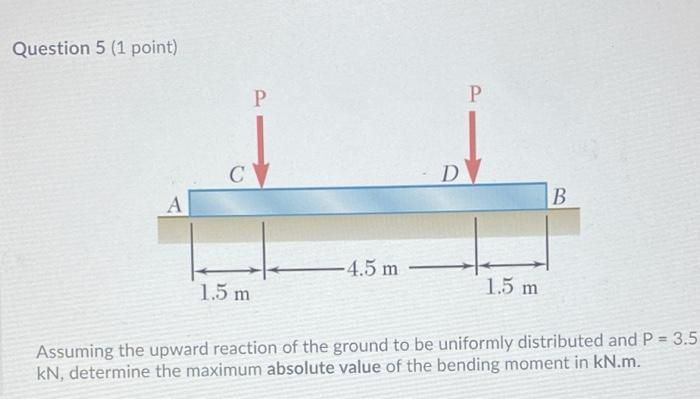 Question 5 (1 point)
P P
C -D
A B
= 4.5m
1.5m 15m
Assuming the upward reaction of the ground to be uniformly distributed and P = 3.5
KN, determine the maximum absolute value of the bending moment in kN.m.
This is AI generated Response.
Asked by: amu
Created at: 2025-07-25 16:10:28
Asked by: amu
Created at: 2025-07-25 16:10:28
Final Answer:
Rendered
Raw Text
Did you like this answer?
Let's solve the problem step by step:
**Given:**
- Two point loads \( P = 3.5 \) kN each at points \( C \) and \( D \)
- \( AC = 1.5 \) m, \( CD = 4.5 \) m, \( DB = 1.5 \) m
- Upward reaction (support) is **uniformly distributed**.
- Find the **maximum absolute value of the bending moment** (in kN·m).
---
### **Step 1: Find the Uniformly Distributed Reaction Load**
**Total Length of Beam:**
\[
L = 1.5 + 4.5 + 1.5 = 7.5 \text{ m}
\]
**Total Downward Force:**
\[
\text{Total load} = P + P = 3.5 + 3.5 = 7.0 \text{ kN}
\]
**Uniformly Distributed Reaction (\( w \)):**
\[
w = \frac{7.0 \text{ kN}}{7.5 \text{ m}} = 0.933 \text{ kN/m}
\]
**Explanation:**
The uniformly distributed upward reaction must balance the total downward force of the two point loads.
---
### **Step 2: Draw Shear and Bending Moment Diagram**
We know:
- Loads at \( C \) (1.5 m from A) and \( D \) (1.5 m from B)
- Uniform upward load everywhere.
Let’s consider a section between \( C \) and \( D \) (i.e., between 1.5 m and 6.0 m from \( A \)), as that's where the maximum moment is likely to occur (between the loads).
**At a section between \( C \) and \( D \), say at distance \( x \) from \( A \) where \( 1.5 < x < 6.0 \):**
\[
\text{Shear just right of } C: V = \text{Upward reaction to left} - \text{point load at } C
\]
\[
\text{Upward reaction to left of } C = w \cdot 1.5 = 0.933 \times 1.5 = 1.4 \text{ kN}
\]
\[
\text{Shear just right of } C = 1.4 - 3.5 = -2.1 \text{ kN}
\]
**Between \( C \) and \( D \), shear increases linearly by \( w \) per meter:**
\[
\text{Shear at } x = -2.1 + w(x-1.5)
\]
**Set shear = 0 to find location of maximum moment:**
\[
-2.1 + 0.933(x-1.5) = 0
\]
\[
0.933(x-1.5) = 2.1
\]
\[
x-1.5 = \frac{2.1}{0.933} = 2.25
\]
\[
x = 1.5 + 2.25 = 3.75 \text{ m from } A
\]
**Explanation:**
Maximum bending moment occurs where shear crosses zero, i.e., between \( C \) and \( D \), 3.75 m from \( A \).
---
### **Step 3: Calculate the Maximum Bending Moment**
**Sum moments to the left of \( x = 3.75 \) m:**
- Upward reaction: \( w \times 3.75 \)
- Downward load at \( C \): 3.5 kN at \( x=1.5 \)
\[
M = (\text{Upward force}) \times (\text{distance to } x/2) - (\text{Point load}) \times (\text{distance from C to x})
\]
\[
\text{Upward:} \quad w \cdot 3.75 \cdot \frac{3.75}{2} = 0.933 \cdot 3.75 \cdot 1.875 = 6.57 \text{ kN}\cdot\text{m}
\]
\[
\text{Downward:} \quad 3.5 \cdot (3.75 - 1.5) = 3.5 \cdot 2.25 = 7.88 \text{ kN}\cdot\text{m}
\]
\[
M = 6.57 - 7.88 = -1.31 \text{ kN}\cdot\text{m}
\]
**Check at supports and under the loads (at C or D):**
- At \( C \) (1.5 m from \( A \)):
\[
M_{C} = w \cdot 1.5 \cdot \frac{1.5}{2} = 0.933 \cdot 1.5 \cdot 0.75 = 1.05 \text{ kN}\cdot\text{m}
\]
- At \( D \) (6.0 m from \( A \)):
\[
M_{D} = w \cdot 6.0 \cdot \frac{6.0}{2} - 3.5 \cdot (6.0 - 1.5)
\]
\[
= 0.933 \cdot 6.0 \cdot 3.0 - 3.5 \cdot 4.5 = 16.8 - 15.75 = 1.05 \text{ kN}\cdot\text{m}
\]
So, the **maximum absolute value** is at \( x = 3.75 \) m, and is **1.31 kN·m**.
---
## **Final Answer**
**The maximum absolute value of the bending moment is \(\boxed{1.31 \text{ kN}\cdot\text{m}}\).**
📢 Instructions:
- Ask anything relatd to above question only.
- For new Question goto :