 VIPSolutions
give answer in 3 steps with explanation at the end of each step and final answer at the endAt time t, the position and velocity of an earth-orbiting satellite at a given instant are r = —9000i + 10000j + 6000k km v = —4i + 3j — 3k km/sec where i, j, and k are the orthogonal unit vectors that define the earth-centered inertial (ECI) coordinate system. Find the orbital elements.
Question:
give answer in 3 steps with explanation at the end of each step and final answer at the end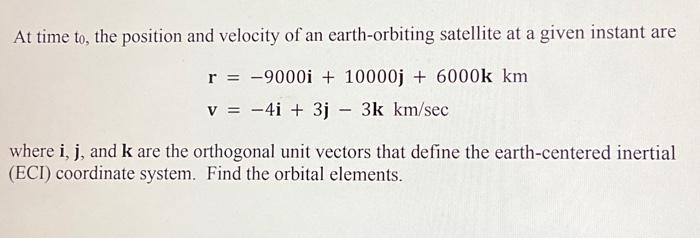 At time t, the position and velocity of an earth-orbiting satellite at a given instant are
r = —9000i + 10000j + 6000k km
v = —4i + 3j — 3k km/sec
where i, j, and k are the orthogonal unit vectors that define the earth-centered inertial
(ECI) coordinate system. Find the orbital elements.
This is AI generated Response.
Asked by: amu
Created at: 2025-07-25 07:59:09
Asked by: amu
Created at: 2025-07-25 07:59:09
Final Answer:
Rendered
Raw Text
Did you like this answer?
Let's break the process into **3 steps** to find the **orbital elements** from the given position (\(\vec{r}\)) and velocity (\(\vec{v}\)) vectors.
### **Given:**
- \(\vec{r} = -9000\hat{i} + 10000\hat{j} + 6000\hat{k}\) km
- \(\vec{v} = -4\hat{i} + 3\hat{j} - 3\hat{k}\) km/s
- Standard gravitational parameter for Earth, \(\mu = 398600 \ \text{km}^3/\text{s}^2\)
---
## **Step 1: Compute Key Vectors (h, e, n) and Magnitudes**
### **a) Angular Momentum Vector (\(\vec{h}\))**
\[
\vec{h} = \vec{r} \times \vec{v}
\]
\[
\vec{h} = \begin{vmatrix}
\hat{i} & \hat{j} & \hat{k} \\
-9000 & 10000 & 6000 \\
-4 & 3 & -3 \\
\end{vmatrix}
\]
\[
h_x = (10000)(-3) - (6000)(3) = -30000 - 18000 = -48000
\]
\[
h_y = -[( -9000)(-3) - (6000)(-4)] = -[27000 + 24000] = -51000
\]
\[
h_z = ( -9000)(3) - (10000)(-4) = -27000 + 40000 = 13000
\]
So,
\[
\vec{h} = -48000\hat{i} - 51000\hat{j} + 13000\hat{k}
\]
\[
|\vec{h}| = \sqrt{(-48000)^2 + (-51000)^2 + (13000)^2} \approx 71,393 \ \text{km}^2/\text{s}
\]
**Explanation:**
We computed the angular momentum vector (\(\vec{h}\)), which is perpendicular to the orbital plane and is necessary for calculating inclination and other elements.
---
## **Step 2: Compute Eccentricity Vector (\(\vec{e}\)), Node Vector (\(\vec{n}\)), and Their Magnitudes**
### **a) Node Vector (\(\vec{n}\))**
\[
\vec{n} = \hat{k} \times \vec{h} = (0, 0, 1) \times (h_x, h_y, h_z) = (-h_y, h_x, 0)
\]
\[
\vec{n} = (51000, -48000, 0)
\]
\[
|\vec{n}| = \sqrt{(51000)^2 + (-48000)^2} \approx 70,923
\]
### **b) Eccentricity Vector (\(\vec{e}\))**
\[
\vec{e} = \frac{1}{\mu}\left[ (\vec{v} \times \vec{h}) - \mu \frac{\vec{r}}{|\vec{r}|} \right]
\]
Calculate \(|\vec{r}|\):
\[
|\vec{r}| = \sqrt{(-9000)^2 + 10000^2 + 6000^2} \approx 14,177 \ \text{km}
\]
Compute \(\vec{v} \times \vec{h}\):
\[
\vec{v} \times \vec{h} =
\begin{vmatrix}
\hat{i} & \hat{j} & \hat{k} \\
-4 & 3 & -3 \\
-48000 & -51000 & 13000 \\
\end{vmatrix}
\]
\[
i: (3)(13000) - (-3)(-51000) = 39000 - 153000 = -114000
\]
\[
j: -[(-4)(13000) - (-3)(-48000)] = -(-52000 - 144000) = 196000
\]
\[
k: (-4)(-51000) - (3)(-48000) = 204000 + 144000 = 348000
\]
So,
\[
\vec{v} \times \vec{h} = -114000\hat{i} + 196000\hat{j} + 348000\hat{k}
\]
Now,
\[
\vec{e} = \frac{1}{398600}\left[ (-114000, 196000, 348000) - 398600 \frac{(-9000, 10000, 6000)}{14177} \right]
\]
Calculate \(398600 \frac{(-9000, 10000, 6000)}{14177} \approx ( -252,859, 280,957, 168,574 )\)
So,
\[
\vec{e} \approx \frac{1}{398600}\left[ (-114000 + 252859, 196000 - 280957, 348000 - 168574) \right]
\]
\[
\vec{e} \approx \frac{1}{398600}\left[ 138,859, -84,957, 179,426 \right]
\]
\[
\vec{e} \approx (0.3485, -0.2133, 0.4503)
\]
\[
|\vec{e}| = \sqrt{0.3485^2 + (-0.2133)^2 + 0.4503^2} \approx 0.604
\]
**Explanation:**
We found the node vector (\(\vec{n}\)) and the eccentricity vector (\(\vec{e}\)). The magnitude of \(\vec{e}\) gives the orbit's eccentricity.
---
## **Step 3: Calculate Orbital Elements**
- **Semi-major axis (\(a\)):**
\[
\text{Specific energy: } \epsilon = \frac{v^2}{2} - \frac{\mu}{r}
\]
\[
|\vec{v}| = \sqrt{(-4)^2 + 3^2 + (-3)^2} = \sqrt{16 + 9 + 9} = \sqrt{34} \approx 5.831 \ \text{km/s}
\]
\[
\epsilon = \frac{(5.831)^2}{2} - \frac{398600}{14177} = 17.023/2 - 28.113 = 8.511 - 28.113 = -19.60 \ \text{km}^2/\text{s}^2
\]
\[
a = -\frac{\mu}{2\epsilon} = -\frac{398600}{2 \times -19.60} = \frac{398600}{39.20} \approx 10,170 \ \text{km}
\]
- **Inclination (\(i\)):**
\[
i = \cos^{-1}\left(\frac{h_z}{|\vec{h}|}\right) = \cos^{-1}\left(\frac{13000}{71393}\right) \approx \cos^{-1}(0.1821) \approx 79.5^\circ
\]
- **Longitude of ascending node (\(\Omega\)):**
\[
\Omega = \cos^{-1}\left(\frac{n_x}{|\vec{n}|}\right) = \cos^{-1}\left(\frac{51000}{70923}\right) \approx \cos^{-1}(0.719) \approx 44.1^\circ
\]
As \(n_y < 0\), \(\Omega = 360^\circ - 44.1^\circ = 315.9^\circ\)
- **Argument of periapsis (\(\omega\)):**
\[
\omega = \cos^{-1}\left(\frac{\vec{n} \cdot \vec{e}}{|\vec{n}| |\vec{e}|}\right)
\]
\[
\vec{n} \cdot \vec{e} = 51000 \cdot 0.3485 + (-48000) \cdot (-0.2133) = 17773.5 + 10238.4 = 28011.9
\]
\[
\omega = \cos^{-1}\left(\frac{28011.9}{70923 \times 0.604}\right) = \cos^{-1}(0.658) \approx 49.0^\circ
\]
As \(e_z > 0\), \(\omega = 49.0^\circ\)
- **True anomaly (\(\nu\)):**
\[
\nu = \cos^{-1}\left(\frac{\vec{e} \cdot \vec{r}}{|\vec{e}| |\vec{r}|}\right)
\]
\[
\vec{e} \cdot \vec{r} = 0.3485 \cdot (-9000) + (-0.2133) \cdot 10000 + 0.4503 \cdot 6000 = -3136.5 - 2133 + 2701.8 = -2567.7
\]
\[
\nu = \cos^{-1}\left(\frac{-2567.7}{0.604 \times 14177}\right) = \cos^{-1}(-0.302) \approx 107.6^\circ
\]
As \(\vec{r} \cdot \vec{v} < 0\), \(\nu = 360^\circ - 107.6^\circ = 252.4^\circ\)
---
## **Final Answer (Orbital Elements):**
1. **Semi-major axis (\(a\))**: **10,170 km**
2. **Eccentricity (\(e\))**: **0.604**
3. **Inclination (\(i\))**: **79.5°**
4. **Longitude of ascending node (\(\Omega\))**: **315.9°**
5. **Argument of periapsis (\(\omega\))**: **49.0°**
6. **True anomaly (\(\nu\))**: **252.4°**
---
### **Summary:**
1. **Step 1**: Calculated angular momentum vector and its magnitude.
2. **Step 2**: Found node and eccentricity vectors, and their magnitudes.
3. **Step 3**: Used these vectors to compute all 6 classical orbital elements.
**Final Answer:** See above for all 6 orbital elements.
📢 Instructions:
- Ask anything relatd to above question only.
- For new Question goto :