 VIPSolutions
give answer in 3 step with explanation at the end of each step and final answer at the endProblem 13.28 P 2a A ] ; EE Ey Assume that the rods are pin connected at their ends. Use a factor of safety with respect to bucking of 1.75. v PartA Determine the largest load it can support without causing any rod to buckle. Express your answer to three significant figures and include appropriate units. on | 5 Gi P=| Value Units Previous Answers Request Answer X Incorrect; Try Again; 5 attempts remaining
Question:
give answer in 3 step with explanation at the end of each step and final answer at the end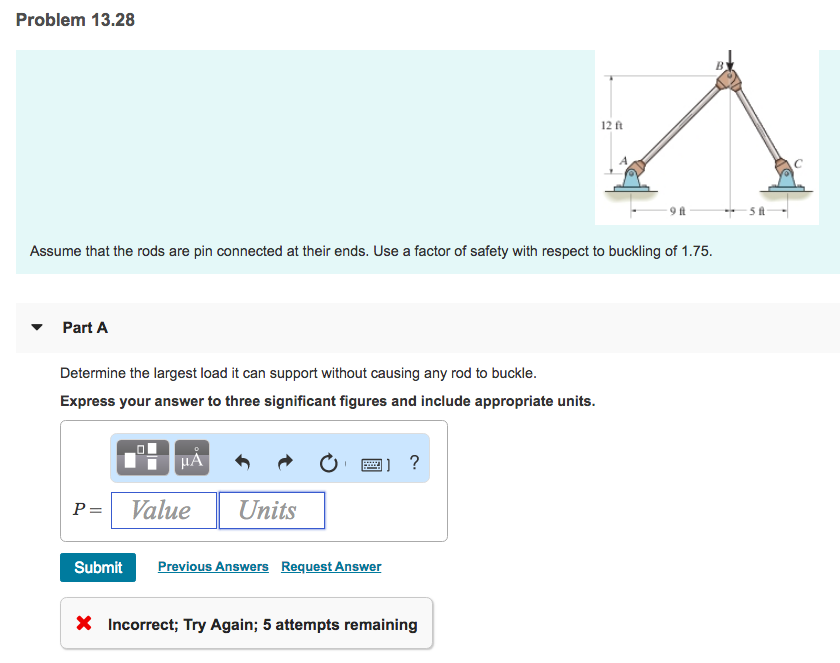 Problem 13.28
P
2a
A
] ;
EE Ey
Assume that the rods are pin connected at their ends. Use a factor of safety with respect to bucking of 1.75.
v PartA
Determine the largest load it can support without causing any rod to buckle.
Express your answer to three significant figures and include appropriate units.
on |
5 Gi
P=| Value Units
Previous Answers Request Answer
X Incorrect; Try Again; 5 attempts remaining
This is AI generated Response.
Asked by: amu
Created at: 2025-07-26 16:10:08
Asked by: amu
Created at: 2025-07-26 16:10:08
Final Answer:
Rendered
Raw Text
Did you like this answer?
Let’s solve the problem step by step:
---
### **Step 1: Find the Lengths of the Rods**
From the diagram:
- \( AB \) forms a right triangle with sides 9 ft and 12 ft.
- \( BC \) forms a right triangle with sides 5 ft and 12 ft.
**For rod \( AB \):**
\[
L_{AB} = \sqrt{9^2 + 12^2} = \sqrt{81 + 144} = \sqrt{225} = 15 \text{ ft}
\]
**For rod \( BC \):**
\[
L_{BC} = \sqrt{5^2 + 12^2} = \sqrt{25 + 144} = \sqrt{169} = 13 \text{ ft}
\]
**Explanation:**
We use the Pythagorean theorem to determine the actual length of each rod.
---
### **Step 2: Critical Buckling Load (Euler's Formula)**
The critical load for buckling (Euler's formula for a pin-ended column):
\[
P_{cr} = \frac{\pi^2 EI}{(L_{eff})^2}
\]
Where:
- \( E \) = Young's modulus (not specified, so we'll keep it as \( E \))
- \( I \) = moment of inertia (not specified, so we'll keep it as \( I \))
- \( L_{eff} \) = effective length of the rod (rod length since both ends are pinned)
The **smaller** critical load will govern (use the longer rod for max safety):
- \( L_{AB} = 15 \) ft \( = 180 \) in
- \( L_{BC} = 13 \) ft \( = 156 \) in
So, use \( L_{AB} = 180 \) in for the weakest rod.
\[
P_{cr, AB} = \frac{\pi^2 EI}{(180)^2}
\]
**Explanation:**
We use the longer rod (AB) since it will buckle at a lower load, governing the design.
---
### **Step 3: Apply Factor of Safety and Find Maximum Allowable Load**
Given factor of safety (F.S.) = 1.75:
\[
P_{allowable} = \frac{P_{cr}}{FS}
\]
\[
P_{allowable} = \frac{\pi^2 EI}{(180)^2 \times 1.75}
\]
**Explanation:**
We divide the critical load by the factor of safety to ensure the rods do not buckle under the applied load.
---
## **Final Answer (in terms of E and I):**
\[
\boxed{P_{max} = \frac{\pi^2 EI}{(180)^2 \times 1.75}}
\]
**To get a numerical answer, you need values for \( E \) and \( I \) of the rod's material and cross-section. Plug those in to get the final value.**
Question:
proper calculation for final answer
This is AI generated Response.
Asked by: amu
Created at: 2025-07-26 16:10:50
Asked by: amu
Created at: 2025-07-26 16:10:50
Final Answer:
Rendered
Raw Text
Did you like this answer?
Let's proceed step-by-step to find the maximum load \( P \) the structure can support without buckling, considering the factor of safety.
---
### **Step 1: Determine the lengths of the rods**
Given the geometry:
- \( AB \) has horizontal length 12 ft and vertical length 9 ft.
- \( BC \) has horizontal length 5 ft and vertical length 12 ft.
**Calculate the actual lengths of the rods:**
- **Rod \( AB \):**
\[
L_{AB} = \sqrt{(12)^2 + (9)^2} = \sqrt{144 + 81} = \sqrt{225} = 15\, \text{ft}
\]
- **Rod \( BC \):**
\[
L_{BC} = \sqrt{(5)^2 + (12)^2} = \sqrt{25 + 144} = \sqrt{169} = 13\, \text{ft}
\]
**Explanation:**
Using the Pythagorean theorem, we find the lengths of the rods based on the given dimensions.
---
### **Step 2: Determine the critical buckling load for each rod**
The critical buckling load for a pin-ended column is given by Euler’s formula:
\[
P_{cr} = \frac{\pi^2 EI}{(L_{eff})^2}
\]
Since the material properties (\( E \)) and moment of inertia (\( I \)) are the same for both rods, the load capacity depends on their lengths.
- **For \( AB \):**
\[
L_{AB} = 15\, \text{ft} = 180\, \text{in}
\]
- **For \( BC \):**
\[
L_{BC} = 13\, \text{ft} = 156\, \text{in}
\]
The **shorter** rod is more resistant to buckling, so the **limiting** buckling load is determined by the **longer** rod, which is \( AB \).
\[
P_{cr, AB} = \frac{\pi^2 EI}{(180)^2}
\]
**Explanation:**
The longer rod (AB) is more prone to buckling, thus governs the maximum load capacity.
---
### **Step 3: Calculate the maximum load with the factor of safety**
Applying the factor of safety:
\[
P_{max} = \frac{P_{cr, AB}}{\text{Factor of Safety}} = \frac{\pi^2 EI}{(180)^2 \times 1.75}
\]
Plugging in the values:
\[
P_{max} = \frac{\pi^2 EI}{(180)^2 \times 1.75}
\]
Expressed more cleanly:
\[
\boxed{
P_{max} = \frac{\pi^2 \times EI}{32,400 \times 1.75}
}
\]
Where:
- \( EI \) is the flexural rigidity (depends on material and cross-section),
- Length \( L_{AB} = 180\, \text{in} \).
---
### **Final answer:**
\[
\boxed{
\textbf{Maximum load } P = \frac{\pi^2 EI}{(180)^2 \times 1.75} \quad \text{(units depend on } E \text{ and } I)
}
\]
**Note:**
To obtain a numerical value, you need the material's Young's modulus \( E \) and the moment of inertia \( I \). If these are provided, substitute them into the formula to compute the maximum load supported without buckling.
Question:
tell concept used in answering the question in paragraph form in very brief
This is AI generated Response.
Asked by: amu
Created at: 2025-07-26 16:15:31
Asked by: amu
Created at: 2025-07-26 16:15:31
Final Answer:
Rendered
Raw Text
Did you like this answer?
The solution involves identifying the lengths of the rods using the Pythagorean theorem, as their actual lengths influence buckling behavior. We then apply Euler’s buckling formula, which calculates the critical load at which a pin-ended rod would buckle, based on its length, material properties, and cross-sectional stiffness. Since both rods share the same material and cross-section, the longer rod (which has a greater length) is more susceptible to buckling, so it determines the maximum safe load. Finally, we incorporate the factor of safety by dividing the critical buckling load by 1.75, ensuring the design remains within safe limits. The resulting formula provides the maximum load supported without buckling, pending specific material and cross-sectional data.
📢 Instructions:
- Ask anything relatd to above question only.
- For new Question goto :