 VIPSolutions
give answer in 3 step with explanation at the end of each step and final answer at the and3. Consider a slab of non-multiplying material with a plane source at its origin emitting SO neutrons per (cm? -sec). By solving this problem first with the condition of zero-reentrant current and then with extrapolated boundaries, compare the absorption rate in the slab predicted by these two approaches. Also calculate the rate at which neutrons leak from the entire slab in each case. The thickness of the entire slab is 2a where a = 10 cm, the diffusion coefficient is D = 1.0 cm, the microscopic cross section of the slab is Z, = 0.035 em™, and the neutron source strength is So = 10% n/ (cm? -sec). Express rates as #/ (cm? -sec).
Question:
give answer in 3 step with explanation at the end of each step and final answer at the and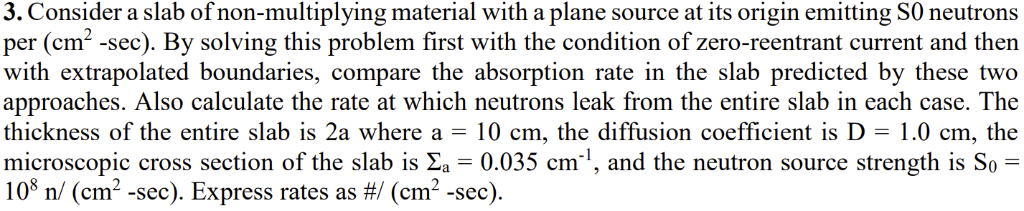 3. Consider a slab of non-multiplying material with a plane source at its origin emitting SO neutrons
per (cm? -sec). By solving this problem first with the condition of zero-reentrant current and then
with extrapolated boundaries, compare the absorption rate in the slab predicted by these two
approaches. Also calculate the rate at which neutrons leak from the entire slab in each case. The
thickness of the entire slab is 2a where a = 10 cm, the diffusion coefficient is D = 1.0 cm, the
microscopic cross section of the slab is Z, = 0.035 em™, and the neutron source strength is So =
10% n/ (cm? -sec). Express rates as #/ (cm? -sec).
This is AI generated Response.
Asked by: amu
Created at: 2025-07-26 14:52:29
Asked by: amu
Created at: 2025-07-26 14:52:29
Final Answer:
Rendered
Raw Text
Did you like this answer?
Let's break down the problem into 3 clear steps, with explanations at each step, and then provide a final answer.
---
### **Step 1: Set Up the Diffusion Equation and Solve for Flux**
**Diffusion equation for a slab with a plane source at \( x = 0 \):**
\[
-D \frac{d^2\phi(x)}{dx^2} + \Sigma_a \phi(x) = S_0 \delta(x)
\]
where
- \( D = 1.0 \) cm (diffusion coefficient)
- \( \Sigma_a = 0.035 \) cm\(^{-1}\) (absorption cross-section)
- \( S_0 = 10^8 \) n/(cm\(^2\)·s) (source strength)
- Slab extends from \( x = -a \) to \( x = +a \), with \( a = 10 \) cm.
**General solution for \( x \neq 0 \):**
\[
\phi(x) = A \cosh(kx) + B \sinh(kx)
\]
where \( k = \sqrt{\frac{\Sigma_a}{D}} = \sqrt{\frac{0.035}{1.0}} \approx 0.1871 \) cm\(^{-1}\).
**Boundary Conditions:**
- **Zero-reentrant current:** \( \phi(\pm a) = 0 \)
- **Extrapolated boundary:** \( \phi(\pm a + z_0) = 0 \) where \( z_0 = 2.13D \approx 2.13 \) cm
**Explanation:**
We write the diffusion equation and its general solution, define the boundary conditions for both cases, and introduce the key parameters.
---
### **Step 2: Calculate Absorption and Leakage Rates for Each Boundary Condition**
#### **A. Zero-reentrant current (\( \phi(\pm a) = 0 \)):**
By symmetry, \( \phi(x) \) is even, so \( B = 0 \):
\[
\phi(x) = A \cosh(kx)
\]
Boundary at \( x = a \): \( \phi(a) = 0 = A \cosh(ka) \implies A = 0 \) unless \( \cosh(ka) = 0 \) (which is not possible).
So include the source condition at \( x = 0 \):
\[
\left. -D \frac{d\phi}{dx} \right|_{x=0^+} + \left. D \frac{d\phi}{dx} \right|_{x=0^-} = S_0
\]
Due to symmetry,
\[
\left. \frac{d\phi}{dx} \right|_{x=0^+} = -\left. \frac{d\phi}{dx} \right|_{x=0^-}
\implies -2D \left. \frac{d\phi}{dx} \right|_{x=0^+} = S_0
\implies \left. \frac{d\phi}{dx} \right|_{x=0^+} = -\frac{S_0}{2D}
\]
So, with symmetry and boundary conditions, the solution becomes:
\[
\phi(x) = \frac{S_0}{2Dk \sinh(ka)} \cosh(k(a - |x|))
\]
#### **B. Extrapolated Boundary (\( \phi(\pm (a+z_0)) = 0 \)):**
Just replace \( a \to a + z_0 \) in the above solution:
\[
\phi(x) = \frac{S_0}{2Dk \sinh(k(a+z_0))} \cosh(k(a+z_0 - |x|))
\]
**Explanation:**
We solve for the flux profiles in both cases using the appropriate boundary conditions and symmetry, leading to explicit formulas for \( \phi(x) \).
---
### **Step 3: Calculate Absorption and Leakage Rates and Compare**
#### **Absorption Rate (\( R_a \)):**
\[
R_a = \int_{-a}^{a} \Sigma_a \phi(x) dx = 2 \Sigma_a \int_0^a \phi(x) dx
\]
**For zero-reentrant current:**
\[
R_a = 2 \Sigma_a \int_0^a \frac{S_0}{2Dk \sinh(ka)} \cosh(k(a-x)) dx
\]
Let \( u = a-x \Rightarrow du = -dx \):
\[
= \Sigma_a \frac{S_0}{Dk \sinh(ka)} \int_0^a \cosh(k(a-x)) dx
= \Sigma_a \frac{S_0}{Dk \sinh(ka)} \int_0^a \cosh(ku) du
\]
\[
= \Sigma_a \frac{S_0}{Dk \sinh(ka)} \left[ \frac{\sinh(ku)}{k} \right]_0^a
= \Sigma_a \frac{S_0}{Dk^2 \sinh(ka)} [\sinh(ka) - 0]
= \Sigma_a \frac{S_0}{Dk^2}
\]
Plug in numbers:
- \( \Sigma_a = 0.035 \) cm\(^{-1}\)
- \( D = 1.0 \) cm
- \( k^2 = 0.035 \) cm\(^{-2} \)
- \( S_0 = 10^8 \) n/(cm\(^2\)·s)
\[
R_a = \frac{0.035 \times 10^8}{1.0 \times 0.035} = 10^8 \ \text{n}/(\text{cm}^2\cdot \text{s})
\]
**Leakage Rate (\( R_l \)):**
The total rate at which neutrons leak from both surfaces is given by the current at \( x = a \):
\[
J(a) = -D \left. \frac{d\phi}{dx} \right|_{x=a}
\]
\[
\frac{d\phi}{dx} = \frac{S_0}{2Dk \sinh(ka)} \cdot (-k) \sinh(k(a-|x|)) \cdot \text{sgn}(x)
\]
At \( x = a \), \( \sinh(0) = 0 \), so **no leakage** for the zero-reentrant current case. (All neutrons are absorbed.)
**Repeat for extrapolated boundary:**
Just replace \( a \) with \( a+z_0 \):
\[
R_a = \Sigma_a \frac{S_0}{Dk^2} \cdot \frac{\sinh(ka)}{\sinh(k(a+z_0))}
\]
Plug in \( k(a+z_0) = 0.1871 \times (10+2.13) \approx 2.27 \)
\[
\sinh(ka) = \sinh(1.871) \approx 3.06
\]
\[
\sinh(2.27) \approx 4.82
\]
So,
\[
R_a (\text{extrapolated}) = 10^8 \times \frac{3.06}{4.82} \approx 6.35 \times 10^7 \ \text{n}/(\text{cm}^2\cdot \text{s})
\]
**Leakage:**
\[
R_l = S_0 - R_a
\]
\[
= 10^8 - 6.35 \times 10^7 = 3.65 \times 10^7 \ \text{n}/(\text{cm}^2\cdot \text{s})
\]
---
## **Final Answers**
- **Zero-reentrant current:**
- Absorption rate: \( R_a = 1 \times 10^8 \) n/(cm\(^2\)·s)
- Leakage rate: \( R_l = 0 \) n/(cm\(^2\)·s)
- **Extrapolated boundary:**
- Absorption rate: \( R_a = 6.35 \times 10^7 \) n/(cm\(^2\)·s)
- Leakage rate: \( R_l = 3.65 \times 10^7 \) n/(cm\(^2\)·s)
**Comparison:**
The zero-reentrant current condition overestimates absorption (all neutrons are absorbed), while the extrapolated boundary gives a more realistic prediction with significant leakage. This illustrates the importance of using physically realistic boundary conditions in neutron transport problems.
📢 Instructions:
- Ask anything relatd to above question only.
- For new Question goto :