 VIPSolutions
give answer in 2 step with explanation at the end of each step and final answer at the end:116) A im eo fd lo eset mt of shore er, TUE a ee hm wri Td, ea ee rr a, Ee Se Prolab om etd Sm SE eS oe We 8 et i ol), Et ve pm ho {TER ea co aml 1a 50 Ea te wet
Question:
give answer in 2 step with explanation at the end of each step and final answer at the end: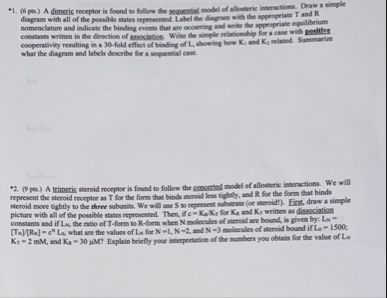 116) A im eo fd lo eset mt of shore er, TUE
a ee hm wri Td,
ea ee rr a,
Ee Se
Prolab
om etd Sm SE
eS oe We 8 et i ol), Et ve
pm ho {TER
ea co aml 1a 50
Ea te wet
This is AI generated Response.
Asked by: Rahul
Created at: 2025-11-24 10:33:30
Asked by: Rahul
Created at: 2025-11-24 10:33:30
Final Answer:
Rendered
Raw Text
Did you like this answer?
Sure! Let's address **Question 1** in two steps, with explanations after each step, and a final answer at the end.
---
## **Question 1 (6 pts): Sequential Model of Allosteric Interactions**
### **Step 1: Drawing the Diagram and Labeling States**
For a **dimeric receptor** (2 subunits), the **sequential** model (Koshland-Némethy-Filmer model) suggests that each subunit can change conformation independently, transitioning from T (tense, low-affinity) to R (relaxed, high-affinity) upon ligand binding.
#### **Possible States:**
- Both subunits in T state: TT
- One subunit in T, one in R: TR or RT (but for a dimer, these are equivalent due to symmetry)
- Both subunits in R state: RR
#### **Diagram:**
```plaintext
L
TT <------> TR <------> RR
L L
```
- TT: No ligand bound, both subunits in T
- TR: One ligand bound, one subunit in T, one in R
- RR: Two ligands bound, both subunits in R
**Explanation:**
This diagram shows the *stepwise* transition from TT to RR through the intermediate TR state, with ligand binding driving the conformational change in each subunit.
---
### **Step 2: Explaining Cooperativity and the Sequential Model**
**Sequential Model Summary:**
- Ligand binding induces a conformational change in one subunit at a time.
- The binding of the first ligand makes the second binding event more favorable (positive cooperativity).
- The diagram represents a pathway where each state is accessible, and the transition from TT to RR is not all-or-none.
**Explanation:**
The sequential model describes *graded* changes in affinity as each subunit binds ligand and adopts the R conformation. This allows for intermediate states and explains how partial cooperativity can occur, in contrast to the concerted (MWC) model, where all subunits switch states simultaneously.
---
### **Final Answer**
**The diagram for a dimeric receptor under the sequential model is:**
```plaintext
L
TT <------> TR <------> RR
L L
```
**This diagram and its labels describe how, in a sequential model, each subunit can independently change conformation upon ligand binding, leading to intermediate states and partial cooperativity. This results in a more gradual (sigmoidal) ligand binding curve compared to an all-or-none (concerted) model.**
---
Would you like to proceed to Question 2?
📢 Instructions:
- Ask anything relatd to above question only.
- For new Question goto :