 VIPSolutions
give answer in 2 step with explanation at the end of each step and final answer at the end:800 A _—Eutectold temperature —| 1400 700. - - : n = A ed 1200 600 oh E F ! EV 1000 500. \ 1 g RY 8 £| N\, s 800 H 400 Ho 1 | H ™, & A \ 600 300 Nd cts \, 200 sow | MA 400 ME + J TY PRON ES — -» 200 [ 107 1 10 12 100 10 10° Tim
Question:
give answer in 2 step with explanation at the end of each step and final answer at the end: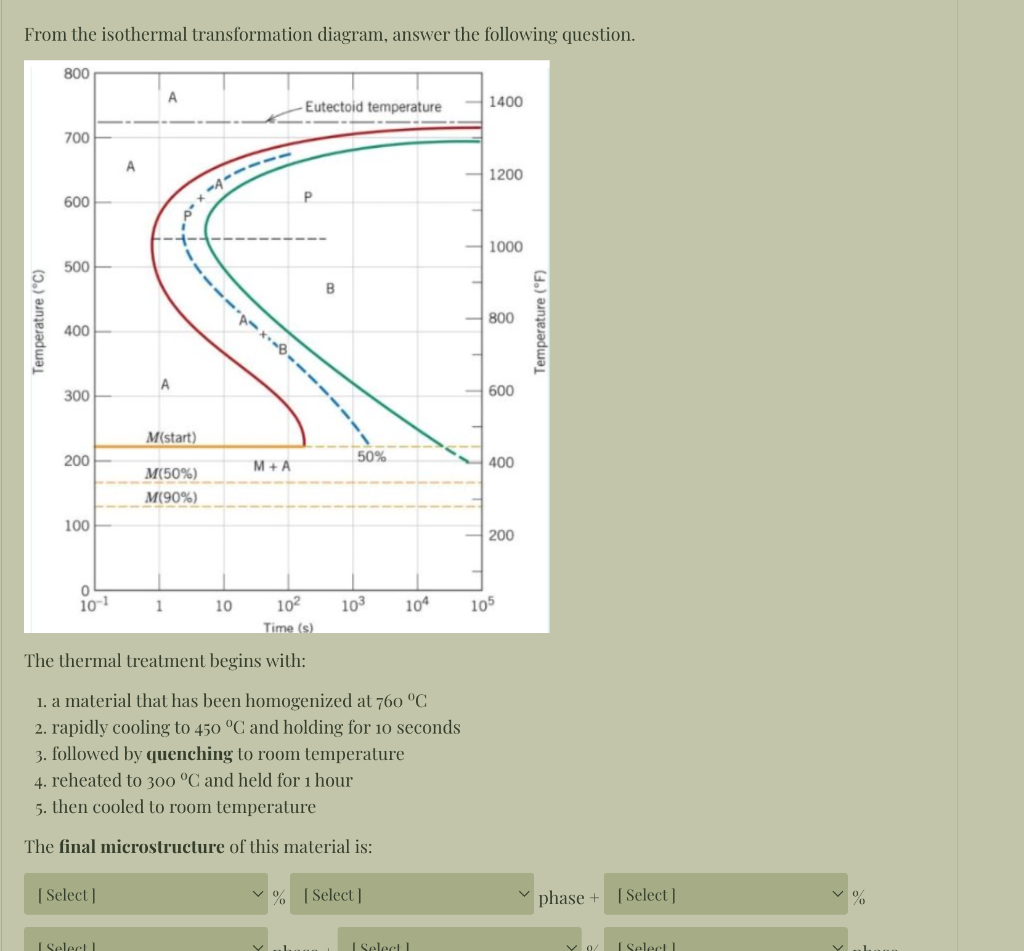 800
A _—Eutectold temperature —| 1400
700. - - : n
=
A ed 1200
600 oh E
F
!
EV 1000
500. \ 1
g RY 8 £|
N\,
s 800
H 400 Ho 1 |
H ™, &
A \ 600
300 Nd
cts \,
200 sow | MA 400
ME + J TY PRON ES —
-» 200
[
107 1 10 12 100 10 10°
Tim
This is AI generated Response.
Asked by: Rahul
Created at: 2025-11-24 06:06:04
Asked by: Rahul
Created at: 2025-11-24 06:06:04
Final Answer:
Rendered
Raw Text
Did you like this answer?
## Step 1: Analyzing the Thermal Treatment Path
- **Step 1:** The material is homogenized at 760°C (in the austenite region "A").
- **Step 2:** It is rapidly cooled to 450°C and held for 10 seconds.
- Looking at the TTT diagram, at 450°C and for 10 seconds, the material does **not** cross into the pearlite or bainite regions (it's still in the austenite region).
- **Step 3:** It is then quenched to room temperature.
- Quenching from this point means the austenite transforms to **martensite** (since it bypasses the nose of the TTT curve).
- **Step 4:** The material is reheated to 300°C and held for 1 hour (tempering).
- Tempering martensite at 300°C causes some martensite to decompose, forming **tempered martensite** (a mix of ferrite and very fine carbides).
**Explanation:**
At the end of quenching, the microstructure is mostly martensite. Tempering at 300°C partially decomposes martensite, resulting in tempered martensite.
---
## Step 2: Determining the Final Microstructure
- **Step 5:** The material is cooled to room temperature after tempering.
- After tempering, the microstructure is **tempered martensite**.
- Since the material was held at 450°C for only 10 seconds (not long enough to form bainite or pearlite), and then quenched, almost all the austenite transforms to martensite; after tempering, that martensite becomes tempered martensite.
**Explanation:**
There is no significant amount of bainite or pearlite, only tempered martensite.
---
## **Final Answer**
**The final microstructure of this material is:**
- **~100% tempered martensite phase** (since all austenite was transformed to martensite upon quenching, and then tempered at 300°C).
📢 Instructions:
- Ask anything relatd to above question only.
- For new Question goto :