 VIPSolutions
give answer in 2 step with explanation at the end of each step and final answer at the end:| ZE = Er | £2 SES £2 be iS es 8 i L AR HE E
Question:
give answer in 2 step with explanation at the end of each step and final answer at the end: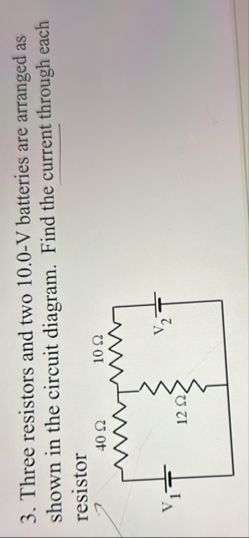 |
ZE
=
Er |
£2
SES
£2
be iS
es 8 i
L
AR
HE E
This is AI generated Response.
Asked by: Rahul
Created at: 2025-11-24 04:03:49
Asked by: Rahul
Created at: 2025-11-24 04:03:49
Final Answer:
Rendered
Raw Text
Did you like this answer?
Let's solve the problem step by step:
---
## **Step 1: Find the Equivalent Resistance**
The circuit shows a **series** connection of three resistors: 4 Ω, 10 Ω, and 12 Ω.
The total (equivalent) resistance \( R_{eq} \) in series is:
\[
R_{eq} = R_1 + R_2 + R_3 = 4\,\Omega + 10\,\Omega + 12\,\Omega = 26\,\Omega
\]
**Explanation:**
When resistors are in series, their resistances simply add together.
---
## **Step 2: Find the Total Current in the Circuit**
The total voltage from the two batteries is:
\[
V_{total} = V_1 + V_2 = 10.\,V + 10.\,V = 20.\,V
\]
Using Ohm's Law (\( I = \frac{V}{R} \)):
\[
I = \frac{V_{total}}{R_{eq}} = \frac{20.\,V}{26\,\Omega} \approx .769\,A
\]
**Explanation:**
In a series circuit, the same current flows through all resistors. The total voltage divides across the resistors according to their resistances.
---
## **Final Answers**
- **Current through each resistor:**
\( \boxed{.769\,A} \) (same for all, since they are in series)
📢 Instructions:
- Ask anything relatd to above question only.
- For new Question goto :