 VIPSolutions
give answer in 2 step with explanation at the end of each step and final answer at the end:4. A small metal sphere, carrying a net charge of qi = -2.80 uC, is held in a stationary position by insulating supports. A second small metal sphere, with a net charge of gz = - 7.80 uC and a mass of 1.5 grams, is projected toward qs. When the two spheres are 0.800 m apart, gz is moving speed 2.0 m/s. Q—= q U=220m/s q, K——0.800 m——> Assume the two spheres are point charges. You can ignore the force of gravity. How close does q: get to q:?
Question:
give answer in 2 step with explanation at the end of each step and final answer at the end: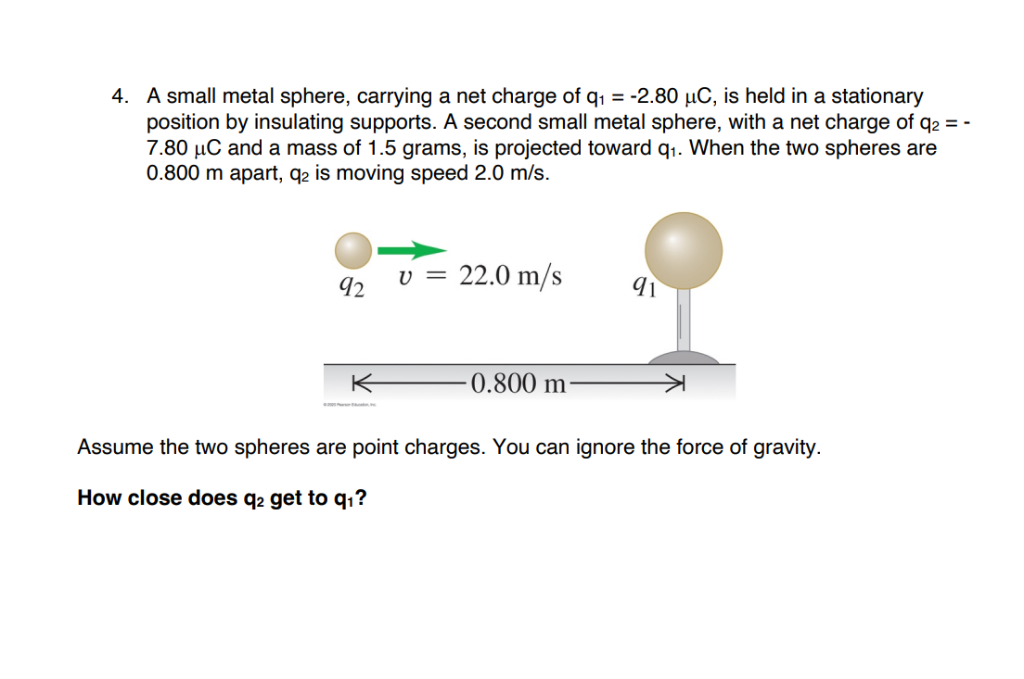 4. A small metal sphere, carrying a net charge of qi = -2.80 uC, is held in a stationary
position by insulating supports. A second small metal sphere, with a net charge of gz = -
7.80 uC and a mass of 1.5 grams, is projected toward qs. When the two spheres are
0.800 m apart, gz is moving speed 2.0 m/s.
Q—=
q U=220m/s q,
K——0.800 m——>
Assume the two spheres are point charges. You can ignore the force of gravity.
How close does q: get to q:?
This is AI generated Response.
Asked by: Rahul
Created at: 2025-11-24 03:55:17
Asked by: Rahul
Created at: 2025-11-24 03:55:17
Final Answer:
Rendered
Raw Text
Did you like this answer?
## Step 1: Set Up Conservation of Energy
The only forces acting are electric, so **mechanical energy is conserved**.
- **Initial energy:**
- Kinetic: \(\frac{1}{2}mv^2\)
- Electric Potential: \(U_i = k \frac{q_1 q_2}{r_i}\)
- **Final energy:**
- Kinetic: (when \(q_2\) is at its closest, it momentarily stops)
- Electric Potential: \(U_f = k \frac{q_1 q_2}{r_f}\)
So,
\[
\frac{1}{2}mv^2 + k \frac{q_1 q_2}{r_i} = k \frac{q_1 q_2}{r_f}
\]
**Explanation:**
We use conservation of energy because no non-conservative forces (like friction) are present. The closest approach happens when the moving sphere's kinetic energy is completely converted into electrostatic potential energy.
---
## Step 2: Solve for Closest Distance \(r_f\)
Let's solve for \(r_f\):
\[
\frac{1}{2}mv^2 + k \frac{q_1 q_2}{r_i} = k \frac{q_1 q_2}{r_f}
\]
\[
\Rightarrow \frac{1}{2}mv^2 = k q_1 q_2 \left(\frac{1}{r_f} - \frac{1}{r_i}\right)
\]
\[
\Rightarrow \frac{1}{r_f} = \frac{1}{r_i} + \frac{\frac{1}{2}mv^2}{k q_1 q_2}
\]
\[
\Rightarrow r_f = \left[ \frac{1}{r_i} + \frac{\frac{1}{2}mv^2}{k q_1 q_2} \right]^{-1}
\]
Now plug in the values:
- \(m = 1.5\, \text{g} = .0015\, \text{kg}\)
- \(v = 2.\, \text{m/s}\)
- \(q_1 = -2.80 \times 10^{-6}\, \text{C}\)
- \(q_2 = -7.80 \times 10^{-6}\, \text{C}\)
- \(k = 8.99 \times 10^9\, \text{N}\cdot\text{m}^2/\text{C}^2\)
- \(r_i = .800\, \text{m}\)
Calculate numerator:
\[
\frac{1}{2}mv^2 = \frac{1}{2} \times .0015 \times (2.)^2 = .003\, \text{J}
\]
Calculate denominator:
\[
k q_1 q_2 = 8.99 \times 10^9 \times (-2.80 \times 10^{-6}) \times (-7.80 \times 10^{-6})
\]
\[
= 8.99 \times 10^9 \times 2.184 \times 10^{-11}
= .196 \, \text{J}
\]
So,
\[
\frac{\frac{1}{2}mv^2}{k q_1 q_2} = \frac{.003}{.196} \approx .0153
\]
Now,
\[
\frac{1}{r_f} = \frac{1}{.800} + .0153 = 1.25 + .0153 = 1.2653
\]
\[
r_f = \frac{1}{1.2653} \approx .791 \, \text{m}
\]
**Explanation:**
By substituting all values into the derived formula, we get the closest approach distance as \(r_f \approx .791\) m.
---
## **Final Answer**
\[
\boxed{.791\, \text{m}}
\]
This is the closest \(q_2\) gets to \(q_1\).
📢 Instructions:
- Ask anything relatd to above question only.
- For new Question goto :