 VIPSolutions
give answer in 2 step with explanation at the end of each step and final answer at the end:Kuestions 1. A child tosses a tennis ball straight up into the air vith an initial speed of 11 mys. Ignore the height of the child, and assume that air resistance is negligible. om me (@) Determine the maximum height that the ball will reach. (b) Sketch a graph of potential energy versus time for the ball during its time in the air. Explain why the graph has the shape that it does, Label the minimum and maximum potential energy values. (©) On the same set of axes, sketch a graph of total energy versus time and a graph of kinetic energy versus time. Explain why they are shaped the way that they are. Identify any maximum or minimum values.
Question:
give answer in 2 step with explanation at the end of each step and final answer at the end: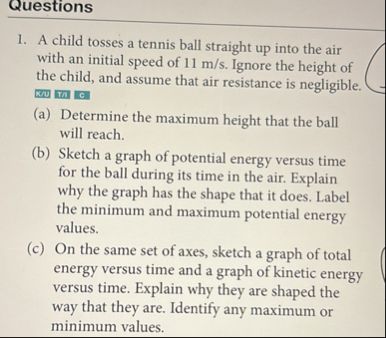 Kuestions
1. A child tosses a tennis ball straight up into the air
vith an initial speed of 11 mys. Ignore the height of
the child, and assume that air resistance is negligible.
om me
(@) Determine the maximum height that the ball
will reach.
(b) Sketch a graph of potential energy versus time
for the ball during its time in the air. Explain
why the graph has the shape that it does, Label
the minimum and maximum potential energy
values.
(©) On the same set of axes, sketch a graph of total
energy versus time and a graph of kinetic energy
versus time. Explain why they are shaped the
way that they are. Identify any maximum or
minimum values.
This is AI generated Response.
Asked by: Rahul
Created at: 2025-11-24 03:22:34
Asked by: Rahul
Created at: 2025-11-24 03:22:34
Final Answer:
Rendered
Raw Text
Did you like this answer?
# 1. Tennis Ball Toss Problem
## (a) **Determine the Maximum Height**
### **Step 1: Use Kinematics**
- The initial velocity \( u = 11 \) m/s (upward).
- At maximum height, final velocity \( v = \) m/s.
- Acceleration due to gravity \( g = 9.8 \) m/s² (downward).
Use the equation:
\[
v^2 = u^2 + 2a s
\]
where \( s \) is the displacement (maximum height).
Plug in values:
\[
= (11)^2 + 2(-9.8) s
\]
\[
= 121 - 19.6 s
\]
\[
19.6s = 121
\]
\[
s = \frac{121}{19.6} \approx 6.17 \text{ m}
\]
**Explanation:**
We set the final velocity to zero at the top, and solve for the displacement using kinematic equations.
---
## (b) **Sketch a Graph of Potential Energy vs. Time**
### **Step 2: Understand Potential Energy Behavior**
- Potential energy at height \( h \): \( PE = mgh \).
- At \( t = \), ball is at lowest point (\( h = \)), so \( PE = \).
- As time increases, ball rises, \( h \) increases, \( PE \) increases.
- At maximum height (\( t = t_{max} \)), \( PE \) is maximum.
- After that, ball falls, \( h \) decreases, \( PE \) decreases back to zero.
**Graph Shape:**
The graph is a symmetric "hill" (parabola) with time, peaking at the middle (maximum height).
**Explanation:**
Potential energy increases as the ball rises, peaks at the highest point, and decreases as it falls back down, forming a symmetric curve.
---
## (c) **Graph of Total and Kinetic Energy vs. Time**
### **Step 3: Energy Graphs**
- **Total Energy:** Stays constant (horizontal line), since energy is conserved (no air resistance).
- **Kinetic Energy:** \( KE = \frac{1}{2} mv^2 \)
- At \( t = \), \( KE \) is maximum (\( v = 11 \) m/s).
- As ball rises, \( v \) decreases, \( KE \) decreases, reaching zero at maximum height.
- As ball falls, \( v \) increases (downward), \( KE \) increases, back to initial value when it returns to starting point.
**Graph Shape:**
- **Total Energy:** Flat horizontal line.
- **Kinetic Energy:** Symmetric "valley" (parabola) with minimum at the midpoint (when \( v = \) at top).
**Explanation:**
Total energy doesn’t change due to conservation. Kinetic energy is highest at the start and end (when \( v \) is largest), and lowest at the top (when \( v = \)).
---
## **Final Answers**
- **(a) Maximum height:** \(\boxed{6.17 \text{ m}}\)
- **(b) Potential energy vs. time:** Parabola, minimum at start/end (), maximum at top.
- **(c) Total energy vs. time:** Flat line; kinetic energy vs. time: Parabola, maximum at start/end, minimum (zero) at top.
📢 Instructions:
- Ask anything relatd to above question only.
- For new Question goto :