 VIPSolutions
give answer in 2 step with explanation at the end of each step and final answer at the end:= FE) = Ji = cos(at) dt o . 1 —st 1st a TE . = —Leteos(an | [7 (
Question:
give answer in 2 step with explanation at the end of each step and final answer at the end: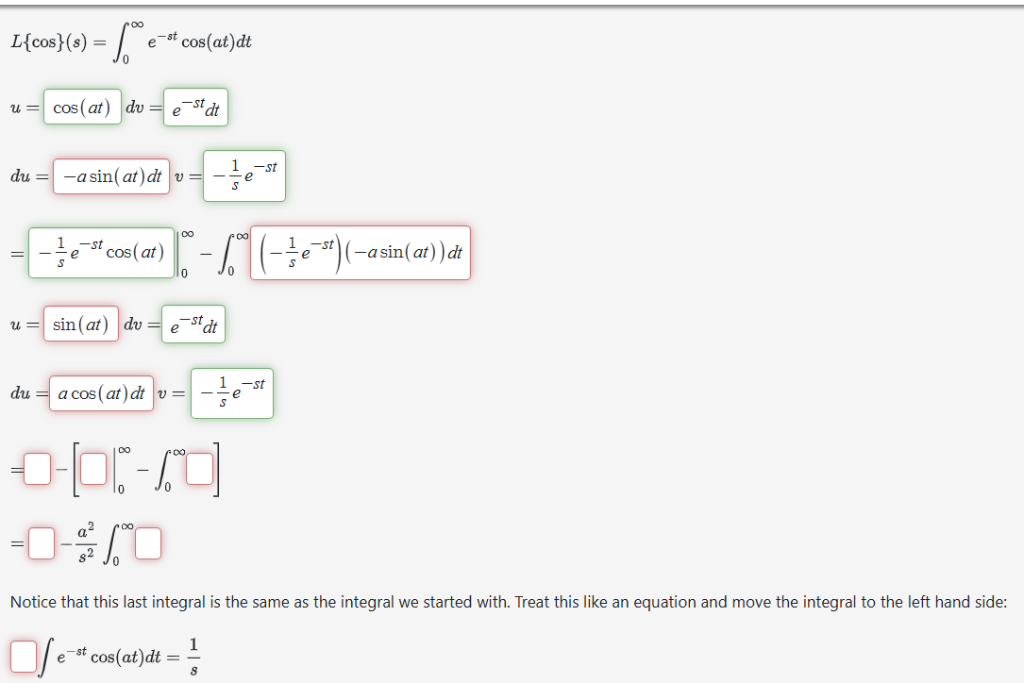 =
FE) = Ji = cos(at) dt
o
. 1 —st
1st a TE .
= —Leteos(an | [7 (
This is AI generated Response.
Asked by: Rahul
Created at: 2025-11-24 02:11:42
Asked by: Rahul
Created at: 2025-11-24 02:11:42
Final Answer:
Rendered
Raw Text
Did you like this answer?
## Step 1: Setup and Integration by Parts
We want to find the Laplace transform of \(\cos(at)\):
\[
\{\cos(at)\}(s) = \int_{}^{\infty} e^{-st} \cos(at)\,dt
\]
Let:
- \( u = \cos(at) \)
- \( dv = e^{-st}dt \)
- Hence, \( du = -a\sin(at)dt \), \( v = -\frac{1}{s} e^{-st} \)
Apply integration by parts:
\[
\int u\,dv = uv - \int v\,du
\]
\[
= \left[ -\frac{1}{s} e^{-st} \cos(at) \right]_^\infty - \int_^\infty \left(-\frac{1}{s} e^{-st}\right)(-a\sin(at))\,dt
\]
\[
= \left[ -\frac{1}{s} e^{-st} \cos(at) \right]_^\infty - \frac{a}{s} \int_^\infty e^{-st} \sin(at)\,dt
\]
**Explanation:**
We use integration by parts to split the original integral into two terms: one evaluated at the limits and another involving the Laplace transform of \(\sin(at)\).
---
## Step 2: Integrate \(\sin(at)\) Term and Solve for the Original Integral
Now, let’s compute \(\int_^\infty e^{-st} \sin(at)\,dt\) using integration by parts again:
Let:
- \( u = \sin(at) \)
- \( dv = e^{-st}dt \)
- Hence, \( du = a\cos(at)dt \), \( v = -\frac{1}{s} e^{-st} \)
\[
\int_^\infty e^{-st} \sin(at)\,dt = \left[ -\frac{1}{s} e^{-st} \sin(at) \right]_^\infty + \frac{a}{s} \int_^\infty e^{-st} \cos(at)\,dt
\]
Notice, the last integral is the same as the one we started with! Let \( I = \int_^\infty e^{-st} \cos(at)\,dt \):
Substitute back and collect like terms:
\[
I = \left[ -\frac{1}{s} e^{-st} \cos(at) \right]_^\infty - \frac{a}{s} \left( \left[ -\frac{1}{s} e^{-st} \sin(at) \right]_^\infty + \frac{a}{s}I \right )
\]
The terms at infinity vanish due to the exponential decay, and at \( t= \), \(\cos()=1\), \(\sin()=\):
\[
I = - \left(-\frac{1}{s}\right) - \frac{a}{s} \left( + \frac{a}{s}I \right )
\]
\[
I = \frac{1}{s} - \frac{a^2}{s^2}I
\]
\[
I \left(1 + \frac{a^2}{s^2}\right) = \frac{1}{s}
\]
\[
I = \frac{1}{s(1 + \frac{a^2}{s^2})} = \frac{1}{s} \cdot \frac{s^2}{s^2 + a^2}
\]
\[
I = \frac{s}{s^2 + a^2}
\]
---
## **Final Answer**
\[
\boxed{
\int_{}^{\infty} e^{-st} \cos(at)\,dt = \frac{s}{s^2 + a^2}
}
\]
**Explanation:**
By applying integration by parts twice and recognizing the recurrence, we solve for the original Laplace transform integral and find the standard result.
📢 Instructions:
- Ask anything relatd to above question only.
- For new Question goto :