 VIPSolutions
give answer in 2 step with explanation at the end of each step and final answer at the end:Stewart's suppliers are fed up and will not continue selling fo Stewart unless Stewart begins making prompt payments (that is, paying in 30 days or less). The firm is going fo have fo reduce its level of accounts payable, either fo an amount that is equal fo 30 days purchases (if it does not take discounts) or fo 10 days purchases (if it decides to take discounts). Management has decided fo obtain the needed funds by borrowing on an additional 1-year note payable (call this a current liability) from its bank ar a rate of 16%, discount interest, with a 15% compensating balance required. The cash currently held by Stewart is needed for transactions, so it cannot be used as part of the compensating balance. So, the issue now facing the company is this: How much trade credit should it use, and how large a loan should if obtain from its bank? Stewart's balance sheet follows: Answer the following questions: How large would the accounts payable balance be if Stewart takes discounts? If if does not take discounts and pays in 30 days? How large must the bank loan be if Stewart takes discounts? If Stewart doesn’ take discounts? What are the nominal and effective costs of nonfree trade credit? What is the effective cost of the bank loan? Based on these costs, what should Stewart do? Assume that Stewart foregoes the discount and borrows the amount needed to become current on its payables. Construct a pro forma balance sheet based on this decision. (Hint: You will need to include an account called “prepaid interest” under current assets.) Using interest rates in the range of 5% to 25% and compensating balances in the range of 0% f0 30%, perform a sensitivity analysis that shows how the size of the bank loan would vary with changes in the interest rate and the compensating balance percentage.
Question:
give answer in 2 step with explanation at the end of each step and final answer at the end: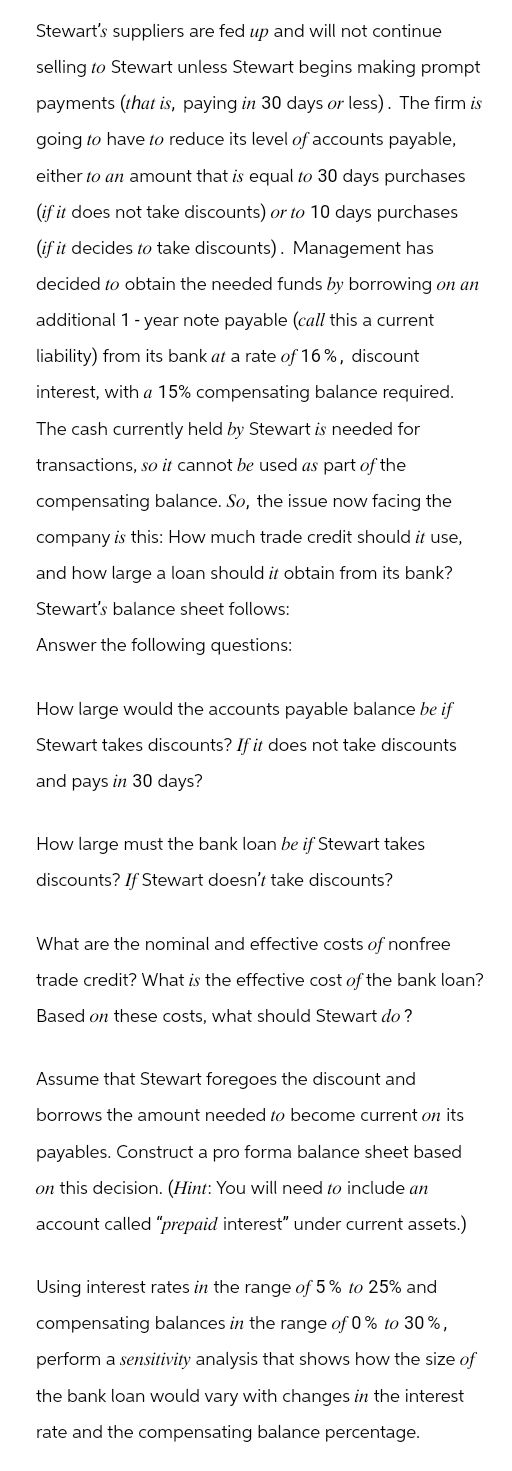 Stewart's suppliers are fed up and will not continue
selling fo Stewart unless Stewart begins making prompt
payments (that is, paying in 30 days or less). The firm is
going fo have fo reduce its level of accounts payable,
either fo an amount that is equal fo 30 days purchases
(if it does not take discounts) or fo 10 days purchases
(if it decides to take discounts). Management has
decided fo obtain the needed funds by borrowing on an
additional 1-year note payable (call this a current
liability) from its bank ar a rate of 16%, discount
interest, with a 15% compensating balance required.
The cash currently held by Stewart is needed for
transactions, so it cannot be used as part of the
compensating balance. So, the issue now facing the
company is this: How much trade credit should it use,
and how large a loan should if obtain from its bank?
Stewart's balance sheet follows:
Answer the following questions:
How large would the accounts payable balance be if
Stewart takes discounts? If if does not take discounts
and pays in 30 days?
How large must the bank loan be if Stewart takes
discounts? If Stewart doesn’ take discounts?
What are the nominal and effective costs of nonfree
trade credit? What is the effective cost of the bank loan?
Based on these costs, what should Stewart do?
Assume that Stewart foregoes the discount and
borrows the amount needed to become current on its
payables. Construct a pro forma balance sheet based
on this decision. (Hint: You will need to include an
account called “prepaid interest” under current assets.)
Using interest rates in the range of 5% to 25% and
compensating balances in the range of 0% f0 30%,
perform a sensitivity analysis that shows how the size of
the bank loan would vary with changes in the interest
rate and the compensating balance percentage.
Asked by: Rahul
Created at: 2025-11-23 07:08:01
Final Answer:
📢 Instructions:
- Ask anything relatd to above question only.
- For new Question goto :