 VIPSolutions
give answer in 2 step with explanation at the end of each step and final answer at the end:Poblenc EEE li ot nd od i A mln ryder bi. ope lye Te Sr ferme al
Question:
give answer in 2 step with explanation at the end of each step and final answer at the end: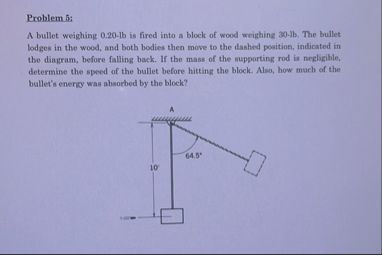 Poblenc
EEE li ot nd od i A
mln ryder bi.
ope lye
Te Sr
ferme al
This is AI generated Response.
Asked by: Rahul
Created at: 2025-11-23 05:36:05
Asked by: Rahul
Created at: 2025-11-23 05:36:05
Final Answer:
Rendered
Raw Text
Did you like this answer?
## Step 1: Conservation of Momentum During Collision
When the bullet lodges in the block, the system (bullet + block) moves together. This is a perfectly inelastic collision, so we use conservation of linear momentum:
Let:
- \( m_b \) = mass of bullet = .20 lb = \( \frac{.20}{32.2} \) slugs ≈ .0062 slugs
- \( m_w \) = mass of wood = 30 lb = \( \frac{30}{32.2} \) slugs ≈ .932 slugs
- \( v_b \) = speed of bullet before impact (unknown)
- \( v' \) = common speed of block+bullet immediately after collision (unknown)
**Equation:**
\[
m_b v_b = (m_b + m_w) v'
\]
**Explanation:**
Linear momentum is conserved because the external forces (gravity and tension) act perpendicular to the direction of the bullet's motion at the instant of collision.
---
## Step 2: Energy Conservation for Swing
After the collision, the block and bullet swing upward to the dashed position, reaching a maximum angle of 64.8°. At the highest point, all kinetic energy is converted to gravitational potential energy.
**Let \( L \) = 10 ft (length of string):**
- Height gained (\( h \)) by the center of mass is:
\[
h = L (1 - \cos \theta) = 10 (1 - \cos 64.8^\circ) \approx 10(1 - .425) \approx 5.75 \text{ ft}
\]
**Potential energy gained:**
\[
PE = (m_b + m_w) g h
\]
where \( g = 32.2 \) ft/s²
**Set \( KE = PE \):**
\[
\frac{1}{2} (m_b + m_w) v'^2 = (m_b + m_w) g h
\Rightarrow v' = \sqrt{2gh}
\]
\[
v' = \sqrt{2 \cdot 32.2 \cdot 5.75} \approx \sqrt{370.3} \approx 19.24 \text{ ft/s}
\]
Now, plug \( v' \) into the first equation to solve for \( v_b \):
\[
.0062\,v_b = (.0062 + .932) \cdot 19.24
\]
\[
.0062\,v_b = .9382 \cdot 19.24 \approx 18.06
\]
\[
v_b = \frac{18.06}{.0062} \approx 2,913 \text{ ft/s}
\]
**Explanation:**
We used conservation of energy to relate the after-collision speed to the swing height, and then conservation of momentum to find the bullet's original speed.
---
## Final Answers
**1. Speed of the bullet before hitting the block:**
\[
\boxed{2,913 \text{ ft/s}}
\]
**2. How much of the bullet's energy was absorbed by the block?**
Initial kinetic energy of the bullet:
\[
KE_{bullet,\,initial} = \frac{1}{2} m_b v_b^2 = \frac{1}{2} \cdot .0062 \cdot (2913)^2 \approx 26,281 \text{ ft-lb}
\]
Kinetic energy right after collision (all goes to PE at max height):
\[
KE_{after} = \frac{1}{2} (.9382) \cdot (19.24)^2 \approx 173.68 \text{ ft-lb}
\]
**Energy absorbed by the block:**
\[
\Delta KE = KE_{bullet,\,initial} - KE_{after} \approx 26,281 - 173.68 \approx 26,107 \text{ ft-lb}
\]
---
### **Summary Table**
| Quantity | Value |
|--------------------------------------------------|--------------------|
| Speed of bullet before hitting block | 2,913 ft/s |
| Energy absorbed by the block | 26,107 ft-lb |
📢 Instructions:
- Ask anything relatd to above question only.
- For new Question goto :