 VIPSolutions
give answer in 2 step with explanation at the end of each step and final answer at the end:Express the integral as a limit of Riemann sums. Do not evaluate the limit. (Use the right endpoints 8 I -Aim)de 4-00 fim =1" {11 ’ Find the general indefinite integral. (Use C for the constant of integration.) Seoses Loja
Question:
give answer in 2 step with explanation at the end of each step and final answer at the end: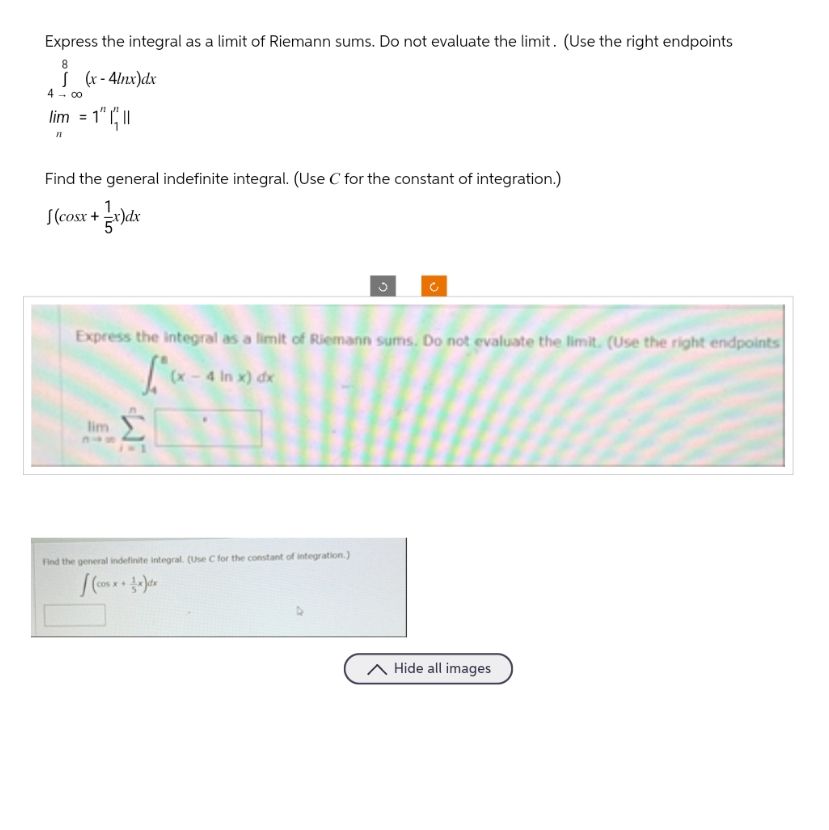 Express the integral as a limit of Riemann sums. Do not evaluate the limit. (Use the right endpoints
8
I -Aim)de
4-00
fim =1" {11
’
Find the general indefinite integral. (Use C for the constant of integration.)
Seoses Loja
This is AI generated Response.
Asked by: Rahul
Created at: 2025-11-22 06:18:56
Asked by: Rahul
Created at: 2025-11-22 06:18:56
Final Answer:
Rendered
Raw Text
Did you like this answer?
## Step 1: Express the Definite Integral as a Limit of Riemann Sums
Given:
\[
\int_{4}^{8} (x - 4\ln x)dx
\]
Divide \([4, 8]\) into \(n\) subintervals, each of width \(\Delta x = \frac{8-4}{n} = \frac{4}{n}\).
The right endpoint for the \(i\)th subinterval:
\(x_i = 4 + i\Delta x = 4 + \frac{4i}{n}\)
So, the Riemann sum is:
\[
\sum_{i=1}^{n} \left[ x_i - 4\ln(x_i) \right] \Delta x
\]
### Explanation:
- We split the interval into \(n\) equal parts.
- The right endpoint formula is used because the question specifies right endpoints.
---
## Step 2: Write the Limit Representation
So, the limit is:
\[
\lim_{n \to \infty} \sum_{i=1}^{n} \left[ \left(4 + \frac{4i}{n}\right) - 4\ln\left(4 + \frac{4i}{n}\right)\right] \cdot \frac{4}{n}
\]
### Explanation:
- Substitute the expressions for \(x_i\) and \(\Delta x\) into the Riemann sum.
- Take the limit as \(n \to \infty\) for the exact value.
---
## Final Answer (Riemann Sum Representation):
\[
\boxed{
\lim_{n \to \infty} \sum_{i=1}^{n} \left[ \left(4 + \frac{4i}{n}\right) - 4\ln\left(4 + \frac{4i}{n}\right)\right] \cdot \frac{4}{n}
}
\]
---
## Step 1 (Indefinite Integral): Integrate Each Term
Given:
\[
\int \left( \cos x + \frac{1}{5}x \right) dx
\]
- \(\int \cos x \, dx = \sin x\)
- \(\int \frac{1}{5}x \, dx = \frac{1}{5} \cdot \frac{x^2}{2} = \frac{1}{10}x^2\)
### Explanation:
- Integrate term by term using basic integration rules.
---
## Step 2 (Include the Constant):
Combine the results and add the constant \(C\):
\[
\sin x + \frac{1}{10}x^2 + C
\]
### Explanation:
- All indefinite integrals should include the arbitrary constant \(C\).
---
## Final Answer (Indefinite Integral):
\[
\boxed{\sin x + \frac{1}{10}x^2 + C}
\]
📢 Instructions:
- Ask anything relatd to above question only.
- For new Question goto :