 VIPSolutions
give answer in 2 step with explanation at the end of each step and final answer at the end:@ Safari File Edit View History Bookmarks Window Help. m) FT Q 8 & FriNov21 6:25PM oe om ~ @ drive.google.com J [© + © [1 £1 = © Home - Googe. c “ . Waves on a String ou make an afsman Once you hav the Highest amu cd he een inh evr ide ett rth sin er ret fre. 12. Ash een tat tw harmonics an laren) Ag make srl changes f D a IE0=E"eR0PaBEN® B20 ¢E2 RY 3 > >
Question:
give answer in 2 step with explanation at the end of each step and final answer at the end: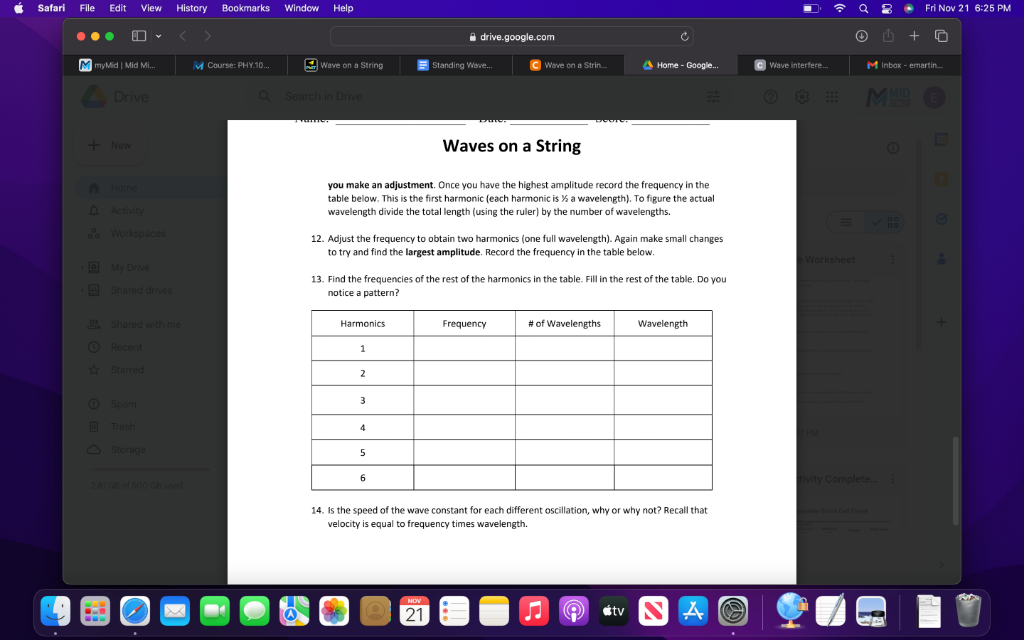 @ Safari File Edit View History Bookmarks Window Help. m) FT Q 8 & FriNov21 6:25PM
oe om ~ @ drive.google.com J [© + ©
[1 £1 = © Home - Googe. c “ .
Waves on a String
ou make an afsman Once you hav the Highest amu cd he een inh
evr ide ett rth sin er ret fre.
12. Ash een tat tw harmonics an laren) Ag make srl changes
f
D a
IE0=E"eR0PaBEN® B20 ¢E2 RY
3 > >
This is AI generated Response.
Asked by: Rahul
Created at: 2025-11-22 05:07:53
Asked by: Rahul
Created at: 2025-11-22 05:07:53
Final Answer:
Rendered
Raw Text
Did you like this answer?
# Step-by-Step Solution
break down the and questions on "W on a String into two main, with explanations at each step.
---
## Step1: Understand the Table and Harmonics
**Explanation
The table asks for information aboutics, frequency, number of wavelengths and wavelength. For a string fixed at both ends:
- **n-th harmonic:** The string forms `n` half-wavelengths.
- **Number of wavelengths:** For the n-th harmonic, the length of the string \( L \) contains \( n/2 \) wavelengths, so:
\[
\text{Number of wavelengths} = \frac{n}{2}
\]
\[
\text{Wavelength} (\lambda) = \frac{2L}{n}
\]
- **Frequency:** The frequency of the n-th harmonic is:
\[
f_n = n f_1
\]
where \( f_1 \) is the fundamental frequency.
---
## Step 2: Fill in the Table (General Form)
**Explanation:**
Let’s fill the table with formulas and an example, assuming the string length \( L \) and fundamental frequency \( f_1 \) are known.
| Harmonics | Frequency (\(f_n\)) | # of Wavelengths (\(n/2\)) | Wavelength (\(2L/n\)) |
|-----------|---------------------|----------------------------|-----------------------|
| 1 | \(f_1\) | 1/2 | \(2L/1\) |
| 2 | \(2f_1\) | 2/2 = 1 | \(2L/2 = L\) |
| 3 | \(3f_1\) | 3/2 | \(2L/3\) |
| 4 | \(4f_1\) | 2 | \(2L/4 = L/2\) |
| 5 | \(5f_1\) | 5/2 | \(2L/5\) |
| 6 | \(6f_1\) | 3 | \(2L/6 = L/3\) |
**Pattern noticed:**
- The frequency increases linearly with the harmonic number.
- The wavelength decreases as the harmonic number increases.
---
## Final Answer
- **Step 1:** The n-th harmonic on a string fixed at both ends contains \( n/2 \) wavelengths, with wavelength \( \lambda = 2L/n \).
- **Step 2:** The frequencies are integer multiples of the fundamental (\( f_n = n f_1 \)), and the pattern shows frequency increases with harmonic number while wavelength decreases.
**To fully complete the table, you’ll need the actual measured values for frequency and string length \( L \). Use the above formulas to fill in your data.**
📢 Instructions:
- Ask anything relatd to above question only.
- For new Question goto :