 VIPSolutions
give answer in 2 step with explanation at the end of each step and final answer at the end:A pulse is moving toward the end of a spring with a speed of 80 cm/s. It is not known whether the end is a fixed end or a free end. The diagrams below show the shape of the pulseatt = Osand att = 1s. Is the end of the spring a free end or a fixed end? Explain. If there is not enough information, state so explicitly. Write your explanation on paper and support your explanation with a clear diagram. | want to have handwriting answer and clear diagram like request from question a Cod 4 3 | [0X3 2 4 IG 2 4 6 8 10 12 14 El 4 q free . 2 JP HB EY | square = Idem 4 4 L Gels >] 1 2 4 6 8 10 12 14 -1 -2 -3 4
Question:
give answer in 2 step with explanation at the end of each step and final answer at the end: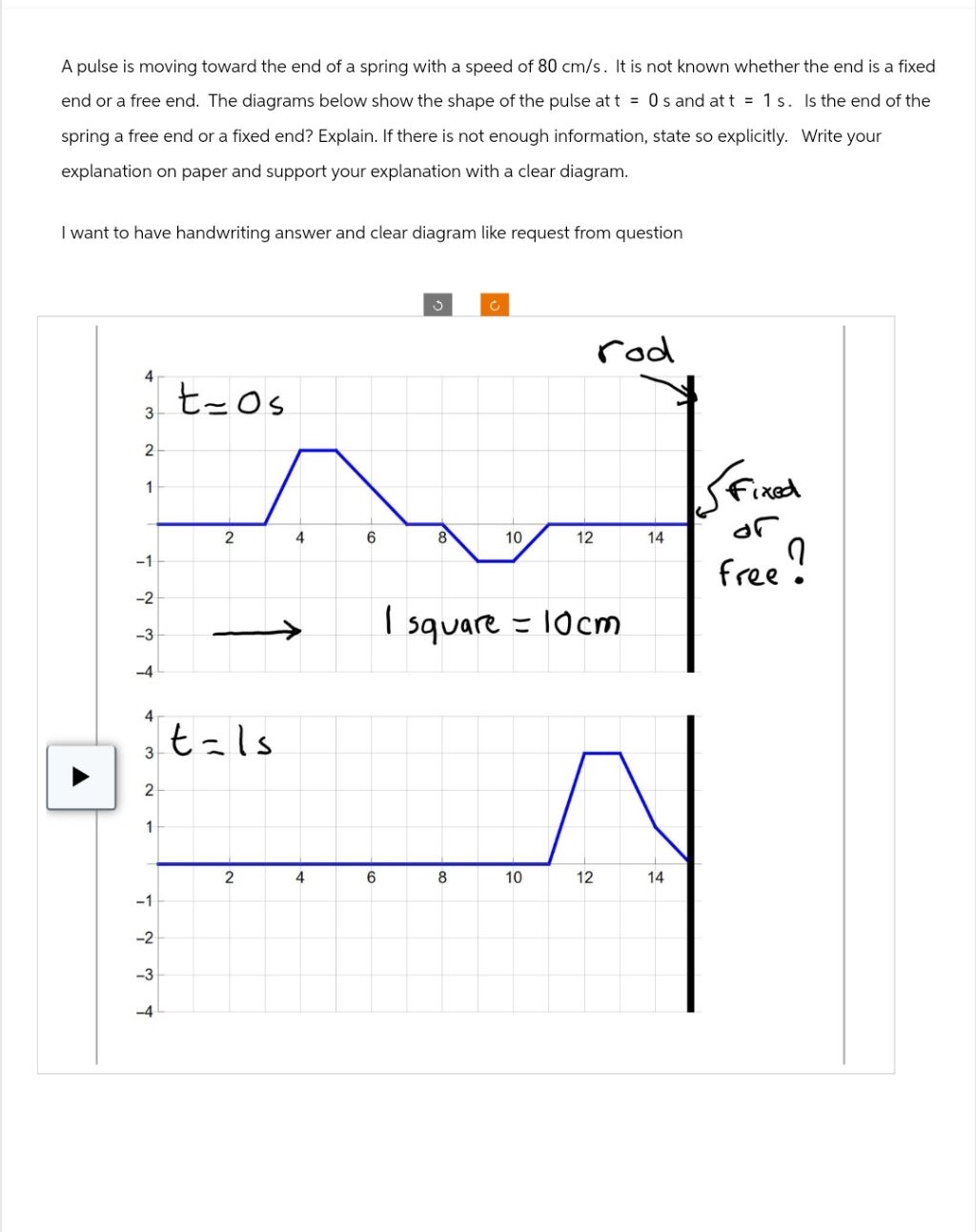 A pulse is moving toward the end of a spring with a speed of 80 cm/s. It is not known whether the end is a fixed
end or a free end. The diagrams below show the shape of the pulseatt = Osand att = 1s. Is the end of the
spring a free end or a fixed end? Explain. If there is not enough information, state so explicitly. Write your
explanation on paper and support your explanation with a clear diagram.
| want to have handwriting answer and clear diagram like request from question
a
Cod
4
3 | [0X3
2
4 IG
2 4 6 8 10 12 14 El
4 q
free .
2
JP HB EY | square = Idem
4
4
L Gels
>]
1
2 4 6 8 10 12 14
-1
-2
-3
4
This is AI generated Response.
Asked by: Rahul
Created at: 2025-11-21 09:09:42
Asked by: Rahul
Created at: 2025-11-21 09:09:42
Final Answer:
Rendered
Raw Text
Did you like this answer?
## Step 1: Analyze the Pulse Movement
At **t = s**, the pulse is moving toward the end (right side of the, where the rod is shown).
At **t = 1 s**, the pulse has moved 80 cm to the right (since speed = 80 cm/s × 1 s). Each square is 10 cm, so the pulse moves 8 squares to the right.
**Observation:**
The pulse shape at t = 1 s is not inverted; it retains its original orientation after reaching the end. The entire pulse shifts right, and its peak remains upwards.
**Explanation:**
- If the end was **fixed**, the pulse would invert (flip upside down) after reflection.
- If the end was **free**, the pulse would reflect without inversion.
---
## Step 2: Identify the Nature of the End
Since the pulse at t = 1 s is not inverted (it looks the same as at t = s but shifted to the right), this means the pulse reflected without inversion.
**Explanation:**
**No inversion of the pulse** indicates a **free end**. If it were a fixed end, the pulse would be inverted after reflection.
---
## **Final Answer**
**The end of the spring is a free end.**
The pulse reflected without inversion, which only happens at a free end.
---
### Handwritten Explanation and Diagram Guide
To provide a handwritten answer, draw:
- The initial pulse at t = s approaching the end.
- The pulse at t = 1 s, reflected but not inverted, matching the diagram.
- Annotate: “No inversion ⇒ Free end”
---
If you want a sample handwriting, let me know!
📢 Instructions:
- Ask anything relatd to above question only.
- For new Question goto :