 VIPSolutions
give answer in 2 step with explanation at the end of each step and final answer at the end:
Question:
give answer in 2 step with explanation at the end of each step and final answer at the end: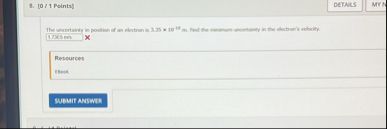
This is AI generated Response.
Asked by: Rahul
Created at: 2025-11-21 08:17:36
Asked by: Rahul
Created at: 2025-11-21 08:17:36
Final Answer:
Rendered
Raw Text
Did you like this answer?
## Problem Restatement
**Question:**
The uncertainty in position of an electron is \( 3.25 \times 10^{-11} \) m. Find the minimum uncertainty in the electron's velocity.
---
## Step 1: Apply Heisenberg's Uncertainty Principle
The Heisenberg Uncertainty Principle states:
\[
\Delta x \cdot \Delta p \geq \frac{h}{4\pi}
\]
where:
- \( \Delta x \) = uncertainty in position
- \( \Delta p \) = uncertainty in momentum
- \( h \) = Planck’s constant (\(6.626 \times 10^{-34}\) Js)
Since momentum \( p = m v \), we have \( \Delta p = m \cdot \Delta v \). The equation becomes:
\[
\Delta x \cdot m \cdot \Delta v \geq \frac{h}{4\pi}
\]
**Explanation:**
We start by setting up the relationship between the uncertainties in position and velocity using Heisenberg’s principle.
---
## Step 2: Solve for Uncertainty in Velocity
Rearrange for \( \Delta v \):
\[
\Delta v \geq \frac{h}{4\pi m \Delta x}
\]
Plug in the values:
- \( h = 6.626 \times 10^{-34} \) Js
- \( m \) (electron mass) = \( 9.11 \times 10^{-31} \) kg
- \( \Delta x = 3.25 \times 10^{-11} \) m
\[
\Delta v \geq \frac{6.626 \times 10^{-34}}{4\pi \cdot 9.11 \times 10^{-31} \cdot 3.25 \times 10^{-11}}
\]
Calculate the denominator:
- \( 4\pi \approx 12.566 \)
- \( 12.566 \times 9.11 \times 10^{-31} \times 3.25 \times 10^{-11} \approx 3.722 \times 10^{-40} \)
Calculate \( \Delta v \):
\[
\Delta v \geq \frac{6.626 \times 10^{-34}}{3.722 \times 10^{-40}} \approx 1.78 \times 10^{6} \text{ m/s}
\]
**Explanation:**
After substituting all values and calculating, we find the minimum uncertainty in velocity.
---
## **Final Answer**
\[
\boxed{1.78 \times 10^{6} \text{ m/s}}
\]
This is the minimum uncertainty in the electron's velocity.
📢 Instructions:
- Ask anything relatd to above question only.
- For new Question goto :