 VIPSolutions
give answer in 2 step with explanation at the end of each step and final answer at the end:2) Which of the following is/are true? @ 2) The operators corresponding othe components of the angular momenta Ly Ly, 4) donot commute xcept th cpertor re the same 5) The operators comesponding to the components of he angular momentum do not commute with the operator corespondng to ©) The operators corresponding othe components of the angular momentum commute with the operator corresponding to
Question:
give answer in 2 step with explanation at the end of each step and final answer at the end: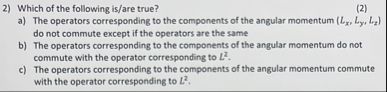 2) Which of the following is/are true? @
2) The operators corresponding othe components of the angular momenta Ly Ly, 4)
donot commute xcept th cpertor re the same
5) The operators comesponding to the components of he angular momentum do not
commute with the operator corespondng to
©) The operators corresponding othe components of the angular momentum commute
with the operator corresponding to
This is AI generated Response.
Asked by: Rahul
Created at: 2025-11-21 04:04:09
Asked by: Rahul
Created at: 2025-11-21 04:04:09
Final Answer:
Rendered
Raw Text
Did you like this answer?
## Step 1: Analyze Each Statement
### a) "The operators corresponding to the components of the angular momentum (\(L_x, L_y, L_z\)) do not commute except if the operators are the same"
- **Explanation:**
The commutation relations for angular momentum operators:
\[[L_x L_y] i\h L_z\]
and cyclic permutations.
This means they do **not commute** unless they are the same operator (e.g., \([L_x, L_x]=\)).
**So, statement (a) is true.**
### b) "The operators corresponding to the components of the angular momentum do not commute with the operator corresponding to \(L^2\)"
- **Explanation:**
For \(L^2 = L_x^2 + L_y^2 + L_z^2\), the commutators are:
\([L^2, L_x] = \), \([L^2, L_y] = \), \([L^2, L_z] = \)
So, they **do commute**.
**So, statement (b) is false.**
### c) "The operators corresponding to the components of the angular momentum commute with the operator corresponding to \(L^2\)"
- **Explanation:**
As shown above, all components **do commute** with \(L^2\).
**So, statement (c) is true.**
---
## Step 2: Final Answer
### **Final Answer:**
- The true statements are:
**(a) and (c) are correct.**
📢 Instructions:
- Ask anything relatd to above question only.
- For new Question goto :