 VIPSolutions
give answer in 2 step with explanation at the end of each step and final answer at the end:42. lll The two insulated wires in FIGURE P29.42 cross at a 30° angle but do not make electrical contact. Each wire carries a 5.0 A current. Points 1 and 2 are each 4.0 cm from the intersection and equally distant from both wires. What are the magnitude and direction of the magnetic fields at points 1 and 2? 50A 50A 50A | 2 1e 20cm FIGURE P29.42 FIGURE P29.43 43. II What are the strength and direction of the magnetic field at the center of the loop in FIGURE P29.43?
Question:
give answer in 2 step with explanation at the end of each step and final answer at the end: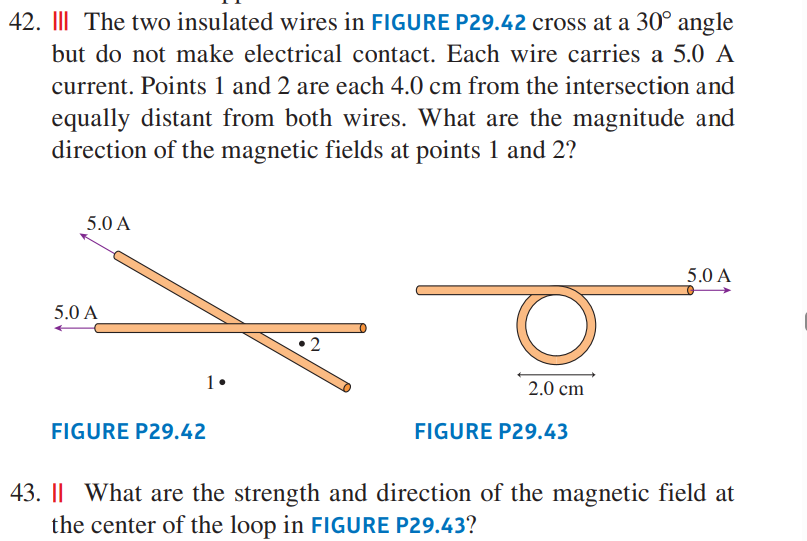 42. lll The two insulated wires in FIGURE P29.42 cross at a 30° angle
but do not make electrical contact. Each wire carries a 5.0 A
current. Points 1 and 2 are each 4.0 cm from the intersection and
equally distant from both wires. What are the magnitude and
direction of the magnetic fields at points 1 and 2?
50A
50A
50A |
2
1e 20cm
FIGURE P29.42 FIGURE P29.43
43. II What are the strength and direction of the magnetic field at
the center of the loop in FIGURE P29.43?
This is AI generated Response.
Asked by: Rahul
Created at: 2025-11-21 03:56:11
Asked by: Rahul
Created at: 2025-11-21 03:56:11
Final Answer:
Rendered
Raw Text
Did you like this answer?
## Problem Restatement
**Given:**
- Two wires cross at a 30° angle, but do not touch.
- Each wire carries a 5. A current (directions as shown in the figure).
- Points 1 and 2 are each 4. cm from the intersection, equally distant from both wires.
**Asked:**
What are the **magnitude and direction** of the magnetic fields at points 1 and 2?
---
## Step 1: Magnetic Field from a Long Straight Wire
The **magnetic field** at distance \( r \) from a long, straight wire carrying current \( I \) is:
\[
B = \frac{\mu_ I}{2\pi r}
\]
where \( \mu_ = 4\pi \times 10^{-7}~\text{T}\cdot\text{m/A} \), \( I = 5.~\text{A} \), \( r = 4.~\text{cm} = .040~\text{m} \).
\[
B_{\text{each wire}} = \frac{4\pi \times 10^{-7} \times 5.}{2\pi \times .040} = \frac{2 \times 10^{-6}}{.040} = 5. \times 10^{-5}~\text{T}
\]
**Explanation:**
We calculate the magnetic field produced at a perpendicular distance of 4. cm from each wire, using the Biot–Savart law for an infinite straight wire.
---
## Step 2: Vector Addition of Fields and Direction
**Since the two wires cross at a 30° angle:**
- At each point, the magnetic field due to each wire is perpendicular to the wire and follows the right-hand rule.
- At points 1 and 2, the distance to both wires is the same, so the magnetic field magnitude from each wire is the same: \( 5. \times 10^{-5}~\text{T} \).
- The angle between the two wires (and thus between the two magnetic field vectors at the points) is 30°.
The **resultant magnetic field** magnitude is:
\[
B_{\text{total}} = \sqrt{B_1^2 + B_2^2 + 2B_1B_2\cos\theta}
\]
where \( \theta = 30^\circ \):
\[
B_{\text{total}} = \sqrt{(5. \times 10^{-5})^2 + (5. \times 10^{-5})^2 + 2 (5. \times 10^{-5}) (5. \times 10^{-5}) \cos 30^\circ}
\]
\[
= 5. \times 10^{-5} \sqrt{2 + 2\cos 30^\circ}
\]
\[
\cos 30^\circ = \frac{\sqrt{3}}{2}
\]
\[
2 + 2\cos 30^\circ = 2 + 2 \times \frac{\sqrt{3}}{2} = 2 + \sqrt{3}
\]
\[
B_{\text{total}} = 5. \times 10^{-5} \sqrt{2 + \sqrt{3}}
\]
\[
2 + \sqrt{3} \approx 2 + 1.732 = 3.732
\]
\[
\sqrt{3.732} \approx 1.931
\]
\[
B_{\text{total}} \approx 5. \times 10^{-5} \times 1.931 = 9.66 \times 10^{-5}~\text{T}
\]
**Explanation:**
We added the two magnetic field vectors, separated by 30°, using vector addition. The direction can be determined using the right-hand rule and will be at an angle bisecting the 30° between the two field vectors.
---
## **Final Answer**
**Magnitude:**
\[
\boxed{9.7 \times 10^{-5}~\text{T}}
\]
**Direction:**
Perpendicular to the plane formed by the two wires, at an angle bisecting the 30° between the two magnetic field vectors at points 1 and 2. The precise direction (into or out of the page) depends on the application of the right-hand rule for each current direction as shown in the figure.
📢 Instructions:
- Ask anything relatd to above question only.
- For new Question goto :