 VIPSolutions
give answer in 2 step with explanation at the end of each step and final answer at the end:a vertical constrained force is applied to a wedge exactly vertical, perpendicolar to the floor (the vector is vertical ) . The force application point does not move relative to the floor so the wedge is pushed to the left. Assuming no friction everywhere i need to draw the free body diagram that shows tue relation between the lefward force on the wedge to the left as a function of the initial force F. a
Question:
give answer in 2 step with explanation at the end of each step and final answer at the end: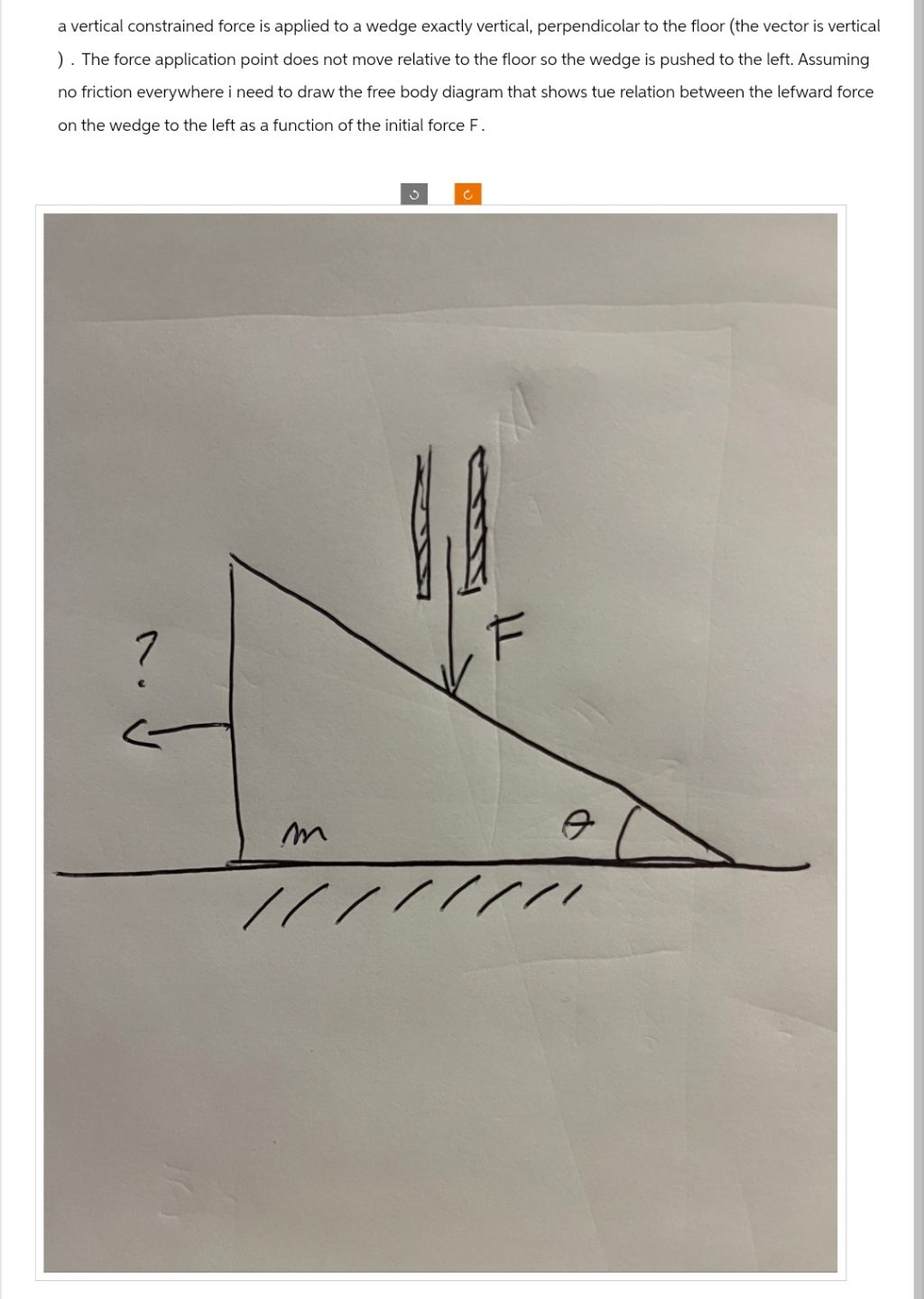 a vertical constrained force is applied to a wedge exactly vertical, perpendicolar to the floor (the vector is vertical
) . The force application point does not move relative to the floor so the wedge is pushed to the left. Assuming
no friction everywhere i need to draw the free body diagram that shows tue relation between the lefward force
on the wedge to the left as a function of the initial force F.
a
This is AI generated Response.
Asked by: Rahul
Created at: 2025-11-21 03:52:36
Asked by: Rahul
Created at: 2025-11-21 03:52:36
Final Answer:
Rendered
Raw Text
Did you like this answer?
## Step 1: Draw the Free Body Diagram
Let’s focus on the **forces acting on the wedge**:
- **F**: The vertical force applied downward.
- **Normal force from the ground**: Acts vertically upward (let’s call it \( N \)).
- **Reaction force from the applied load**: The wedge, due to the force F applied vertically, will experience a reaction force at the contact point that must be balanced by the ground and any constraint.
Since there is **no friction** and the force application point does not move relative to the floor, the force F is transmitted directly downward at the point of contact. However, due to the wedge’s geometry, the reaction at the sloped surface (invisible in the diagram but implied by the force application) will have both vertical and horizontal components.
**Key Point**:
The **horizontal component** of the reaction force at the ground is what pushes the wedge to the left. This is the force we need to find as a function of \( F \).
---
## Step 2: Resolve Forces Using Geometry
The force \( F \) applied vertically acts through the inclined plane at an angle \( \theta \). The **reaction force** at the interface can be broken into two components:
- **Parallel to the base** (horizontal, leftward): \( F_{\text{left}} \)
- **Perpendicular to the base** (vertical, upward): \( F_{\text{up}} \)
Since the force is transmitted through the inclined plane, the **horizontal component** (pushing the wedge to the left) is:
\[
F_{\text{left}} = F \cdot \cot(\theta)
\]
- **Explanation**: The vertical force F can be resolved into components parallel and perpendicular to the incline. The horizontal (leftward) component is found using trigonometry:
- The force parallel to the base is \( F \cdot \cot(\theta) \) (since \( \cot(\theta) = \frac{\text{adjacent}}{\text{opposite}} = \frac{\text{horizontal}}{\text{vertical}} \)).
---
## **Final Answer**
\[
\boxed{F_{\text{left}} = F \cot(\theta)}
\]
- This is the horizontal force to the left on the wedge as a function of the initial vertical force \( F \) and the angle \( \theta \) of the wedge.
📢 Instructions:
- Ask anything relatd to above question only.
- For new Question goto :